Vortices and Quantized Circulation
A smooth superfluid phase gives an irrotational velocity field. How, then, can a superfluid rotate? The phase can wind around a line where the condensate amplitude vanishes. Far from that line, circulation is quantized; near it, density gradients determine a resolved core. Computing both regions connects topology to a measurable energy cost.
Consider a straight, singly quantized vortex in a homogeneous three-dimensional dilute Bose gas at zero temperature. Set , take and , and use the leading Gross–Pitaevskii description. The bulk total density is ; replacing it by the condensate density makes a relative error beyond this leading approximation. Throughout,
The vortex is neutral: there is no electromagnetic field or magnetic screening length. A charged condensate requires a different far-field calculation.
Preparation. Superfluid stiffness develops the phase energy and current. Bogoliubov theory explains the healing length. Thermal unbinding in two dimensions is treated in two-dimensional Bose gases.
Winding, circulation and the core
Write the laboratory-time field in cylindrical coordinates as
Single-valuedness fixes the integer . On a closed contour outside the core,
Locally the flow is curl-free. Its distributional vorticity is concentrated on the line:
The circulation depends on winding, not on the detailed density profile.
A nonzero constant amplitude at the origin would make the angular gradient energy divergent. The field resolves that problem by suppressing its amplitude. Substitution into the stationary GP equation gives, with ,
Primes denote derivatives with respect to . We now set and choose the positive, monotone solution. A local series near the origin is
The outer boundary condition determines the slope ; regularity at the origin alone does not. At large distance the same equation gives
The density therefore approaches its bulk value algebraically. The vortex is not a circular hole with an exactly sharp radius.
Solving the profile
The companion solves the nonlinear boundary-value problem with the inner series and the displayed outer expansion. It varies the outer radius, the solver tolerance and the inner boundary. A separate finite-difference Newton solve starts from a simple trial profile and converges to the same solution. The resulting dimensionless values are
The scale is defined by the GP equation; it is not the half-density radius. The number current is
Although the formal velocity diverges at the origin, the current tends to zero linearly there because . It also vanishes as far away.
The maximum is at , with . A singular phase velocity does not imply a singular mass flux.
The figure compares the computed density with a simple variational profile and shows how the energy approaches its logarithmic form.
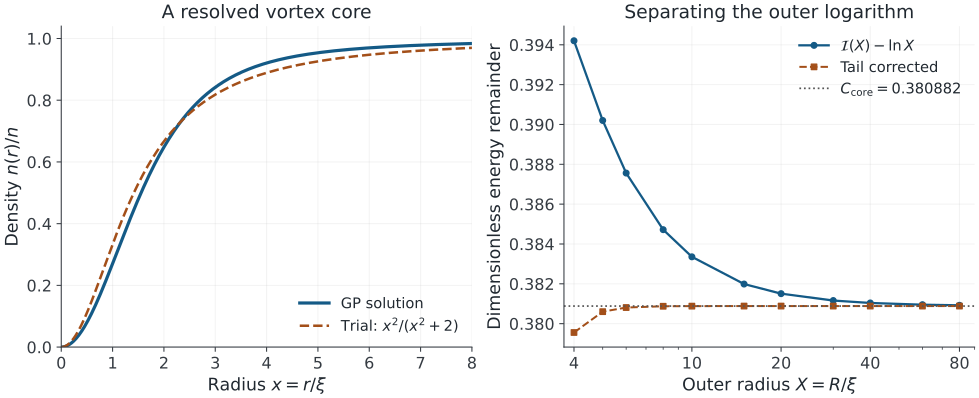
Left: GP vortex density and trial density , with .
Right: the finite-radius energy remainder approaches ; subtracting its leading inverse-radius correction accelerates convergence. These are stationary mean-field calculations, not a vortex-nucleation simulation.
Logarithmic energy and a specified core constant
Fix the bulk chemical potential and compare the vortex with the uniform solution at that same chemical potential. The relevant excess is the grand potential, . Per unit vortex length ,
This expression has only nonnegative terms. The subtraction of is what converts the interaction contribution into the square . With , define
For the integrand starts as . This is the kinetic energy of circulation spread over many radii, and it produces the logarithm. Retaining further terms gives
Thus a finite-radius calculation must separate the core constant from its outer-tail correction. The numerical results are:
| After subtracting | ||
|---|---|---|
At , tightening the boundary-value tolerance from to changes the corrected constant by less than . Independently, halving the finite-difference mesh spacing reduces its profile and energy errors by about four. These tests support
Equivalently, the leading bracket is . Fetter's review of GP vortices (PDF), §III.A, quotes the corresponding factor approximately as .
The constant has a precise meaning only after fixing the definition of , the energy subtraction and the core model.
With , the constant is . The logarithmic far-field coefficient is fixed by stiffness; the constant requires the core calculation.
A virial check independent of the logarithmic tail
Multiply the radial equation by and rearrange it into a total derivative:
The inner endpoint vanishes. Hence
In the infinite-radius limit, the potential-energy integral is exactly . Unlike the total energy, it converges without subtracting a logarithm. The companion evaluates its two sides separately; at the absolute residual is below . This checks the gradient, interaction and boundary normalizations together.
Comparing states at fixed particle number
Why specify the grand potential so carefully? At a fixed bulk density imposed through , the vortex removes particles:
The deficit is logarithmic, although its fraction of the particles in a large cylinder tends to zero. Comparing the bare energies at the same would give ; it compares states with different particle numbers. In fact the two leading logarithms in that comparison cancel. It is not the energy needed to insert a vortex into a fixed- gas.
For the canonical comparison, slightly increase the vortex state's bulk density so that both states have the same . The required relative adjustment is of order . A Legendre transform then gives the same logarithm and core constant as , with corrections to the dimensionless energy of order . Thus the quoted logarithmic vortex energy is also the large-cylinder fixed- result, but obtaining it requires matching particle number rather than silently holding both and fixed in different profiles.
This distinction does not alter circulation. It fixes which thermodynamic comparison the energy represents.
Vortex interactions and the scale of rotation
Outside well-separated cores, the energy per unit length is the phase functional
At zero temperature in this continuum gas . For two vortices, add their phase gradients before squaring. The cross term can be evaluated using and . For separation well inside a large outer cutoff ,
Boundary images and core-overlap corrections are excluded here. Like windings lower their interaction energy by moving farther apart; opposite windings lower it by approaching. The force is an energy gradient, but vortex motion also has a transverse Magnus response, so this statement alone is not a radial equation of motion.
For a vortex–antivortex pair the outer logarithms cancel, giving, at leading GP order,
A centered singly quantized vortex in a large, approximately uniform cylinder carries angular momentum in our units. Comparing in a frame rotating at angular speed then gives the energetic crossing
This estimates when the one-vortex state becomes favorable for that geometry. A surface barrier can delay entry, and a nucleation experiment need not switch at this value. Neither this stationary calculation nor the isolated-core solution supplies a vortex-production rate.
Summary
Quantized circulation fixes the far-field velocity. The GP equation supplies the density depletion that makes the current regular at the center and fixes the core contribution to the energy. For the stated healing length and subtraction, the singly quantized vortex has . Its long-range logarithm controls interactions and rotational energetics, while core physics and boundaries govern how a vortex is created or destroyed.
The profile, convergence tables, virial test and figure generator are reproducible from examples/condensed-matter/bose-fluids/flow-vortices/. Finite-temperature two-dimensional vortex proliferation requires the additional entropy and stiffness renormalization developed in two-dimensional Bose gases.
Exercises
1. A variational core
Use the family , with . Find its large-radius energy constant, minimize it over , and compare it with the numerical constant. Does the optimizing make the trial function the exact GP solution?
Solution
The three energy integrals separate. In the large-radius limit they give
Therefore
The minimum occurs at , with
It provides a useful upper variational estimate in the singly wound sector, but not the exact solution. Its slope is , rather than , and its far-field correction is , rather than . Nevertheless its potential-energy integral is at the optimum. Satisfying this one scaling identity is necessary for a stationary minimum, not sufficient to solve the full differential equation.
2. Rotation versus local sound
For a large cylinder, compare the wall speed at the energetic vortex crossing with the sound speed . Evaluate their ratio at and explain why a value below unity does not contradict the uniform Landau criterion.
Solution
Since , the ratio is
At this gives approximately . A vortex is an extended state with quantized circulation and angular momentum, whereas the homogeneous Landau calculation compares weak quasiparticle excitations in a uniform flow. A rotating boundary can exchange angular momentum and enable a different energy comparison. The energetic crossing says nothing about the barrier separating the vortex-free and vortex states; it does not predict spontaneous entry at that angular speed.
References
- A. L. Fetter, “Rotating Trapped Bose-Einstein Condensates,” arXiv:0801.2952v1 (PDF), §II.B, Eqs. (2.19), (2.21), (2.33)–(2.37), and §III.A, Eqs. (3.1)–(3.4) and the following energy discussion: GP normalization, circulation, core structure and logarithmic vortex energy. The calculation here specifies its thermodynamic subtraction and determines the numerical constant directly.
Scrollable formula. Use Left and Right arrow keys to reveal hidden content.
Scrollable table. Use Left and Right arrow keys to reveal hidden columns.
Scrollable figure. Use Left and Right arrow keys to reveal hidden content.