Quantum Critical Scaling and Finite-Temperature Regimes
How can a transition at zero temperature determine a heat capacity measured at nonzero temperature? The useful answer is a calculation of the competing energy scales. We evaluate the thermal free energy of the Ising chain's Majorana mode, follow it into a gapped regime, and test where the continuum result agrees with the lattice. The resulting crossover is smooth: a drawn “fan” is not an additional phase boundary.
Preparation: The quantum Ising transition supplies the lattice spectrum and its parity sectors. Thermal states explains the Gibbs partition function. We take the thermodynamic limit before the low-temperature limit and use , keeping the material velocity explicit.
A critical mode with a tunable gap
Consider the clean, infinite transverse-field Ising chain with lattice spacing ,
Fermionization gives one fermionic occupation number for each momentum in the Brillouin zone, with energy
Near the critical point, define the signed mass and critical velocity by
The bulk gap is . Its sign distinguishes the ordered and disordered ground states; on a finite ordered ring, the parity-tunneling splitting is a different, much smaller scale. The continuum scaling limit sends and to zero with their ratio fixed.
The continuum field is a real, or Majorana, fermion. Its right- and left-moving components together give the one-mode counting above. There is no extra spin or antiparticle degeneracy. Conversely, no extra factor of one half belongs in the thermal occupation sum. The half in the Bogoliubov ground-state energy does not halve the entropy of each fermionic level.
For a finite physical ring the fermion boundary condition and allowed total parity are linked. Taking an unconstrained product over occupations at fixed ring length would miss that link. In the thermodynamic free-energy density those sector differences vanish. All momentum integrals below use this order of limits. The parity projectors and their thermal traces are worked out explicitly by Mbeng, Russomanno and Santoro, arXiv:2009.09208v2, §10, Eqs. (366)–(373).
Evaluate the thermal determinant
Subtract the zero-temperature energy density at the same parameters and call the remainder . A fermionic level has partition factor , so
The subtraction removes the ultraviolet-sensitive vacuum term. The remaining integral is convergent and is the leading universal thermal contribution in this scaling limit. The ground-state singularity and analytic backgrounds must still be included if one differentiates the total free energy with respect to the tuning field.
At zero mass, expand the logarithm and integrate each exponential:
Consequently the entropy and heat capacity per physical length are
This is the central-charge- result. A complex Dirac mode would give twice these values. The velocity is necessary for the dimensions and the numerical coefficient; setting it to one without a coordinate rescaling would hide a material parameter.
For nonzero mass, differentiate at fixed Hamiltonian, hence fixed and . With and ,
The latter follows equally by differentiating the excitation energy . It is positive. Differentiating along a path with fixed would change the Hamiltonian as well as the temperature and would not give its heat capacity.
For an independent representation, expand the logarithm and set . The defining integral of the modified Bessel function gives
This converges rapidly when the gap is appreciable. At small , the original integral is more convenient.
Thermally populate a massive mode
When , the occupation is dilute and the low-momentum dispersion is
Keeping the first Boltzmann term and doing the Gaussian momentum integral yields
The factor in the density of excitations is the one-dimensional phase space around a quadratic minimum. It cannot be replaced by a temperature-independent degeneracy. The leading heat capacity is
These formulas describe both signs of the mass for the bulk thermal density. They do not identify the ground-state phase: order-parameter correlations, boundary states or the signed mass carry information absent from this even function.
Numerical integration illustrates the smooth crossover:
| 0 | 0.26179939 | 0.52359878 | 0.52359878 |
| 1 | 0.17280211 | 0.45175214 | 0.58135352 |
| 2 | 0.08533038 | 0.30288356 | 0.60436228 |
| 4 | 0.01579653 | 0.08769390 | 0.33581246 |
| 8 | 0.00039560 | 0.00377436 | 0.02908385 |
In particular, the scaled heat capacity initially increases with the gap-to-temperature ratio. A maximum in a response or a chosen percentage deviation from its critical value need not occur at the same crossover location as in another observable.
Test the continuum window against the lattice
The exact thermodynamic-limit thermal contribution of the lattice model is
This follows from Pfeuty, Annals of Physics 57 (1970), p. 81, Eqs. (2.13)–(2.14) (PDF) after subtracting the ground energy and translating the spin normalization. It compares the exact bulk lattice thermodynamics with its continuum approximation after solving each momentum integral accurately. The companion uses Gauss–Legendre integration on the Brillouin zone and an adaptive integral for the continuum. At , and , doubling the lattice quadrature from 64 to 128 to 256 nodes gives
These nodes approximate an infinite-chain integral; they are not finite physical rings. Agreement of the quadratures is separate from taking the scaling limit.
Away from exactly , the small-momentum lattice expansion is
Thus lattice data at opposite signed masses have a small analytic velocity asymmetry even at the same . The fixed-point scaling function uses . Replacing it by absorbs this leading analytic correction but does not remove the remaining lattice curvature. At , the first correction is derived in Exercise 1:
For , the computed coefficient of in the relative correction is 0.07377465, 0.07239401, 0.07207160 and 0.07199222 at successively halved temperatures starting at . It approaches the predicted value 0.07196587. This tests the approach to the continuum, not merely a fitted curve collapse.
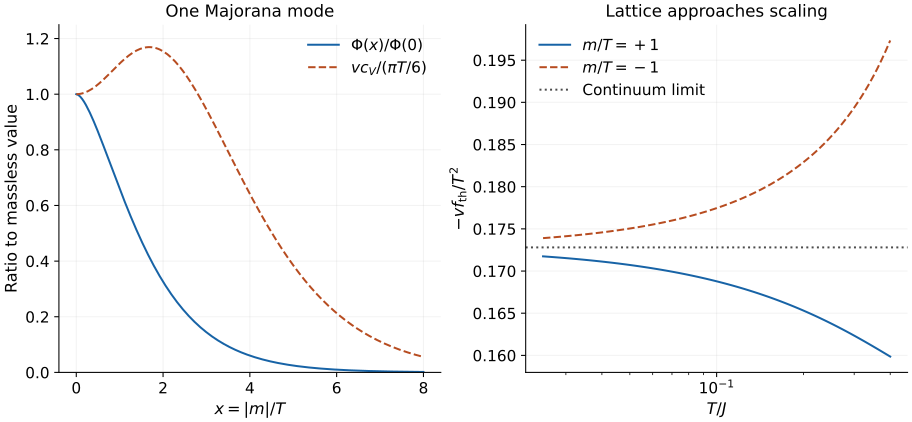
Left: exact continuum thermal integrals, normalized by their massless values. Right: the actual Ising lattice integral along and , with and the fixed critical velocity . Their common low-temperature limit is . The separation at larger temperature includes the analytic velocity correction and lattice dispersion curvature; neither curve is a phase boundary.
The executable calculation is in examples/condensed-matter/quantum-criticality/thermal-bosons/. It also compares the Bessel series with the adaptive integral and checks the heat capacity by finite differences of the free energy at fixed mass. Those checks test mode counting, thermodynamic derivatives and numerical resolution independently of the lattice scaling extrapolation.
What a quantum critical fan does and does not say
For this example, the two competing lengths are the mass scale and the thermal scale . In the window
the thermal integral is close to its critical result. For lower temperature at a fixed nonzero mass it becomes activated. Once the temperature reaches the lattice bandwidth, the continuum mode count fails: the lattice entropy per site saturates at , whereas the critical continuum entropy would keep increasing. The upper end of the window is as important as its lower end.
Lines such as mark a chosen order-one comparison of scales. The infinite, short-range one-dimensional Ising chain has no finite-temperature ordered phase, so these are crossovers, even on the side whose ground state is ordered. Sachdev and Keimer, arXiv:1102.4628v2, §III and Figs. 4–5 (PDF) explain how thermal regimes inherit different zero-temperature excitations; their discussion also distinguishes integrable Ising dynamics from generic equilibration. The present free mode has conserved occupations. Its scaling free energy alone does not establish a universal relaxation rate proportional to temperature.
More generally, let denote spatial dimension, the relevant tuning field, its correlation-length exponent and the dynamic exponent. Under hyperscaling, the singular free-energy density obeys
with nonuniversal metric factors understood. The crossover energy is proportional to . For an operator of scaling dimension , a uniform source in has scaling eigenvalue . Two source derivatives therefore give the static response scaling
This assumes the critical part dominates the integrated connected correlator; ultraviolet contact terms can add regular backgrounds. For the Ising order parameter, and , giving a static susceptibility proportional to . Its amplitude includes the microscopic normalization of the spin. This scaling argument does not determine a spectral line shape or a relaxation time.
The single-argument form assumes that irrelevant couplings have a nonsingular zero-coupling limit for the observable being considered. A dilute Bose gas in provides a useful failure: its repulsion flows toward zero, yet its zero-temperature density on the occupied side is proportional to chemical potential divided by that repulsion. Removing the interaction would make the state unstable. The resulting extra scale is developed in the dilute edge of a Mott lobe and in Sachdev, arXiv:1105.1793v1, §3.2, Eq. (50) and Fig. 3 (PDF). A crossover diagram must therefore state its fixed point, observable, interaction assumptions and microscopic window.
Summary
One Majorana mode gives a thermal free energy proportional to at criticality and an activated contribution across a gap. The exact scaling integral connects them smoothly. Comparing it with the lattice identifies the finite-temperature window in which the critical description is accurate and separates numerical integration errors from physical lattice corrections. A crossover scale is useful even when it is not a phase boundary, and scaling thermodynamics does not by itself establish equilibration dynamics.
Exercises
1. Compute the first lattice correction
At the critical field, expand the exact dispersion through cubic order in positive momentum and obtain the leading correction to both the thermal free energy and heat capacity. Keep and explicit.
Solution
For small positive momentum,
The derivative of with respect to is . Hence the first-order change in the folded momentum integral is
where the dimensionless integral is . Differentiating at fixed lattice Hamiltonian gives
The relative heat-capacity correction is six times the relative free-energy correction. The expansion concerns low temperatures; extending the polynomial to the band edge would be invalid. The finite momentum boundary contributes only exponentially small terms in this asymptotic calculation.
2. Find where the continuum entropy must fail
Use the lattice occupation factors to obtain the leading large-temperature entropy and heat capacity per site. Explain why they rule out extrapolating the massless continuum answer to arbitrarily high temperature.
Solution
For a fermionic two-level occupation with excitation energy , the entropy is
The Brillouin-zone average of the squared Ising excitation energy is
There is one such occupation per spin site in the bulk thermodynamic count. Therefore
At , the companion gives entropy per site 0.68329499 at and 0.69203792 at , approaching . The continuum linear growth of entropy cannot represent a spin with a two-dimensional local Hilbert space at high temperature. It applies only while the thermally populated momenta remain close to the critical point.
References
-
G. B. Mbeng, A. Russomanno and G. E. Santoro, The quantum Ising chain for beginners, arXiv:2009.09208v2, §10, Eqs. (366)–(373): physical parity sectors and thermal traces. Their Ising axes are rotated relative to ours, and the occupation energy denoted in Eq. (369) is our , rather than half of it.
-
P. Pfeuty, The one-dimensional Ising model with a transverse field, Annals of Physics 57, 79–90 (1970), PDF, p. 81, Eqs. (2.10), (2.13)–(2.14), and the preceding bulk-limit qualification. With spin operators , translate his exchange to and transverse coefficient to , and shift the dimensionless momentum by . His excitation energy then becomes our .
-
S. Sachdev, Dilute Fermi and Bose Gases, arXiv:1105.1793v1 (PDF), §2 and Fig. 1 for the distinction between continuum and lattice thermal crossovers; §3.2, Eq. (50) and Fig. 3 for interaction-dependent density and thermal transitions above the dilute Bose gas's upper critical dimension. Its dilute gas has quadratic dispersion; the relativistic Majorana integrals above are derived here and use a different mode count.
-
S. Sachdev and B. Keimer, Quantum criticality, arXiv:1102.4628v2 (PDF), §§II.A–III, especially Figs. 4–5 and the discussion of integrability on pp. 8–10. Their tuning parameter is translated here to the explicit Ising ratio ; the material velocity is retained.
Scrollable formula. Use Left and Right arrow keys to reveal hidden content.
Scrollable table. Use Left and Right arrow keys to reveal hidden columns.
Scrollable figure. Use Left and Right arrow keys to reveal hidden content.