Tunneling and Josephson Probes
A zero-bias conductance peak asks how an incoming electron is reflected. A Josephson experiment asks how an occupied level changes with superconducting phase. Neither question, by itself, determines whether that level is the boundary of a topological bulk. We will calculate both responses, including a local, topologically trivial model with exactly the same tunneling spectrum.
Preparation. The Kitaev chain supplies the end operators, and BdG equations supplies electron–hole scattering. We use , so , and write for the magnitude of electron charge.
A grounded contact with a defined linewidth
Consider two end operators obeying . Their low-energy Hamiltonian is
The signed overlap is ; the positive BdG excitation energy is . A normal lead contacts only the first end. The superconductor is grounded, its condensate phase is fixed, and its bulk gap is the largest energy. There is one effective spinless lead channel, with electron and hole scattering states. Extra uncoupled spin channels do not double this result.
In the unit-normalized Majorana basis, define the internal one-particle matrix and the coupling to energy-normalized electron/hole channels by
The channel phases are a convention. The physical definition of is , where . It will be the half-width of the unsplit resonance.
Eliminating a flat, wide lead gives the retarded self-energy . Its constant real part is absorbed into the specified Hamiltonian. Summing the resulting scattering series gives
Here is a one-particle resolvent, not the bosonic commutator response used elsewhere in the Library. Its poles lie below the real frequency axis. The identity
makes explicit. In this basis particle–hole redundancy gives .
Put . Direct inversion yields
For an incoming electron, normal reflection returns its charge to the lead; hole reflection transfers a Cooper pair to the condensate. Thus
At zero overlap, cancel the common factor of before taking the limit:
The zero-energy decoupled second mode has no contact residue. For any nonzero overlap, however, and the unit-height resonances sit at . The limits of zero energy and zero splitting therefore do not commute. The calculated peak is a resonant Andreev-reflection statement, with no inference yet about topology. Flensberg’s calculation (PDF), Eqs. (8)–(14), uses a linewidth half our and a two-mode coupling half our .
The approximation requires all probed energies, temperature, splitting, and linewidths to remain well below the bulk gap and lead bandwidth. A contact that appreciably modifies the parent superconductor requires a larger model.
Temperature and an absorbing reservoir are different operations
For a lead at temperature , define the dimensionless charge kernel
The differential conductance is the thermal convolution
This broadens a unitary scattering probability; it does not add an imaginary self-energy. For an unsplit mode with no other reservoir,
The last limit still requires below the microscopic cutoff. Numerical integration gives:
| Unsplit peak | Split pair, | |
|---|---|---|
| 0 | 1.000000 | 0.000000 |
| 0.05 | 0.992040 | 0.058589 |
| 0.20 | 0.906657 | 0.413551 |
| 0.50 | 0.706922 | 0.568802 |
| 2.00 | 0.306375 | 0.300452 |
Entries are . Heating initially fills the split pair’s central dip; it suppresses the unsplit peak. Similar finite-temperature values need not imply similar zero-temperature spectra.
Now instead attach additional grounded fermionic channels. Choose their couplings so their retarded self-energy is , with . The full scattering matrix, including these channels, remains unitary. The measured reflection subblock does not. Its resolvent entry becomes
Keeping the other reservoirs at fixed voltage gives
The bracket is probability lost into the extra channels. At zero energy and zero splitting,
Using twice the Andreev probability after inserting an unexplained imaginary linewidth would miss this contribution. A floating reservoir requires a voltage determined by current balance; it is a different experiment. Nor should automatically be identified with a measured parity-switching rate. A floating Coulomb-blockaded island needs charging energies and parity-dependent tunneling, rather than this grounded quadratic contact model.
A local Andreev level with the identical spectrum
Take an ordinary localized complex fermion with
Couple the lead only to . The internal matrix and contact matrix are exactly the ones above. Every local conductance curve, including its thermal convolution, is therefore identical. This construction contains no topological bulk or spatially separated protected ends. Its zero energy and contact asymmetry are assumed properties of a local Andreev bound state (ABS), vulnerable to allowed perturbations.
The counterexample proves a limited but decisive point: a local tunneling spectrum alone cannot establish spatial protection or non-Abelian exchange. In the quadratic grounded model the retarded anticommutator is a state-independent number, so it also does not read out the occupation parity of the distant pair. A parity-sensitive interferometer couples both ends or otherwise introduces parity-dependent energies. Its interpretation requires its own Hamiltonian and competing-state analysis.
Josephson branches and parity relaxation
For two ends meeting across a weak junction, single-electron tunneling carries half the superconducting phase difference. This follows directly at the Kitaev sweet point. On the left segment's right end and the right segment's left end, project the boundary electrons onto their zero-mode parts:
The omitted pieces belong to gapped modes; the projected electrons are not complete canonical site operators. A real weak hopping gives
At this point . General boundary weights renormalize ; a tunneling phase shifts the definition of . The specified low-energy Hamiltonian is
Define the directed current by ; reversing the phase/current orientation reverses its sign. At fixed junction parity,
This branch is periodic. The set of energies is periodic: advancing the phase by exchanges the two branch labels. The Majorana basis itself changes under the corresponding gauge transformation. A globally conserved parity does not necessarily fix the junction parity if remote modes can exchange a fermion with it. We assume those processes absent when following a branch. Alicea (PDF), §V.B, Eqs. (99)–(104), derives this projection and discusses remote-end overlap and poisoning; its junction coupling has the opposite sign to our chosen .
If the junction exchanges parity with a thermal environment, both branches contribute:
The equilibrium current is periodic. At zero temperature its cusp comes from following the lower energy across a parity crossing, not from retaining the original parity.
An explicit interpolation is a two-state rate equation. Let and take a prescribed phase ramp . Rates satisfying instantaneous detailed balance and having total relaxation rate give
This is a declared Markov model of parity exchange, not a microscopic prediction for . Its exact integrating-factor solution is
With and initial , the value after one ramp is , , and for relaxation-to-ramp ratios , , and , respectively. At zero rate the branch remains fixed. At any positive rate the initial-condition term eventually decays; the long-time current of this model is periodic. An observed transient therefore depends on preparation and measurement duration.
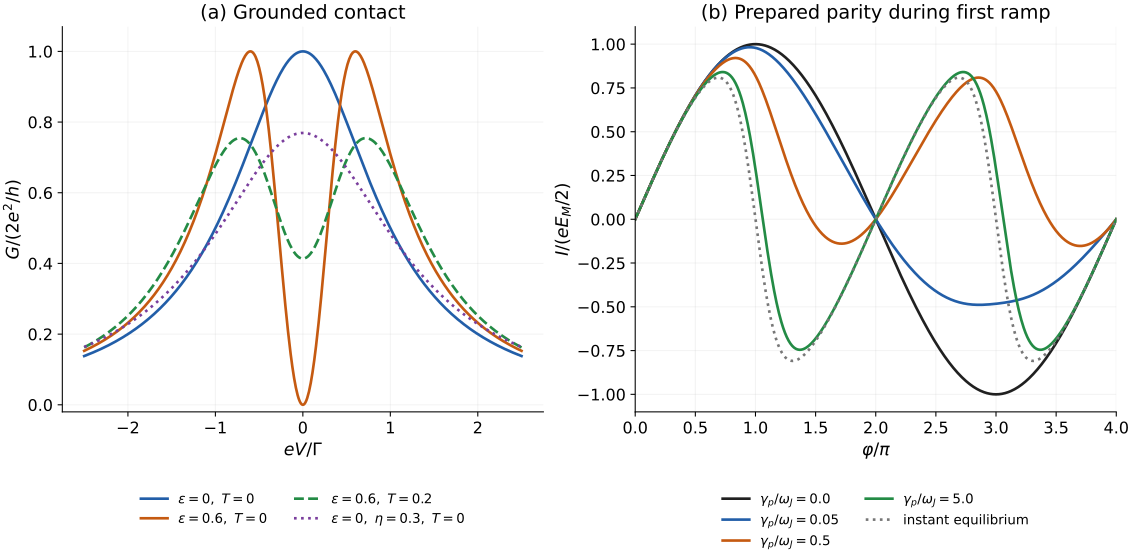
Left: the specified single-channel contact, with energies in units of its half-width; finite temperature smooths the split pair’s central dip. The dotted curve uses an additional grounded absorbing reservoir. Right: the first phase ramp from a prepared parity state, with currents normalized by . Finite-rate curves solve the two-state equation at ; the equilibrium curve assumes relaxation at every phase.
A conventional, highly transmitting short junction supplies another caution. Its avoided Andreev crossing can be traversed diabatically, producing an apparent doubled-period transient without a protected crossing. Exercise 2 quantifies that alternative. Ordinary Cooper-pair current and circuit dynamics may also coexist with the contribution calculated here.
What selected experiments establish
Literature check: 24 October 2026. These examples distinguish measurements from their proposed interpretation; they are not a comprehensive device comparison.
- The 2018 report Quantized Majorana conductance was retracted in 2021. Its claimed quantization should not be used as established evidence. See the published retraction notice.
- Microsoft Azure Quantum’s 2025 interferometric parity-readout paper, introduction and Discussion, explicitly says its measurements alone do not determine whether the detected states are topological. A June 2026 Matters Arising challenges the transport-based gap interpretation; the authors’ reply defends the interferometric interpretation. Those competing interpretations are not settled by the contact calculation above. The accessible publisher previews support this description; they do not amount to a reanalysis of the devices’ data.
- Van Loo and collaborators’ 2026 minimal-chain experiment reports single-shot quantum-capacitance parity readout and millisecond-scale switching. The published abstract distinguishes two-site modes’ limited protection from longer-chain protection; the author manuscript, Figs. 2–4, explains the readout comparison.
- Zatelli and collaborators’ July 2026 preprint, Figs. 2–4 and Conclusion, reports coherent parity oscillations in coupled minimal chains. It explicitly distinguishes these coupling-driven operations from topologically protected gates and identifies fusion/braiding protocols as further tests. A parity rotation is not automatically the exchange operation derived in the next article.
Summary
A contact linewidth, an end-mode splitting, temperature, and an extra reservoir have different effects and must enter different parts of the calculation. A local ABS can reproduce the entire low-energy scattering matrix. Josephson periodicity additionally depends on which parity is conserved and for how long.
The companion in examples/condensed-matter/topological-superconductors/transport-braiding/ checks full scattering unitarity and particle–hole symmetry, independent finite-band boundary matching, thermal current differentiation, and parity-rate evolution against its integral solution. It determines properties of the stated effective models, not a device’s topology.
Exercises
1. Extracting a linewidth under a specified reservoir model
An unsplit contact at zero temperature has measured peak and half-width . Find the two linewidths in the grounded absorbing-reservoir model. Would a thermal convolution justify the same inference?
Solution
For zero splitting the charge kernel is a Lorentzian with width and relative height . Therefore
The Andreev probability at the peak is , not the measured relative conductance . The difference comes from the extra reservoir channels. Thermal broadening instead convolves the unitary line shape and is not, in general, a Lorentzian of width . The inference is conditional on the known reservoir model and negligible temperature; these two observables do not identify a microscopic loss mechanism.
2. A conventional junction’s apparent doubled period
Consider the ordinary short-junction two-level model
Find its energies and the probability to traverse the crossing near diabatically during a slow phase ramp relative to microscopic scales. State what this says about inferring topology from a doubled-period transient.
Solution
The Pauli matrices anticommute, giving
The spectrum has an avoided crossing of size and is periodic. Near the crossing, put . Then
The Landau–Zener formula for is . Consequently,
Near unit transmission there is a window in which the ramp is slow compared with the bulk gap but fast compared with this small avoided crossing. Repeated diabatic passages can approximately follow a doubled-period branch if relaxation is slow. The crossing remains unprotected: the transient alone does not establish a topological Josephson effect. In equilibrium the lower-energy branch and the free energy retain ordinary periodicity.
References
- J. Alicea, New directions in the pursuit of Majorana fermions in solid state systems, Rep. Prog. Phys. 75, 076501 (2012), arXiv:1202.1293v1 (PDF), §§V.A–B, Eqs. (99)–(104) and the following parity-relaxation discussion. Its historical detection language is not a current evidence assessment.
- K. Flensberg, Tunneling characteristics of a chain of Majorana bound states, Phys. Rev. B 82, 180516(R) (2010), arXiv:1009.3533v1 (PDF), Eqs. (2)–(14). Our linewidth and splitting are twice the corresponding parameters in this version.
- H. F. Legg, On the robustness of topological gap detection via transport, Nature 654, E22–E26 (2026), publisher page, opening paragraphs, figure captions and change history; the inspected main-text preview states the challenge to the gap interpretation.
- Microsoft Azure Quantum, Interferometric single-shot parity measurement in InAs–Al hybrid devices, Nature 638, 651–655 (2025), article, introduction and Discussion and outlook: reported readout and explicit limitations of a topological interpretation.
- Microsoft Quantum, Reply to: On the robustness of topological gap detection via transport, Nature 654, E27–E28 (2026), publisher page, inspected opening paragraphs and change history. The reply defends the interferometric interpretation; the July update adds a peer-review file.
- N. van Loo et al., Single-shot parity readout of a minimal Kitaev chain, Nature 650, 334–339 (2026), published abstract and arXiv:2507.01606v1, Figs. 2–4 and Methods VI: quantum-capacitance parity readout in the stated minimal system.
- F. Zatelli et al., Majorana parity qubit in coupled minimal Kitaev chains, arXiv:2607.09511v1 (10 July 2026), Figs. 2–4 and Conclusion: coherent parity oscillations and the distinction between coupling-driven control and protected operations. This is the inspected preprint version.
- H. Zhang et al., Retraction Note: Quantized Majorana conductance, Nature 591, E30 (2021), published notice, dated 8 March 2021, retracting the 2018 report.
Scrollable formula. Use Left and Right arrow keys to reveal hidden content.
Scrollable table. Use Left and Right arrow keys to reveal hidden columns.
Scrollable figure. Use Left and Right arrow keys to reveal hidden content.