The BCS–BEC Crossover
A weakly paired Fermi gas and a condensate of tightly bound fermion molecules can belong to the same broken-symmetry phase. What changes continuously is the size of the pairs, the chemical potential, and the cost of breaking one pair. We follow those changes by solving one regularized gap equation together with the particle-number equation, then test what that saddle does—and does not—predict at both endpoints and at unitarity.
Preparation: BCS mean-field theory supplies the saddle and its phase convention. Scattering lengths and effective interactions supplies vacuum matching. We consider a homogeneous, balanced, equal-mass two-spin gas in three dimensions at zero temperature, with .
Replace a bare attraction by measured scattering data
Assume a broad resonance with negligible effective range at the relevant momenta and a stable atomic or shallow-molecular gas on the timescale of interest. Deep molecular loss channels are outside this zero-range model. Define the total density and its associated scales by
The scattering length is ; is the weak-BCS side and the shallow-dimer side. The zero-range approximation requires the physical range to be much shorter than both the interparticle separation and, in the dilute molecular limit, the dimer size.
Write the regulated local interaction as . On the attractive bare branch, . Vacuum matching fixes
This is the relation for the negative bare coupling in the preceding scattering article. A large positive scattering length is not permission to replace the bare attraction by in an ultraviolet-divergent gap equation.
Keep the definition , choose its uniform phase so that , and let
The finite-cutoff saddle has . Eliminating the bare coupling before removing the cutoff gives the two finite equations
The number equation already counts both spins; there is no additional spin factor. These are the zero-temperature pairing-only saddle equations. Giorgini, Pitaevskii and Stringari, §V.1, Eqs. (54)–(56) gives the same subtraction and density normalization. This truncation is an interpolation, not a systematic expansion at all couplings. In particular, a vanishing bare Hartree term as the cutoff increases does not mean that physical normal-state interaction corrections vanish.
Solve the two constraints together
Introduce dimensionless momentum and saddle parameters,
Angular integration then gives
The factor is fixed by the total-density convention. For each prescribed , both and the positive must be varied. Holding while increasing attraction would remove the molecular endpoint from the calculation.
The integrals converge, but a finite cutoff can still give a sizable bias. Their large-momentum integrands begin as
Thus simply stopping a convergent integral at leaves an error of order . One must also avoid subtracting two nearly equal floating-point numbers at large . The companion uses algebraically rationalized integrands and compares adaptive integration to infinity with fixed Gaussian quadrature in .
Selected solutions are:
| −2 | 0.996948 | 0.046447 | 0.046447 |
| −1 | 0.953983 | 0.208417 | 0.208417 |
| 0 | 0.590606 | 0.686402 | 0.686402 |
| 0.5 | 0.074325 | 1.016763 | 1.016763 |
| 1 | −0.800952 | 1.331872 | 1.554158 |
| 2 | −3.894912 | 1.848581 | 4.311333 |
Here is the smallest positive fermion excitation energy in time. Minimizing gives
Once the chemical potential is negative, no momentum has . The amplitude then differs from the fermion excitation gap. A neutral superfluid also has a gapless collective phase mode, so is not the lowest excitation energy of the entire fluid.
The figure follows these three energies through the crossover. Its isolated experimental point tests the chemical potential at unitarity; it is not a fit used in solving the saddle.
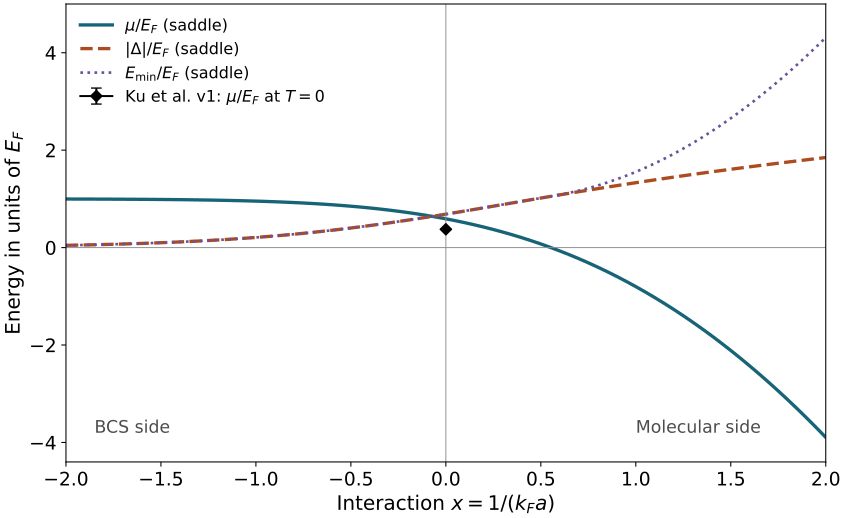
Balanced zero-temperature zero-range pairing saddle. Solid: ; dashed: ; dotted: , coincident with the dashed curve while . The marker is the historical Ku et al. arXiv version-1 Bertsch benchmark , with its quoted error bar; its additional resonance-position systematic is discussed below.
At unitarity, stopping the subtracted integrals at leaves maximum errors in the two saddle parameters of approximately
Adding the analytically integrated asymptotic tails through reduces these errors to below already at . Separately, fixed compactified quadrature at 8, 16, 32 and 64 nodes per subinterval gives maximum parameter differences of
against adaptive integration at . The last digits measure agreement of two numerical methods for these equations, not the accuracy of the saddle as a many-body theory.
Recover the weak-BCS endpoint
For negative scattering length with , the saddle has and an exponentially small gap. Split the subtracted gap integral into a narrow region around and the remaining momenta. The narrow region gives the logarithm; the smooth regions fix its finite constant. With , the result is
The window has disappeared: the constant follows from the parabolic dispersion and the vacuum subtraction. The numerical ratios of the gap to this asymptotic form are , , and at .
This leading saddle exponent is useful, but the saddle prefactor is not the asymptotically exact weak-gas answer. Particle–hole polarization changes the effective attraction at second order. Because that correction enters an exponent, it reduces the leading gap and transition-temperature prefactors by the finite factor
This is the Gor'kov–Melik-Barkhudarov correction for the dilute balanced two-component gas. Their original finite-temperature vertex calculation appears on pp. 1021–1022, Eqs. (15)–(20) and the final transition-temperature formula (PDF). The same saddle also misses the algebraic Hartree and correlation terms in the normal energy. Recovering the free-gas leading energy and an exponential gap does not establish a correct interacting equation of state to the next order.
Resolve the dilute molecular limit
For with , the vacuum dimer has binding energy . Write and . Since , expand the number equation:
Expanding the gap equation to the same order gives
At zero density the second term vanishes and the equation is precisely the vacuum bound-state pole. Using the number equation for the first density correction yields
Equivalently,
The numerical ratio of to the displayed density correction is , , and at . Subtracting the large binding contribution before comparison makes this a test of the interaction term, not merely of the vacuum pole.
The molecules have density and mass . Their chemical potential, measured from the dimer binding energy, is
Comparing with a dilute Bose gas, , reveals the saddle's prediction . This is quantitatively wrong. The four-body calculation of Petrov, Salomon and Shlyapnikov, Eq. (8) (PDF) gives for equal-mass fermions in the zero-range regime, with 2% numerical accuracy quoted in that version. Correct molecular thermodynamics requires matching that scattering process and then using the dilute Bose-gas expansion. One cannot fix it by changing the two-body subtraction: that would spoil the already matched dimer pole.
Nor does a large fermion binding gap imply a proportionately large condensation temperature. An ideal gas of these molecules has a degeneracy scale
while grows without bound. A finite-temperature continuation that only sets the fermion gap to zero confuses dissociation with phase coherence in this limit. This page solves the zero-temperature saddle, not the complete crossover transition line.
Check thermodynamics and confront a benchmark
The same vacuum subtraction makes the grand-potential density finite:
At its stationary gap, and . These integrals give another check that is more discriminating than a small root residual. Let
Differentiation at fixed physical scattering length requires , so thermodynamic consistency demands
The companion differentiates the separately integrated energy along nearby self-consistent solutions. The centered-difference errors decrease quadratically. It also checks the saddle contact relation , which follows by differentiating the explicit inverse-scattering-length term at stationarity. This agrees with the high-momentum occupation tail, whose contact density is within the saddle.
At unitarity, scale invariance gives and . The numerical saddle has
For comparison, Ku et al., arXiv:1110.3309v1, p. 5 below Fig. 4 (PDF) extracted the zero-temperature Bertsch parameter from the thermodynamics of a balanced unitary gas:
That version quotes an additional possible shift of at most 2% from the then-uncertain resonance position. The saddle chemical potential is about 57% larger than its central value, far outside either quoted experimental scale. Reducing the numerical integration error cannot repair that discrepancy: at unitarity no dilute-gas parameter controls the omitted many-body correlations. The useful interpolation and its thermodynamic identities survive; quantitative accuracy does not follow from them.
Summary
Vacuum matching converts the divergent gap equation into a finite equation for physical scattering length. Solving it with the number equation connects a positive-chemical-potential paired Fermi gas to a negative-chemical-potential molecular condensate. The same calculation separates pairing amplitude from fermion excitation gap and exposes three distinct limitations: medium screening on the weak-BCS side, incorrect molecular scattering in the saddle, and uncontrolled correlations at unitarity.
The numerical solutions, convergence studies, energy derivatives and figure are reproducible with examples/condensed-matter/superconductivity/pairing-crossover/.
Exercises
1. Extract the molecular equation of state
Use the derived molecular chemical potential to calculate the saddle energy density and pressure through the first density correction. Then replace its molecular scattering length by the four-body result. Which term changes?
Solution
Integrating the fermion chemical potential with respect to density, with the vacuum energy set to zero, gives
More generally the leading molecular Bose interaction energy is
Taking reduces this interaction term and the leading pressure to times the saddle result. The binding term is unchanged, since it is a two-body observable already matched by . The next dilute-boson correction involves and is not contained in merely replacing the saddle's one coefficient.
2. Recover the dilute dimer wavefunction
In the molecular regime, use the magnitude of the equal-time anomalous amplitude to find its leading momentum dependence. Normalize the corresponding two-body relative wavefunction in the convention , and compare its size to the interparticle separation.
Solution
At leading order , so the anomalous amplitude is proportional to . The normalized relative wavefunction and its Fourier transform are
Indeed, with . The radial probability density is , giving
The pairs are small compared with their separation. Their residual interaction nevertheless requires a four-body calculation; the normalized two-body wavefunction alone cannot determine .
References
- S. Giorgini, L. P. Pitaevskii and S. Stringari, Theory of ultracold atomic Fermi gases, Reviews of Modern Physics 80 (2008) 1215–1274, doi:10.1103/RevModPhys.80.1215. Inspected arXiv:0706.3360v2, §V.1, Eqs. (46)–(58), including the discussion of missing normal-state terms and the incorrect molecular interaction. Their quasiparticle energy is denoted here.
- L. P. Gor'kov and T. K. Melik-Barkhudarov, Contribution to the Theory of Superfluidity in an Imperfect Fermi Gas, Soviet Physics JETP 13 (1961) 1018–1022, original paper (PDF), pp. 1021–1022, Eqs. (15)–(20) and the concluding transition-temperature formula. The source uses the exponential of Euler's constant where we write .
- M. J. H. Ku, A. T. Sommer, L. W. Cheuk and M. W. Zwierlein, Revealing the Superfluid Lambda Transition in the Universal Thermodynamics of a Unitary Fermi Gas, Science 335 (2012) 563–567, doi:10.1126/science.1214987. The benchmark and uncertainty quoted here are specifically from the inspected arXiv:1110.3309v1 (PDF), p. 5 below Fig. 4, rather than an uncertainty copied from a different version.
- D. S. Petrov, C. Salomon and G. V. Shlyapnikov, Weakly Bound Dimers of Fermionic Atoms, Physical Review Letters 93 (2004) 090404, doi:10.1103/PhysRevLett.93.090404. Inspected version 1 (PDF), Eqs. (3)–(8), for dimer–dimer scattering.
Scrollable formula. Use Left and Right arrow keys to reveal hidden content.
Scrollable table. Use Left and Right arrow keys to reveal hidden columns.
Scrollable figure. Use Left and Right arrow keys to reveal hidden content.