Floquet Engineering of Exchange in a Driven Hubbard System
Can a periodic bias tune spin exchange without producing real doublons? In a half-filled Hubbard dimer the measured spin splitting includes virtual states shifted by each integer multiple of the drive frequency. At the off-resonant parameters below, averaging the hopping first predicts a splitting of 0.07207. Summing the virtual sidebands gives 0.03281, close to the exact 0.03135. A useful prethermal interval in a many-body material additionally requires time for spin evolution before substantial heating.
We derive both effects in a driven Hubbard dimer and compare the effective descriptions with its exact six-state evolution. The calculation separates three questions: which coupling is engineered, how the initial state and measured spin must be dressed, and for how long a truncated description stays accurate. A finite dimer tests those approximations; a many-body heating bound requires additional locality and high-frequency assumptions.
Preparation: Superexchange and unitary time evolution. The factorization of a periodic propagator defines stroboscopic quasienergies and micromotion. Here the physical readout is a spin imbalance. We use and denote hopping by , reserving for time.
Remove the large drive before expanding
Consider two sites occupied by two spin-half fermions. Define
Here counts doubly occupied sites and measures the imbalance. Drive the bias at angular frequency :
The dimensionless amplitude is held fixed when the frequency changes. Consequently the laboratory drive amplitude itself grows with frequency; expanding its norm divided by frequency would not be useful. Instead use the exact transformation
Since , the transformed Hamiltonian is
The bias has disappeared; only a hopping phase remains. All terms now have magnitudes controlled by at fixed . The rotation is one at integer periods , and hence changes no stroboscopic quasienergies.
Using , with the Bessel function, gives the harmonics
The leading high-frequency Hamiltonian is therefore
This average is an expansion in the rotating frame. Its application to a real optical lattice also assumes that the drive does not populate omitted bands.
Virtual photons change superexchange
There is another controlled expansion that does not require . Suppose hopping is small compared with the detuning from every appreciably coupled doublon sideband:
A resonance requires a different low-energy subspace and is excluded here. Use a Floquet state . Its time-independent matrix equation is
A singly occupied spin state in sector zero can hop to a doubly occupied state in sector with energy cost . The spin triplet cannot couple to a doublon because of the Pauli principle. For the singlet, the two doublon states give a summed squared matrix element . Second-order elimination therefore gives
The triplet energy is zero and the singlet energy is . Thus is the singlet–triplet splitting. Mentink, Balzer and Eckstein, §II.1, Eq. (6) derives the same sideband ratio; their spin Hamiltonian uses , so in their convention.
Averaging the hopping and then eliminating doublons would instead give . That is only the zero-sideband term. For large frequency at fixed , opposite sidebands combine as
which explains their suppression in the asymptotic high-frequency limit. At an off-resonant frequency comparable to they can remain essential and can change the exchange sign. Merely being far from a low spin frequency does not justify dropping virtual charge sidebands.
Initial kicks are part of the approximation
Adopt the harmonic convention just used, . The first van Vleck correction and first Hermitian kick are
These conventions agree with Eckardt and Anisimovas, §§4.1–4.2, Eqs. (68)–(70) and (87)–(89). Their anti-Hermitian micromotion generator is . For the present hopping harmonics, when , so every commutator in the first correction vanishes. This removes the first correction to the slow Hamiltonian, not the first kick.
Writing , an approximation retaining this kick and the average Hamiltonian is
At integer periods the two rotations reduce to and . The stroboscopic generator is thus conjugate to the average Hamiltonian. Replacing this entire expression by omits a preparation and readout rotation. An initial state transforms by ; an observable transforms by .
This distinction can be tested without a thermodynamic limit. In the two-particle Hilbert space, integrate the Schrödinger equation for one period and multiply that unitary for subsequent periods. Set , , , and prepare the bare state . A directly measurable spin observable is
The following are maximum operator-norm errors over all stroboscopic samples in the stated physical interval. They bound errors for every normalized initial state, not just this spin preparation.
| Average only, | With kick, | With kick, | With kick, | |
|---|---|---|---|---|
| 16 | 0.26171 | 0.03389 | 0.54454 | 1.79741 |
| 32 | 0.12302 | 0.00844 | 0.13222 | 0.52468 |
| 64 | 0.06120 | 0.00204 | 0.03265 | 0.13110 |
The initial kick improves the short-time error from first to second order in inverse frequency. At longer times the omitted quasienergy corrections accumulate: a phase error grows roughly as time times the energy error. In the same comparison the maximum error of with the kick, through time 16, is , and respectively. An observable-specific error need not decrease under every partial correction even when the propagator approximation improves. Nor does one accurate period certify evolution for an arbitrarily large number of periods.
The companion independently compares the laboratory and rotating-frame propagators throughout a period, and checks adaptive integration against products of midpoint matrix exponentials. These test the gauge transformation and numerical evolution, separately from the accuracy of the effective Hamiltonian.
Compare a dressed spin experiment
The same elimination that changes the exchange also changes a state called “a singlet.” Let project onto doublons and be the bare singlet. Its leading periodic dressing is
Normalize this vector; the expression is accurate through first order in hopping, and the normalization retains convenient higher-order terms. The triplet is an exact uncoupled state. Prepare
For this phase convention is real. The spin prediction at integer periods is
It includes the small charge admixture in preparation and readout. Starting instead from a bare Néel state introduces fast charge transients that this pure-spin expression does not describe.
Choose , and . The smallest sideband detuning is three. This is an off-resonant strong-coupling calculation, not a parametric limit. Compare the exact quasienergy splitting on the branch connected continuously to the bare singlet:
| Exact splitting | Relative error | Maximum spin error | ||
|---|---|---|---|---|
| 0.4 | 0.03134670 | 0.03280873 | 0.04664 | 0.34513 |
| 0.2 | 0.00810863 | 0.00820218 | 0.01154 | 0.09025 |
| 0.1 | 0.00204466 | 0.00205055 | 0.002877 | 0.02271 |
| 0.05 | 0.00051227 | 0.00051264 | 0.0007187 | 0.005686 |
The last column samples every stroboscopic time through , so the physical interval becomes longer as hopping decreases. The absolute splitting error falls by approximately sixteen upon halving hopping, as expected for the next, fourth-order correction. The relative splitting and spin errors fall quadratically. In contrast, the averaged-hopping estimate at is : it misses the sideband contribution already at second order.
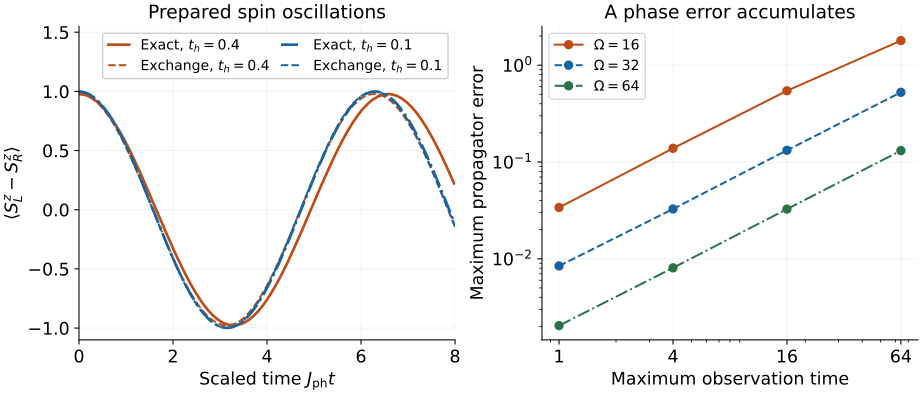
Two distinct approximations for the driven Hubbard dimer. Left: exact stroboscopic spin evolution for the dressed preparation at , and , compared with the photon-assisted exchange prediction. Right: maximum propagator error of the kick-dressed average Hamiltonian over increasing physical time windows at and . Neither panel measures irreversible many-body heating.
The selected results in examples/condensed-matter/nonequilibrium-matter/quenches-floquet/ include both comparisons. Diagonalizing the independent Floquet harmonic matrix with cutoffs two, four, six and eight makes its splitting agree with direct time integration to about at the final cutoff. Midpoint time-step errors decrease quadratically. These numerical checks distinguish discretization errors from the much larger, physically meaningful errors of a truncated exchange or high-frequency expansion.
When does a driven material prethermalize?
In an extended fermionic lattice with short-range bounded couplings, the rotating Hamiltonian has a finite local energy scale set by interactions and hopping. At , a local high-frequency expansion can be truncated near its optimal order. The resulting effective Hamiltonian is approximately conserved, with an exponentially small heating bound and a parametrically long prethermal interval. The finite local Hilbert space, locality and norm assumptions are essential; see Abanin and collaborators, §§II–IV.
This statement is stronger than the existence of a logarithm of a finite-dimensional one-period unitary, and different from a second-order off-resonant exchange calculation. A low-order Hamiltonian can accumulate a visible phase error much earlier than the optimal-order heating time. Thermalization within the effective Hamiltonian further requires suitable ergodic dynamics; integrable examples can keep additional conserved information.
The six-state dimer has coherent quasiperiodic evolution and no irreversible thermodynamic heating rate. Its agreement with an effective spin Hamiltonian supplies no measurement of a bulk prethermal lifetime. Likewise an unbounded bosonic occupation or a continuum band requires additional regulator and resonance control before the bounded-local-system result applies. In a material or optical lattice, interband absorption and environmental loss can compete with intrinsic heating. A reservoir-selected state must be analyzed using its coupling to the environment as well as its effective coherent Hamiltonian.
Summary
A rotating frame converts a strong periodic bias into bounded hopping harmonics. Their average engineers hopping; their virtual sidebands engineer exchange. Micromotion and virtual-charge dressing also transform the state and the observable. Exact few-body evolution tests these effects and their accumulating errors, while a many-body prethermal claim additionally needs a high-frequency local bound and assumptions about relaxation under the effective Hamiltonian.
Exercises
- Weak-amplitude exchange. Expand the photon-assisted exchange through second order in . Determine whether a weak drive enhances or suppresses the antiferromagnetic exchange below and above the charge energy, away from resonance.
Solution
Use and . All other harmonics first enter at fourth order. Hence
For positive the correction enhances exchange when and suppresses it when . The divergence at resonance is a failure of eliminating the sideband, not an infinite exchange. The detuning condition on the matrix element must hold as well as the small-amplitude condition; this expansion cannot be extrapolated across resonance.
- An exactly averaged band. Take a single noninteracting periodic chain with hopping phase . Show that its stroboscopic evolution is exactly generated by the hopping , even when frequency is not large. Explain why this does not establish a generic no-heating theorem.
Solution
For the Fourier convention the Hamiltonian is
All number operators commute, so Hamiltonians at different times commute. Time ordering disappears, and the integral over an integer number of periods is the period average. That average dispersion is . The equality is exact within this isolated single-band model. Its conserved occupations prevent generic heating; interactions, additional bands or another noncommuting drive can remove the argument. It is a special commuting limit, not evidence for an interacting many-body lifetime.
References
- D. A. Abanin, W. De Roeck, W. W. Ho and F. Huveneers, “Effective Hamiltonians, prethermalization, and slow energy absorption in periodically driven many-body systems,” Physical Review B 95, 014112 (2017), doi:10.1103/PhysRevB.95.014112, arXiv:1510.03405v3. Sections II–IV, especially Eqs. (2)–(4) and (24)–(35), state the local bounded-system assumptions and optimal-order estimates.
- A. Eckardt and E. Anisimovas, “High-frequency approximation for periodically driven quantum systems from a Floquet-space perspective,” New Journal of Physics 17, 093039 (2015), doi:10.1088/1367-2630/17/9/093039, arXiv:1502.06477v4. Sections 2.1–2.3 and 4.1–4.3 define Floquet states, the kick and effective Hamiltonian, including preparation-phase dependence.
- J. H. Mentink, K. Balzer and M. Eckstein, “Ultrafast and reversible control of the exchange interaction in Mott insulators,” Nature Communications 6, 6708 (2015), doi:10.1038/ncomms7708, arXiv:1407.4761v2. The opening two-site calculation and §II.1, Eq. (6), give photon-assisted exchange; their exchange coefficient is half the singlet–triplet splitting used here.
Scrollable formula. Use Left and Right arrow keys to reveal hidden content.
Scrollable table. Use Left and Right arrow keys to reveal hidden columns.
Scrollable figure. Use Left and Right arrow keys to reveal hidden content.