Polarization and Thouless Pumping
An insulating ring can return to the same Hamiltonian after a slow cycle while transporting one particle around the ring. Its local density need not reveal that transport. The useful quantity is a continuous branch of polarization: after the cycle, it can differ by one polarization quantum even though the final bulk state is physically equivalent to the initial one.
We will calculate the polarization of the Su–Schrieffer–Heeger chain, turn its two dimerizations into a Rice–Mele pump, and compare the band formula with a finite-ring many-body overlap and a directly evolved current. The unit cell, orbital positions and orientation of the cycle are part of the calculation.
Preparation: Berry Phases and Quantum Geometry and a filled noninteracting band. We consider spinless particles of physical charge , one particle per cell, and zero temperature. Cell spacing and are one. For electrons, set with .
Specify the positions before the polarization
Label the orbitals in cell by and , at positions and . A fixed background charge sits at each cell origin. The Hamiltonian is
Both hoppings will remain positive. Use the cell-periodic Fourier convention
The coefficients in this basis do not include the orbital positions. The physical cell-periodic Bloch vector is , where . Its connection is
The second term is essential. A change of eigenvector phase changes only the first term by a derivative; a change of orbital embedding changes the position operator itself. With the background and origin fixed, the polarization is
Moving one particle by a whole cell changes a dipole by without changing the periodic bulk. This is the polarization quantum, not an uncertainty in a continuously followed polarization difference. The Berry-phase expression and its relation to integrated current are developed in Xiao, Chang and Niu, §§II.1–II.3. Berry Phase Effects on Electronic Properties.
Two SSH dimerizations
Set . Write the off-diagonal element as . A lower eigenvector is
The circle traced by winds around the origin when the intercell hopping is stronger. Hence
and, for our stated embedding and background,
The strongly dimerized limits explain these numbers without any Berry calculus. An intracell occupied bonding orbital is centered at ; an intercell one is centered at . The difference is half a cell. Inversion quantizes the polarization relative to a specified inversion center. Changing the origin or grouping orbitals into another cell changes the reported representative, so a bare claim that “the polarization is zero” is incomplete.
For an open chain containing cells through , retain the intracell bonds and the intercell bonds between those cells. When , a left-edge solution in the semi-infinite limit has only amplitudes:
At its energy is zero. A right-edge state lives on the other sublattice; the finite-chain pair has an exponentially small hybridization. The termination matters: cutting the other bonds changes which end states occur. Edge occupation also depends on the chemical potential and charge constraint. Bulk polarization fixes a boundary-charge fractional part under specified insulating boundary conditions, not a unique occupation of every finite-chain edge level.
A gapped loop transports an integer
Choose the explicit cycle
with increasing from zero to . The direct band gap is minimized at and is
The path avoids the gap closing at , so it continuously connects the two SSH dimerizations without preserving inversion throughout the path. Polarization is then allowed to vary continuously.
For the occupied lower band, define the coefficient-basis curvature on the momentum-cycle torus by
The orientation is . Near the enclosed degeneracy, put . Then . At the positive- crossing of our loop, points in the negative second direction and in the positive third direction. The lower-band flux therefore has negative orientation. Shrinking the loop around this single degeneracy without closing the gap gives
This sign has a physical consequence. The adiabatic velocity of a filled-band state is in the coefficient basis. The group velocity integrates to zero. Including the embedding contribution,
The second term returns to its initial value after a closed adiabatic cycle. Thus
One particle moves in the positive cell direction. For an electron the transported charge is negative. Reversing the cycle reverses the answer. The minus sign between transported charge and follows from our connection and torus orientation; changing those conventions without changing the current formula would give a wrong direction.
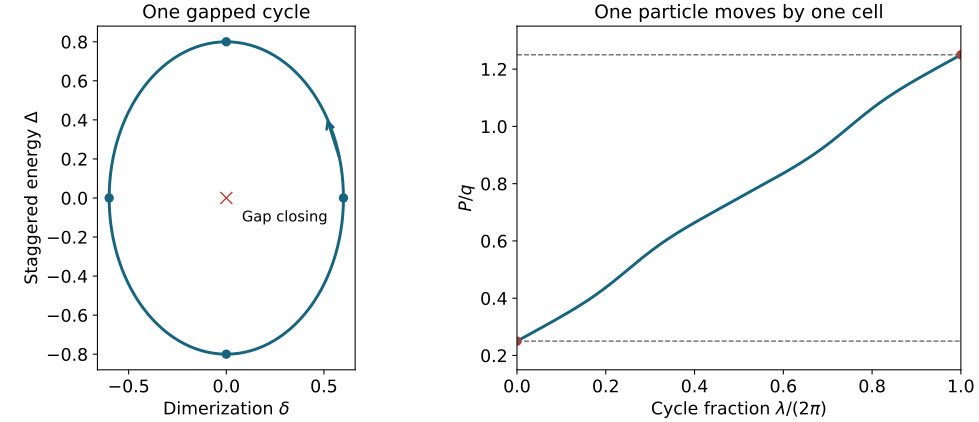
The specified loop remains gapped. With orbital positions and , a continuous polarization branch changes from to . The final bulk polarization equals the initial one modulo its quantum, although the integrated current transports one particle.
The integer requires a filled isolated band, adiabatic evolution and a closed cycle. Finite-speed excitation, a partially filled band or a path through the degeneracy can spoil it. This calculation concerns a periodic bulk. In a finite isolated open chain, insisting on evolution slower than an exponentially small edge avoided crossing can return a unique finite-system ground state to itself. Bulk transport, edge occupations and the order of the thermodynamic and adiabatic limits must then be distinguished. A reservoir or a specified preparation can select a different edge history.
A finite-ring many-body check
Position itself is awkward on a ring, but its exponential is periodic. For the occupied Slater determinant, define
Our background contributes . The finite-size polarization representative is therefore
This is a many-body overlap, even though it reduces to a one-particle determinant for a Slater state. Resta gives the position exponential and the determinant reduction in Eqs. (3)–(4) and (12)–(21). Quantum-Mechanical Position Operator in Extended Systems (PDF).
An equivalent band calculation uses the normalized links
The phase is modulo one. The explicit embedding factor also implements the Brillouin-zone seam correctly. In the determinant construction, the cyclic permutation of occupied momenta contributes a fermionic permutation sign; the stated background removes the corresponding reference-cell phase. The companion checks the full real-space determinant instead of assuming this factorization.
For example, at , the large-grid value is approximately . The finite-ring values for approach it, with respective errors approximately , , and . The determinant and embedded-link calculations agree within across the tested points. The finite-size drift is physical discretization error, not a gauge ambiguity.
Evolving the current rather than assuming adiabaticity
The same companion evolves every occupied two-component Bloch state with the time-dependent Schrödinger equation. The cycle uses a smooth schedule, with duration :
Both endpoint velocities vanish. Midpoint matrix exponentials preserve each state norm, while independent time-step and momentum refinements control the integrated current. The physical velocity operator in our cell basis is
The second term is the time derivative of intracell position. At finite speed the state does not return exactly to the initial occupied band, so its integral need not vanish. The program verifies that the difference between physical and cell-current integrals equals the change of , up to the controlled integration error.
At durations and , the time-step-extrapolated transported particle numbers are approximately and . The final excited-band population falls from about to . These deviations are not expected to decrease monotonically at every short duration: coherent transitions can interfere. The saved results include both raw time-step values and the extrapolation, rather than attributing every deviation from one to nonadiabatic physics. The mesh Chern integral separately converges to .
Summary
Polarization needs a unit cell, physical orbital positions and a reference background. Its representative is defined modulo a charge quantum, while a continuous change measures transported charge. The SSH dimerizations differ by half a quantum in the stated convention. The Rice–Mele loop keeps the bulk gap open and transports one particle per cycle; its direction follows from the Berry-curvature orientation. Finite-ring overlaps and direct current evolution check different parts of this statement.
Exercises
1. Moving an orbital label without moving an orbital
Relabel while keeping . Find the momentum-space change of basis and the position assigned to . Show that the physical Berry connection is unchanged. What goes wrong if the new coefficient vector is used with the old embedding?
Solution
The Fourier convention gives . Thus with . The orbital called is physically at , so . The coefficient connection changes by
Meanwhile . The two changes cancel pointwise. Using the old embedding would spuriously add the average occupation to . This need not be an integer away from the SSH limit: it would describe a different physical position assignment, not merely an eigenvector gauge transformation.
2. A pump that does not pump
Replace the cycle by and , allowing the real hopping to change sign. Does the lower filled band pump a nonzero integer? Explain the role of the gap and compare reversal of the original cycle.
Solution
The degeneracy requires and . Since , this occurs only at , which the new cycle never reaches. It can be contracted to the point while keeping and the gap open. Its torus Chern number and transported charge are therefore zero. A changing sign of one real hopping is not itself a gap closing or a topological pump.
Reversing the original loop leaves its gap unchanged but reverses its orientation. It changes from to and transports . This distinguishes topology of the loop from the sign of an individual hopping.
References
- R. Resta, Quantum-Mechanical Position Operator in Extended Systems, Physical Review Letters 80, 1800–1803 (1998), doi:10.1103/PhysRevLett.80.1800. The preprint (PDF), Eqs. (3)–(4) and (12)–(21), gives the position exponential and its crystalline Slater-determinant reduction. Our background and single-band cyclic permutation are explicit above.
- D. Xiao, M.-C. Chang and Q. Niu, Berry Phase Effects on Electronic Properties, Reviews of Modern Physics 82, 1959–2007 (2010), doi:10.1103/RevModPhys.82.1959. The versioned preprint, §§II.1–II.3.1, derives adiabatic current, polarization and the Rice–Mele example. Our cell-periodic coefficient basis differs from their embedded two-sublattice parametrization.
Scrollable formula. Use Left and Right arrow keys to reveal hidden content.
Scrollable table. Use Left and Right arrow keys to reveal hidden columns.
Scrollable figure. Use Left and Right arrow keys to reveal hidden content.