The TKNN Invariant and the Hall Response of a Chern Insulator
A filled band has no low-energy bulk carriers, yet an electric field can drive a transverse current. In a Chern insulator, that response is fixed by how the occupied states cover momentum space. The same integer constrains the net direction of boundary propagation, although the detailed edge dispersion depends on how the sample is cut.
We will derive the invariant and the zero-temperature Kubo response for one specified two-band Hamiltonian, then diagonalize a strip and solve its edge state analytically. The bulk, response and boundary calculations use a common orientation and charge convention.
Preparation: Berry Phases and Quantum Geometry and Retarded Response. We use two co-located orbitals per square-lattice cell, one occupied spinless band, and . Energies are in the hopping unit. The physical particle charge is ; its semiclassical force is and its charge current is .
An integer that needs more than one gauge
For an isolated lower band, let and . For a completely filled isolated band its first Chern number, the Thouless–Kohmoto–Nightingale–den Nijs (TKNN) invariant, is
Why is it an integer? If one smooth periodic gauge covered the whole Brillouin torus, Stokes' theorem would make this integral zero. When several patches are needed, their boundary integrals remain. On an overlap, and . The remaining integrals measure windings of the transition phases. Single-valued transition functions make each total winding a multiple of .
A nonzero Chern number therefore obstructs a globally smooth periodic eigenvector. It does not obstruct a smooth periodic projector, a well-defined density matrix or a numerical diagonalization at each momentum. It also cannot change continuously under a deformation that keeps the occupied band separated from the empty one.
For , with , the lower-band curvature is
Thus the Chern number counts the oriented covering of the unit sphere by the Brillouin torus. This form is useful because it never requires choosing an eigenvector phase.
Four Dirac points determine the phase diagram
Our lattice Hamiltonian is
The parameter is a band parameter. The energies are , so at half filling the chemical potential can be placed at zero. A gap closing requires both sine terms to vanish. The possible momenta and masses are
| Momentum | Dirac mass | Orientation |
|---|---|---|
The orientation is the sign of the product of the two linearized velocities. A massive continuum cone contributes to the lower-band curvature integral. The half-integer is a local continuum contribution, not a complete lattice invariant. Summing the lattice's four cones, or following their jumps from the trivial phase at large negative , gives
Equivalently,
At the three transition values the individual occupied-band invariant is undefined. Crossing zero closes two cones simultaneously and changes by two. This is a property of the specified lattice symmetry and parameters, not a rule that every topological transition has a unit jump.
Qi, Wu and Zhang derive the two-band Hall integral and illustrate its strip spectrum in §II, Eqs. (1)–(8) and Fig. 2. Their particular Pauli-axis and mass parametrization differs from ours; the signs above follow from the displayed Hamiltonian and lower-band convention. Topological Quantization of the Spin Hall Effect (PDF).
The filled-band Kubo calculation
For the co-located orbitals, define and the uniform charge current . A spatially uniform vector potential couples at first order as . With time dependence , the electric field is .
Use the site's retarded correlator . The response to the source is , supplemented by the explicit current-source contact. The mixed contact is symmetric in its spatial indices. It therefore drops out of the antisymmetric Hall response; it must not be discarded when computing the complete longitudinal response.
At zero temperature the many-body ground state fills the lower band. A uniform current creates a particle-hole excitation at the same momentum, of energy . The Lehmann sum per area reduces to
where
Swapping the spatial indices conjugates this numerator. Define the antisymmetric part by . Then
The spectral expression for the geometric tensor gives . Dividing the response by the electric field and taking the low-frequency limit inside the insulating gap therefore gives
This is the TKNN relation in the occupied-band convention fixed above. The original calculation used magnetic Bloch bands of a periodic potential in uniform magnetic flux. Here the ordinary Brillouin torus of a lattice Chern insulator supplies the same integer. Thouless, Kohmoto, Nightingale and den Nijs, pp. 406–407
With the output current index written first,
Both signs follow from the source convention, not from the sign of the charge: the force and current each contribute one factor of . Restoring units gives per Chern number in the first relation. The anomalous-velocity derivation gives the same result: , and the filled-band group velocity integrates to zero. The state-correction derivation in Xiao, Chang and Niu, §II.1, Eqs. (31)–(34), fixes this velocity sign. Berry Phase Effects on Electronic Properties.
The calculation assumes an insulating many-body ground state of this noninteracting model, zero temperature, linear response and the uniform transport limit. It is not a formula for a partly occupied Chern band, and it does not calculate interaction or disorder corrections. A finite strip's equilibrium circulating edge currents should likewise not be identified with a transport current between leads without specifying the occupation and measurement setup.
Computing the integer without smoothing eigenvector phases
For a mesh of occupied eigenvectors, define forward links
The plaquette product is gauge invariant. In our convention, its phase approaches minus the Berry flux:
The sign follows already from a single link: . Fukui, Hatsugai and Suzuki develop the normalized-link method in Eqs. (7)–(11). They use an anti-Hermitian connection and the opposite Chern sign to ours; the minus sign above is the explicit translation. Chern Numbers in a Discretized Brillouin Zone (PDF).
An integer on a coarse mesh is not a convergence certificate. Nonzero overlaps, resolved plaquette phases and mesh refinement remain necessary, especially near a closing gap. At , the direct curvature integral on meshes with , , and points per direction gives approximately
The link formula already gives one on each of these meshes and remains unchanged after independent random phases are applied to every eigenvector. This is a useful gauge check, but the slowly resolving curvature peak explains why the independent integral is also valuable.
The companion additionally computes the retarded current matrix elements rather than substituting the analytic curvature. At , analytic continuation to gives a real Hall coefficient that approaches as is reduced. Its errors for are approximately , , and , consistent with a quadratic finite-frequency correction. This numerical regulator is not a physical scattering rate.
Solve and diagonalize an edge
Open the lattice in the direction and keep periodic. For cells , write
A plane wave reproduces the bulk Hamiltonian. For a semi-infinite left edge try . Choose
The missing left bond then satisfies the boundary condition automatically. Since , the remaining equation is
Hence
The last inequality is normalizability. The right edge has . At , the crossing occurs near : the left mode has positive group velocity, consistent with . At , the crossing is at the Brillouin-zone seam near , where the same sine dispersion has negative slope, consistent with . A boundary branch can merge into the bulk; it need not remain isolated throughout the whole Brillouin zone.
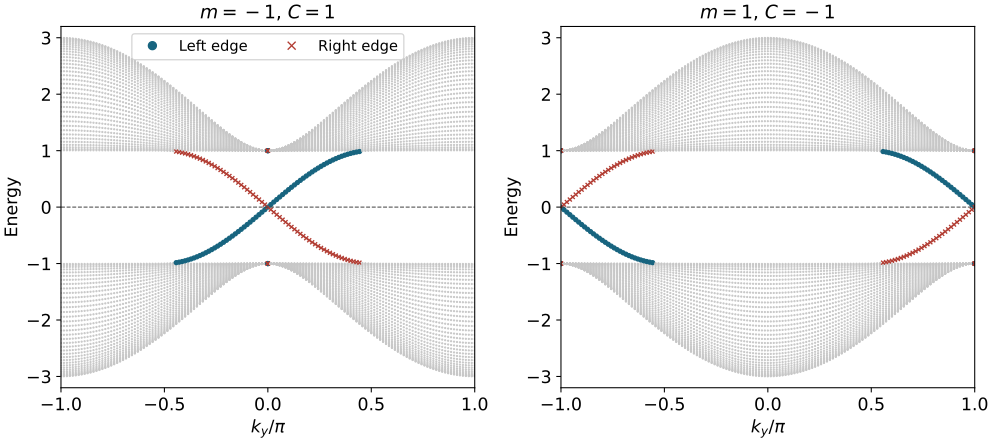
Direct diagonalization of strips with . Blue circles and red crosses identify states with more than probability in the left or right four cells; other states are gray. The two panels use the same termination. Their gap-crossing directions reverse between and .
For and , the analytic energy is and the decay factor is . Finite-strip energy errors decrease from at eight cells to at twelve, at twenty and at thirty-two. The wave-function probabilities independently approach the normalized geometric profile. This tests the actual boundary eigenproblem, rather than drawing the analytic edge curve on top of a bulk calculation.
Summary
The lower occupied band has a Chern number fixed by the orientation of its projector over the Brillouin zone. For the specified square-lattice model, four Dirac masses give the complete phase diagram. A filled-band Lehmann calculation produces with the stated source convention. A separate strip calculation exhibits the corresponding edge chirality and its finite-width corrections. Gauge invariance, momentum convergence and boundary convergence are distinct checks.
Exercises
1. Quantization is a zero-frequency statement
Use the interband Lehmann expression to derive the Hall coefficient at with . Show that its leading deviation is quadratic in for a gapped band. Why does adding a symmetric source contact not repair this finite-frequency deviation?
Solution
Substitution gives
For smaller than the direct gap, expand uniformly:
The correction depends on the distribution of curvature and gaps, not only on topology. Its sign is not fixed for an arbitrary band with curvature of both signs. A symmetric contact cancels from the antisymmetric response by definition. It cannot turn the nonuniversal finite-frequency coefficient into a quantized one.
2. Where does the edge disappear?
For , determine the interval of where the semi-infinite left-edge solution exists, its localization length and its normalized density. What happens as the interval endpoint is approached? Contrast this with a strip of finite width.
Solution
The condition is , or . Thus modulo the Brillouin zone. For , the amplitude localization length in cells and the probability are
At zero momentum, and the state occupies the first cell exactly. At either endpoint, and the localization length diverges: the state merges with a bulk band. In a finite strip, overlap with the other edge produces width-dependent corrections; near the merger a simple isolated-edge approximation fails. Neither the exact sine curve nor exponential finite-width estimates should be extended past the normalizability interval.
References
- T. Fukui, Y. Hatsugai and H. Suzuki, Chern Numbers in Discretized Brillouin Zone: Efficient Method of Computing (Spin) Hall Conductances, Journal of the Physical Society of Japan 74, 1674–1677 (2005), doi:10.1143/JPSJ.74.1674. The versioned preprint (PDF), Eqs. (1)–(3) and (7)–(11), fixes the connection and link conventions; our Chern sign is translated explicitly.
- X.-L. Qi, Y.-S. Wu and S.-C. Zhang, Topological Quantization of the Spin Hall Effect in Two-Dimensional Paramagnetic Semiconductors, Physical Review B 74, 085308 (2006), doi:10.1103/PhysRevB.74.085308. The versioned preprint (PDF), §II, Eqs. (1)–(8), Fig. 2 and Appendix A, connects two-band Kubo response, topology and strip states.
- D. Xiao, M.-C. Chang and Q. Niu, Berry Phase Effects on Electronic Properties, Reviews of Modern Physics 82, 1959–2007 (2010), doi:10.1103/RevModPhys.82.1959. The versioned preprint, §II.1, Eqs. (31)–(34), derives the adiabatic velocity correction. We state the Hall-index orientation explicitly; the companion notes apparent sign inconsistencies elsewhere in that early version.
Scrollable formula. Use Left and Right arrow keys to reveal hidden content.
Scrollable table. Use Left and Right arrow keys to reveal hidden columns.
Scrollable figure. Use Left and Right arrow keys to reveal hidden content.