Hund Coupling and Multiorbital Correlations
Why can an interaction make an atomic spin larger while making its eventual screening slower? Hund exchange selects a high-spin multiplet. Charge motion into and out of that multiplet is then constrained, and each orbital carries only part of its total spin.
We will diagonalize the complete two-orbital interaction, including the terms that move spins and pairs. Coupling these orbitals to two discrete bath levels gives an exactly computed example of moment formation, reduced charge fluctuations and a smaller singlet-formation scale. Its finite-bath spectrum illustrates the mechanism without identifying a discrete gap with a metallic Kondo temperature.
Preparation: Fermionic creation operators, Hubbard spectral weights and elimination of virtual impurity charge states. We use .
Specify the interaction, including operator order
Let annihilate spin in orbital . Both orbitals have the same one-particle energy. There is no spin–orbit coupling or crystal-field splitting unless explicitly added. Take and define
The annihilator order in the pair term matters: reversing its last two operators changes a sign. Define , and . An equivalent form makes spin invariance transparent:
For example, the longitudinal part of the spin interaction lowers the parallel-spin density coefficient to ; its transverse part supplies the spin-flip term. Pair creation in one orbital is a spin singlet, so the full Hamiltonian commutes with all components of the total spin.
This is a specified two-orbital Kanamori model with . Spin invariance does not imply arbitrary orbital invariance. The usual two-orbital choice distinguishes components of orbital pseudospin, and neither these two orbitals nor their interaction should be identified with an unrestricted spherical atomic shell. Georges, de’ Medici and Mravlje, version 2, §2, Eq. (2), and Appendix A, Eqs. (21)–(24) give the operator and symmetry distinctions. Their Kanamori exchange is our .
Diagonalize all six two-electron states
Use the creation-operator ordering
The parallel states and have energy . In the ordered basis , the remaining singly occupied block is
Its symmetric combination is the third triplet member. Its antisymmetric combination is a singlet. The doubly occupied basis , gives
Thus the entire two-electron sector is
| Multiplet | Normalized state or states | Energy | Degeneracy |
|---|---|---|---|
| Spin triplet | , , | 3 | |
| Interorbital singlet | 1 | ||
| Antisymmetric pair | 1 | ||
| Symmetric pair | 1 |
The triplet is lower than either of the first excited singlets by . If the spin-flip term were omitted, its zero-spin-projection member would instead remain at : the three states would no longer form a degenerate spin multiplet. Omitting pair hopping leaves the two double-occupation states at , losing both their splitting and their eigenvectors.
At and , direct diagonalization yields energies . The companion constructs the operators with fermion parity signs on the full 16-state local Fock space. It also reconstructs the interaction from the spin-density expression above. Their difference is zero to floating-point precision, and the spin-raising commutator has norm below . The density-only approximation instead gives commutator norm at these parameters. This tests the missing symmetry rather than only comparing sorted energies.
Hund exchange changes charge gaps differently at different fillings
The lowest interaction energies in all five charge sectors are
For three electrons, one orbital is doubly occupied and the other singly occupied. Counting one intraorbital pair, one opposite-spin interorbital pair and one parallel-spin interorbital pair produces . The off-diagonal terms vanish on these states by Pauli exclusion.
The cost of transferring an electron between two equivalent atoms with charge is
Consequently,
Hund exchange reduces the atomic charge gap at one or three electrons but increases it at the half-filled two-electron shell. These results are exact for the specified atom. They are not the critical interactions for a lattice Mott transition: hopping, bandwidth, orbital structure and allowed ordered phases also matter. This filling dependence is derived more generally in Georges, de’ Medici and Mravlje, §3, Eqs. (9)–(11).
Couple the multiplet to a finite bath
Give each impurity orbital one canonical bath orbital at zero energy. The grand-canonical generator is
There are eight spin orbitals in total. Use the canonical sector with four electrons and choose the particle–hole-symmetric impurity energy
The bath energies and are already measured relative to the global chemical potential. This choice is varied with so that remains fixed; it is not a scan at fixed bare impurity level.
At , removing an electron from the impurity triplet or adding one to it has the same cost:
Diagonalizing the finite model at , gives
| Singlet–triplet gap | |||
|---|---|---|---|
| 0 | 0.97721268 | 0.09114928 | 0.14126503 |
| 0.2 | 1.83430775 | 0.06510716 | 0.05796748 |
| 0.4 | 1.91150987 | 0.05292835 | 0.04532716 |
| 0.8 | 1.94298207 | 0.04185956 | 0.03683199 |
All energies use the same unit as . The total ground state is a singlet throughout this scan. Its impurity moment approaches the spin-one value , even though . Charge fluctuations decrease while the gap to the lowest total-spin-one state becomes smaller. A large instantaneous local moment therefore need not mean a permanently unscreened ground-state spin.
The bath spin satisfies in this singlet. At , all six local two-electron states are degenerate before hybridization; projection onto only the triplet would be invalid. The first row is obtained from the full model, not by extrapolating a triplet-only formula to zero Hund coupling.
Derive and test the smaller singlet scale
Suppose and the induced exchange is small compared with . Eliminating impurity charges one and three to second order produces, for each orbital, an exchange with its bath spin. In the convention , its coefficient before projection onto the triplet is
The two terms are the virtual removal and addition paths. Inside the spin-one triplet, orbital interchange symmetry makes the two projected spins equal; their sum is the total impurity spin. Thus
The factor of one half is a projection matrix element, not a replacement of spin-one operators by classical vectors. The analogous high-spin projection in a continuum Kondo model is derived in Nevidomskyy and Coleman, version 1, Eqs. (7)–(9), pp. 2–3 (PDF). Their conduction spin density is written without our factor , so the coefficient of a physical term is twice their coefficient; the fractional projection is unchanged.
For this half-filled finite bath, the full second-order operator on the 18-dimensional subspace with impurity charge two and impurity spin one is
Here , and the remainder means an expansion at fixed nonzero charge and Hund gaps. Its coefficients are not uniform as . The bath contains two electrons, but the retained subspace includes both bath singlets and bath triplets, including doubly occupied bath orbitals. The scalar term is part of the projected operator, though it drops out of excitation gaps.
For bath spin one, angular-momentum addition gives
for total spin zero, one and two. The lowest singlet and triplet therefore differ by
Let denote the hybridization term in , and let . The companion constructs directly. It agrees with the spin operator, including its constant, within after factoring out the squared hybridization amplitude.
At , , the exact ratios are
for hybridization amplitudes . The relative error is quadratic in amplitude, as expected for a fourth-order correction to a second-order gap. This compares full finite-model diagonalization with elimination of virtual charge states.
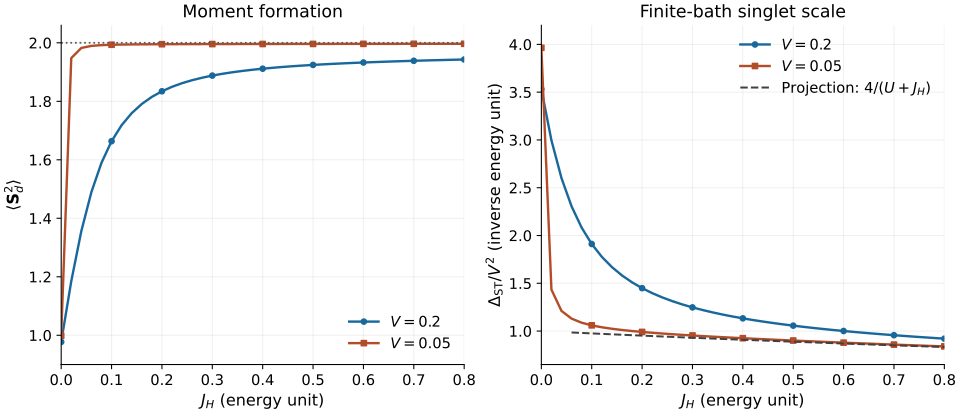
Exact finite-bath results at , with adjusted to particle–hole symmetry at each . The two hybridization amplitudes are and . Left: an instantaneous impurity moment grows while the total ground state remains a singlet. Right: the normalized singlet gap approaches when charge fluctuations and mixing with the excited local singlets are small. The dashed projection curve is shown away from , where triplet-only projection fails. Curves represent this finite model, not a continuum Kondo temperature.
A local moment and its response have different limits
A field coupled by probes the local susceptibility. Since does not commute with hybridization, replacing it by is generally incorrect. The equilibrium response is
For normalized Boltzmann weights , its finite-system Lehmann form is
The coincident-energy ratio is defined by its limit , including degenerate states. A free spin one has . For , , , thermal traces give at and at : the triplet behaves nearly freely above its singlet-formation gap and below the higher local scales. At the product has fallen to . It ultimately tends to zero for the nondegenerate singlet, even though the equal-time impurity moment remains large.
A continuum metallic bath has arbitrarily low-energy particle–hole excitations. Its Kondo crossover, resonance width and Fermi-liquid coherence require such a bath and an appropriate limiting calculation. The two-level bath used here has recurrences, discrete spectral lines and an algebraic small- gap. It cannot establish an exponential Kondo scale, a metallic quasiparticle residue, a spin-freezing phase or a lattice phase boundary. The common mechanism is the local multiplet constraint; the quantitative low-energy problem is different.
Summary
Spin flip and pair hopping determine the local multiplets. Hund exchange raises the half-filled atomic charge gap and lowers those at neighboring integer fillings. In the finite impurity, it strengthens the moment while reducing charge fluctuations and the singlet gap. Controlled projection explains this trend; the model does not establish a metallic coherence scale.
examples/condensed-matter/correlated-fermions/atomic-multiplets/ contains the model, numerical results and figure generator. All eight spin orbitals are retained, with no many-body state cutoff or spectral broadening.
Exercises
1. A crystal field competes with Hund exchange
Add , with , while retaining two electrons. Find the first crossing from the triplet ground state to a singlet. Compare with dropping pair hopping while keeping spin exchange.
Solution
The triplet has one electron in each orbital, so its energy remains . The interorbital singlet also remains at . The double-occupation block becomes
with eigenvalues . Its lower eigenvalue crosses the triplet when
The crossing is exact because the two states have different total spin. At , direct Fock diagonalization gives . Omitting pair hopping changes the lower double-occupation energy to , predicting . Pair hopping therefore changes even a ground-state crossing, not only excited-state labels. This is an isolated-atom crossing; hybridization changes the problem.
2. Why a singlet still has a finite local susceptibility
In the projected model with bath spin one, derive the zero-temperature response to and compare it with the equal-time variance. Use the spin-one singlet
where the kets on the right label impurity and bath spin projections.
Solution
Acting with the impurity spin gives
The triplet lies above the singlet. Both orderings in the zero-temperature Kubo sum contribute, giving
The field polarizes the impurity by mixing excited states into the singlet. Thus is finite at fixed nonzero exchange, while . In contrast, , so multiplying the equal-time variance by would incorrectly predict a Curie divergence. That shortcut is valid for a conserved, thermally free spin component, not for the impurity component inside this coupled singlet. The total spin susceptibility is a different observable: a uniform field coupled to the conserved total spin does not mix this singlet with the triplet at zero temperature.
References
- Antoine Georges, Luca de’ Medici and Jernej Mravlje, “Strong Correlations from Hund’s Coupling,” Annual Review of Condensed Matter Physics 4 (2013), 137–178, doi:10.1146/annurev-conmatphys-020911-125045. arXiv:1207.3033v2, HTML, §2, Eq. (2); §3, Eqs. (9)–(11); §4; Appendix A, Eqs. (21)–(24). The source's Kanamori is the local exchange called here; its different multiorbital models are not interchanged.
- Andriy H. Nevidomskyy and Piers Coleman, “Kondo Resonance Narrowing in d- and f-Electron Systems,” Physical Review Letters 103 (2009), 147205, doi:10.1103/PhysRevLett.103.147205. arXiv:0906.4107v1 (PDF), Eqs. (2) and (7)–(9), pp. 1–3: spin normalization and maximum-spin projection in the continuum model.
Scrollable formula. Use Left and Right arrow keys to reveal hidden content.
Scrollable table. Use Left and Right arrow keys to reveal hidden columns.
Scrollable figure. Use Left and Right arrow keys to reveal hidden content.