Resonant Levels and the Anderson Impurity
A localized orbital coupled to a metal is not an isolated atomic level. An electron can leave the orbital, propagate through the bath, and return. Even without interactions this turns an atomic delta function into a resonance. Coulomb repulsion changes the question: charge may become difficult to move while a spin remains free to fluctuate.
We first solve the resonance exactly, including its occupation and scattering phase. We then identify the charge gaps that permit a local-moment description. A broadened noninteracting level and a Kondo resonance can look similar in a plot, but they arise from different physics.
Preparation: Fermionic spectral functions and a quadratic Hamiltonian.
We use .
Fix the bath and the energy origin
Take a spin-degenerate orbital , a noninteracting metallic bath, and a number-conserving hybridization. All one-particle energies are measured relative to the equilibrium chemical potential. The displayed Hamiltonian is therefore the grand-canonical generator :
Here and . We explicitly use for the time evolution of charged fermion operators. Frequencies are measured from the Fermi energy; the corresponding physical addition energy is .
For a local orbital in a bath with modes per spin, let
The local density of states is per spin and integrates to one for this normalized finite-band bath. In the flat-band example, for . Define the hybridization function and width by
The symbol here is a one-particle hybridization self-energy, not a superconducting gap. The retarded impurity Green function is fermionic:
At zero field it is independent of spin. Spectral weights and occupations below are per spin unless explicitly summed.
Eliminate a quadratic bath exactly
Set . The one-particle resolvent obeys
Substituting the second equation into the first sums every excursion into the bath:
This is an exact quadratic result. It contains no Born approximation and no self-consistency assumption. Integrating a Gaussian bath in a coherent-state path integral gives the same frequency-dependent kernel.
For the flat band, the analytic function in the upper half-plane is
Both logarithms are continued from . In particular, inside the band,
The sign of the imaginary part makes the resonance decay forward in time. When is much larger than the frequencies, level energy, width and temperature of interest, the real part is negligible and
This Lorentzian is exact for the idealized broad-band limit. Its half-width is ; the amplitude decays as , while the survival probability of a prepared one-particle amplitude decays as . A finite closed bath instead has discrete eigenvalues and recurrences.
Since at large , the canonical anticommutator requires
For a compact flat band, this integral includes possible poles outside the band. Dropping them while integrating only the broadened part loses spectral weight.
Count occupied spectral weight
Equilibrium gives
At zero temperature the broad-band integral is elementary:
A level below the Fermi energy is mostly occupied, but hybridization prevents its occupation from being exactly one. At the symmetric point each spin has occupation one half. Finite temperature can be evaluated directly; a contour evaluation also gives
where is the digamma function. This second representation provides a useful independent check of the real-frequency quadrature. For , the results are
| 0.85241638 | 0.81100618 | |
| 0.50000000 | 0.50000000 | |
| 0.14758362 | 0.18899382 |
The total orbital occupation is twice these values. This is not an extra spin factor in the spectral normalization.
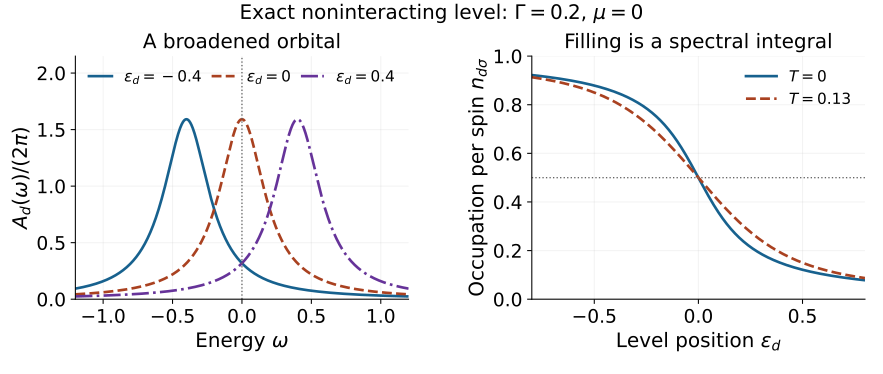
The exact noninteracting broad-band model with . Left: spectra for three orbital energies; the dotted line marks the Fermi energy. Right: occupation per spin, obtained by integrating the spectrum against the Fermi function. Hybridization already smooths the zero-temperature occupation; finite temperature adds further smoothing.
The companion also diagonalizes finite one-particle star Hamiltonians, without imposing a Lorentzian. For , , and , the continuum finite-band occupation is per spin. Its two outside-band poles carry weights approximately and . Increasing the number of midpoint bath modes from 32 to 512 reduces the occupation error from to , with quadratic convergence in the bath spacing. The continuum spectral integral, including the poles, is normalized to within . These tests check this specified finite band; they do not turn a finite bath into an interacting impurity solver.
Read the scattering phase continuously
For the active bath channel, the on-shell scattering amplitude is . In the broad-band model,
Fix the phase branch by following the level continuously from an empty orbital. At the Fermi energy,
At resonance and scattering is maximal, even though the model is noninteracting. This elementary Friedel relation will become a stringent constraint on the screened interacting impurity. For energy-dependent hybridization, the general counting statement involves the total displaced charge, including the bath, rather than the orbital occupation alone. The wide-band phase-shift formulation and its interacting continuation are developed in Mora et al., version 2, §II.C, Eqs. (21)–(23) (PDF).
Separate charge motion from spin motion
Restore . In the atomic limit , the empty, singly occupied and doubly occupied states have energies
The singly occupied doublet is lowest when . Starting from that doublet, removing or adding an electron costs
When both costs greatly exceed and , charge fluctuations are rare while the two spin orientations remain nearly degenerate. In the intermediate window above the eventual screening scale, a field coupled as gives the approximately free-spin susceptibility . This identifies a local moment, not a permanently broken spin symmetry.
If either charge gap becomes comparable to , the corresponding charge state participates at low energy: this is the mixed-valence regime. An almost empty or almost doubly occupied orbital is different again. The noninteracting Lorentzian cannot be used as the full interacting spectral function in these regimes. In particular, the low-temperature Kondo resonance is a collective many-body feature, accompanied by charge-excitation structure on much larger energy scales.
The next step is to eliminate virtual charge states, keeping the surviving spin and its interaction with the metal.
Summary
The resonant level is exactly solvable because the bath and orbital are quadratic. Its hybridization kernel determines the spectrum, occupation and scattering phase, with bound-state weight retained for a finite band. Repulsion creates a different low-energy problem when both charge gaps are large: a nearly fixed orbital charge with a fluctuating spin.
The executable calculations are in examples/condensed-matter/quantum-impurities/local-moment/.
Exercises
1. A resonance is compressible
At zero temperature, couple a static source as . Find the total charge susceptibility of the broad-band noninteracting level. Compare its symmetric-point value with the spin susceptibility for a source , where .
Solution
The charge source shifts to for both spins. Differentiating the occupation gives
The spin source shifts the up and down levels by and . Taking the difference of their occupations and dividing by two gives
At resonance these are and . They stay finite as at fixed width, unlike a free local moment's Curie law. Both are positive physical static responses; the site's commutator retarded correlator for these source signs is their negative in the static limit.
2. Recover the weight of an outside-band pole
For a simple real root of outside a compact bath band, derive its impurity weight. Explain why one must include it in the occupation even though .
Solution
Expand the inverse resolvent at the root:
Outside the band,
so . The spectral measure contains and contributes to the occupation. A vanishing continuum width means that the bound state cannot decay into bath states at its energy; it does not mean that the state has zero impurity amplitude. For the flat band,
References
- C. Mora, C. P. Moca, J. von Delft and G. Zaránd, “Fermi-liquid theory for the single-impurity Anderson model,” Physical Review B 92, 075120 (2015), DOI. Inspected version 2 (PDF), §II.C, Eqs. (21)–(23), for the wide-band Friedel relation and susceptibility definitions; §IV.B discusses the noninteracting conductance limit. Their width is our .
Scrollable formula. Use Left and Right arrow keys to reveal hidden content.
Scrollable table. Use Left and Right arrow keys to reveal hidden columns.
Scrollable figure. Use Left and Right arrow keys to reveal hidden content.