Wilson Chains and Numerical Renormalization Group
How can a calculation retain a few hundred states and resolve an impurity scale thousands of times smaller than the bandwidth? The useful step is to change the bath before truncating its many-body Hilbert space. A logarithmic energy mesh becomes a chain whose successive bonds decrease exponentially. Adding a site then resolves a lower energy scale, while many previously resolved excitations become expensive.
We construct that chain, implement the truncation, and test occupation, entropy and heat capacity against an exactly solvable resonant level. We then calculate the level flow of the interacting one-channel Kondo model. The free benchmark is essential: a visually smooth flow can coexist with appreciable errors in thermodynamics.
Preparation: Use fermionic Fock states and matrix diagonalization. Resonant levels supply the quadratic benchmark; the Kondo renormalization group explains why weak exchange eventually becomes insufficient. We use and chemical potential zero.
A normalized bath and two impurity problems
Let annihilate an energy-normalized bath orbital, with
The local density of states per spin is flat and normalized to one orbital:
This normalization fixes the meaning of the coupling. The resonant-level Hamiltonian is
Here and have energy units. For , the local bath resolvent is
The logarithm is the analytic branch supplied by the integral: inside the band its upper boundary value has negative imaginary part. Thus is the imaginary part's magnitude in . It is a width, not an extra spin sum. The two spin sectors are independent; our resonant-level results are per spin. Double the impurity entropy and heat capacity for the balanced spinful level.
The second model replaces the impurity orbital by a spin one-half:
One spinful bath is one screening channel. Up and down are its two spin components, not two channels. With one electron on site zero, addition of two spins gives a singlet of energy and a triplet of energy . Empty or doubly occupied site zero has zero exchange energy. These eight initial states fix every exchange factor in the numerical calculation.
From logarithmic intervals to a chain
Choose . The positive intervals and their negative partners are
On each interval retain the normalized constant wavefunction. Define its annihilator by integrating over the interval and dividing by the square root of its width. Its local weight and representative energy are
Consequently the retained bath is a star: independent levels coupled to the same impurity through
The constant orbital is the only interval orbital that couples directly to a constant local hybridization. Nevertheless, the original bath Hamiltonian mixes it with nonconstant orbitals within the interval. Dropping those orbitals is the discretization approximation. The later star-to-chain change of basis introduces no further approximation to this discretized bath. See Bulla, Costi and Pruschke, §II.B, Eqs. (13)–(20), for this distinction.
Let be the diagonal star matrix. Starting from its normalized vector , Lanczos orthogonalization gives
Set and omit the previous-vector term at the first step. Reflection symmetry makes every zero. The chain Hamiltonian becomes
For these particular intervals and representative energies, the exact infinite-star coefficients are
This is the flat-band result in Bulla et al., Eq. (32), with bandwidth restored. It has two instructive limits. At large site index,
At fixed site index as the mesh becomes continuous,
The second expression is the recurrence coefficient for a uniform measure's orthogonal polynomials. Its bonds approach a constant instead of decreasing. This exposes the computational tradeoff: taking the continuum limit removes the scale separation that made an aggressive many-body truncation useful.
The companion constructs an 80-bin-per-side star and orthogonalizes it with two reorthogonalization passes. For the first 22 chain sites at , it checks orthogonality, tridiagonality and agreement with the formula above. Subsequent iterations use the analytic coefficients, avoiding loss of orthogonality on a very long chain. Chain index denotes an energy hierarchy; it is not a physical one-dimensional lattice spacing.
What is retained at each iteration?
Let contain the impurity and bath sites zero through . Define
Its dimensionless excitation energies remain of order one as the physical scale decreases. Before resetting the new ground energy, one iteration is
The algorithm performs four operations:
- Tensor the retained eigenstates with the new site's local Fock states: two for a spinless level, four for a spinful bath.
- Diagonalize in sectors of particle number and spin projection. The Kondo calculation labels states by total charge relative to half filling and by twice the total spin projection.
- Keep the lowest states, including every state tied at the cutoff. Project the edge fermions and any measured local operator into this retained basis.
- Add the next site and repeat.
Our implementation preserves complete energy degeneracies within numerical tolerance; is a target, so the actual retained number can be slightly larger. It uses charge and spin-projection blocks rather than a spin-multiplet implementation.
Fermion signs survive the change of basis. If , the new annihilator on the tensor-product space is
Replacing the parity string by an identity generally gives the wrong many-fermion Hamiltonian. A separate three-bath-site Kondo calculation in the full occupation-number basis checks the iterative construction's lowest 16 energies without truncation. The dimensionless error is below .
For a retained eigenvector matrix , an operator transforms as
when projected and then enlarged. Carrying this way is necessary to calculate the level occupation. A low-energy spectrum alone does not determine that local observable.
Scale separation motivates discarding expensive states, but it supplies no universal error bound at a fixed . Virtual excursions through discarded states affect later eigenvectors and energies. A small discarded Boltzmann weight at the current step therefore does not establish that previous truncations were harmless. Our tests vary and compare with an independently solvable model.
Temperature and an exact thermodynamic benchmark
For the elementary single-shell estimator, assign
Here is a specified positive number, not a fitted physical constant. We use unless stated otherwise. At each step evaluate the thermal trace over all states obtained before that step's truncation; earlier truncations remain. If are the dimensionless excitation energies, then
Subtract the entropy or heat capacity of the same finite bath chain without the impurity, at the same temperature. The result is an impurity contribution, not the impurity's reduced-density-matrix entanglement entropy. Ground-energy offsets cancel from these formulas. For occupation, take the thermal average of the transformed local number operator. This construction follows the single-shell method in Bulla et al., §III.A, Eqs. (45)–(57); it is not a full-density-matrix NRG calculation. Summing ordinary partition functions from all iterations would count the same degrees of freedom repeatedly.
For the resonant level, an independent calculation diagonalizes only the one-particle matrix of the entire finite chain. Write its eigenvalues as , its impurity components as , and the bath-only eigenvalues as . With ,
Define the contribution from one fermionic orbital by
Then the exact quadratic reference is
No many-body state truncation enters these sums. They test the iterative method against the identical regulated problem, including its finite chain endpoint.
Take , and . The following are maximum absolute errors against the identical finite chain over all sampled shells, starting at site zero and ending when the assigned temperature first falls below .
| Mesh | State target | Occupation error | Entropy error | Heat-capacity error |
|---|---|---|---|---|
| 32 | ||||
| 64 | ||||
| 128 | ||||
| 128 |
The finer mesh is worse at the same retained-state count because adjacent shells are less separated. Increasing its retained space to 1024 reduces the maximum entropy error to about and the heat-capacity error to . Heat capacity weights squared excitation energies, so missing high states matter more than they do for entropy. Check the occupation separately as the cutoff increases.
Discretization and finite-chain errors remain
First isolate the logarithmic mesh by doing the untruncated quadratic calculation at one common temperature, . The reference column uses Gauss–Legendre quadrature of the original flat continuum measure, rather than logarithmic intervals. Increasing its order from 512 to 1024 changes each reported quantity by less than .
| Bath discretization | |||
|---|---|---|---|
| 0.17794583 | 0.17244561 | 0.20567738 | |
| 0.18341654 | 0.16982062 | 0.20634620 | |
| 0.18597083 | 0.16933645 | 0.20391910 | |
| 0.18706153 | 0.16911223 | 0.20289327 | |
| Flat-continuum quadrature | 0.18734090 | 0.16905325 | 0.20263027 |
These results use the stated interval-average rule without an additional hybridization correction or averaging over displaced meshes. They demonstrate a mesh trend for this quadratic problem. They do not turn the interacting calculation at one mesh into a continuum solution.
Next isolate the chain endpoint. At , site 14 has scale . Comparing exact 15-site and 80-site bath calculations gives the entropy differences
At a lower temperature the chain resolves its endpoint and even–odd structure. At a higher temperature that endpoint matters less, but more high-energy many-body states contribute to the thermal trace. Increasing without increasing the retained space can therefore exchange one error for another. The companion records both comparisons.
Spectral broadening is a fourth, separate choice. A finite chain has discrete transition energies. Replacing their delta functions by smooth peaks may help display a spectral function, but does not add missing states or improve a thermodynamic trace. No broadened spectrum is used in these checks. Averaging displaced logarithmic meshes can reduce mesh oscillations; it likewise does not replace retained-state convergence.
The calculated Kondo level flow
We now keep the spinful chain and its exchange interaction. At every iteration classify levels by
Here counts bath electrons; the impurity is a spin, not an additional charged orbital. Compare only even in the plotted flow. Neighboring parity sectors have different finite-chain level patterns, so mixing them would create a misleading oscillatory “flow.”
The strong-coupling reference can be derived rather than named. When is much larger than the hopping to site one, the impurity and a site-zero electron form the exchange singlet. Within this singlet subspace a single hopping event leaves the subspace and has no first-order matrix element. At infinite , sites one through are therefore an ordinary open free chain. Corrections from virtual singlet breaking vanish with inverse exchange. Diagonalizing that remaining one-particle chain gives the candidate low-energy fixed-point spectrum.
For even , let be its lowest positive one-particle energy in units of . Adding one up electron gives the sector at energy . A particle–hole spin excitation gives at . Adding up and down electrons gives at the same . This is a concrete many-body reference against which to compare the interacting spectrum.
At , , and retained-state target 768, the calculated dimensionless gaps are:
| Last bath site | One-electron sector | Spin sector | Free-chain reference |
|---|---|---|---|
| 16 | 0.54160892 | 0.79831632 | 0.92797074 |
| 24 | 0.84560237 | 1.54445606 | 0.92709340 |
| 32 | 0.92093491 | 1.82982623 | 0.92703885 |
| 40 | 0.92664914 | 1.85253624 | 0.92703544 |
Both interacting gaps approach the independently calculated screened-chain pattern. They are still slightly displaced at the last shell: a finite stopping point is not an exact fixed point. At site 24, raising the retained-state target from 192 to 384 to 768 changes the one-electron gap from 0.847083 to 0.845619 to 0.845602. Thus the crossover can be noticeably more sensitive to truncation than the final low-energy pattern.
A second run at approaches its own screened-chain spectrum. Its dimensionless fixed-point gaps differ because our energy rescaling and logarithmic bath differ. Reducing the exchange to at shifts the crossover to later iterations, hence smaller physical energy. These are actual interacting diagonalizations; the running exchange has not been inserted into a free spectrum. We do not extract a convention-independent Kondo temperature from an arbitrarily chosen gap crossing.
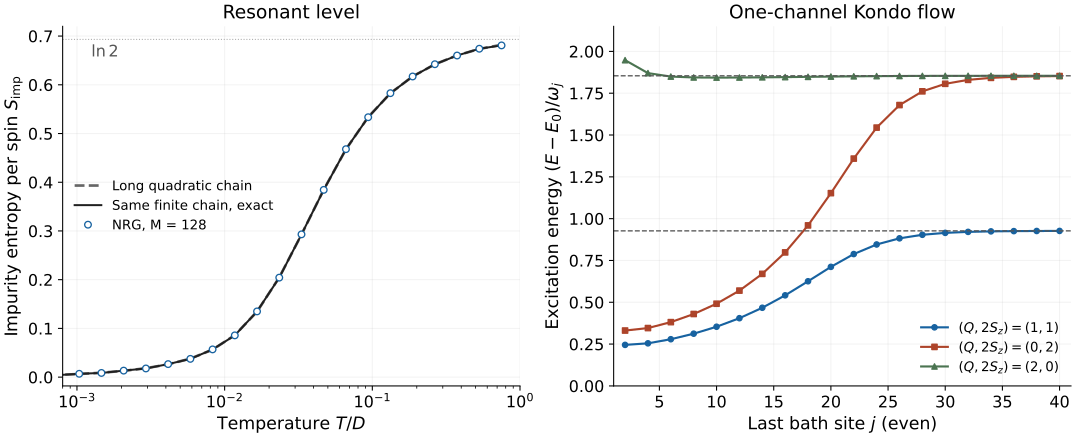
Left: per-spin resonant-level entropy at , and . The finite-shell reference separates truncation error from the longer-chain result.
Right: even-site Kondo flow at , , retaining 768 states at each step, with ties included. Dashed lines are the independently calculated late-shell screened-chain gaps; energies are measured in units of .
The level flow resolves the failure of weak-coupling perturbation theory by following the full retained Hamiltonian. Its interpretation requires the strong-coupling comparison, symmetry labels and convergence tests, not merely an eventual plateau. Quantitative continuum Kondo thermodynamics would additionally require mesh control, a suitable temperature estimator and observable-specific convergence beyond the bounded level-flow calculation here.
Summary
A logarithmic bath representation creates decreasing chain hoppings and makes iterative low-energy truncation practical. The resonant level tests both the projected local operator and thermal traces against an independent free-fermion solution. Its results show why bath discretization, retained states and the relation between chain length and temperature must be varied separately. The interacting Kondo example then connects a calculated flow to a singlet plus a free remaining chain.
The complete implementation and selected outputs are in examples/condensed-matter/quantum-impurities/wilson-chain/. They include the star construction, full-Fock-space sign check, quadratic continuum comparison, retained-state refinements, temperature comparison and both Kondo discretizations. The next article develops screening and the impurity Fermi liquid.
Exercises
1. The first bond and the continuum limit
Starting from the logarithmic weights, calculate the first chain hopping without using the closed formula for all hoppings. Then recover the uniform-continuum value and explain why a normalized finite star must track its omitted tail.
Solution
Reflection symmetry gives , so the first residual is . Its squared norm is the local second moment:
As the mesh approaches one, this becomes , exactly the integral of against the normalized flat measure. With only intervals on each side, the retained weights sum to
Renormalizing that finite vector restores its norm but slightly changes the model's retained weights. It is harmless only after the omitted weight and the affected moments are controlled. Alternatively, keep an explicit tail representation. Normalization alone cannot certify a faithful bath.
2. A false low-temperature impurity entropy
Set the resonant level at particle–hole symmetry and keep a finite symmetric chain with nonzero hybridization. What impurity entropy is obtained if temperature is sent to zero before the chain length is increased? Work per spin and distinguish even from odd numbers of bath sites. Why is this not the metallic resonant level's continuum residual entropy?
Solution
A real nearest-neighbor chain with zero onsite energies has a spectrum symmetric about zero. An odd number of sites supplies one exact zero mode; an even number supplies none. A zero-energy fermionic orbital has two equally weighted occupations and contributes to the grand-canonical entropy, even as temperature tends to zero.
Write for the number of bath sites. If it is even, the bath's zero-temperature entropy is zero. Adding the impurity makes the total chain odd, so
For an odd bath, the bath itself has a zero mode, while the total chain is even. Consequently
A negative difference of entropies is not a negative total thermodynamic entropy. Both answers reflect finite-chain level counting. In the metallic thermodynamic limit, a level of nonzero width has no isolated zero-energy orbital and its impurity entropy tends to zero. The joint NRG limit must keep temperature above the unresolved endpoint scale while retaining the thermally relevant states. This example also explains why an even–odd pattern cannot be removed simply by declaring the last iteration to be zero temperature.
References
- R. Bulla, T. A. Costi and T. Pruschke, Numerical renormalization group method for quantum impurity systems, Reviews of Modern Physics 80, 395–450 (2008), cond-mat/0701105v1 (PDF). Inspected version: §II.B, Eqs. (13)–(20), for the interval approximation; §II.C, Eqs. (26)–(33), for the chain and flat-band coefficients; §§II.D–E, Eqs. (34)–(43) and Fig. 4, for truncation and parity-resolved flow; §III.A, Eqs. (45)–(59), for thermal assignment, subtraction and local observables. Our energy scale includes an explicit bandwidth and hopping prefactor, and our resonant-level thermodynamics is per spin.
Scrollable formula. Use Left and Right arrow keys to reveal hidden content.
Scrollable table. Use Left and Right arrow keys to reveal hidden columns.
Scrollable figure. Use Left and Right arrow keys to reveal hidden content.