Interactions in Disordered Metals
A metal can have a finite compressibility and a finite conductivity while its tunneling spectrum develops a pronounced depression near the chemical potential. Diffusion makes this possible: an added electron repeatedly interacts with a slowly relaxing density disturbance. The resulting Altshuler–Aronov anomaly is a correction to the probability of adding an electron, not a single-particle band gap.
We calculate the leading Coulomb tunneling anomaly in a two-dimensional, spinless diffusive metal. Dynamic screening produces two logarithms. A finite-temperature integral resolves the rounded zero-bias feature and distinguishes the density of states from the conductance of an ideal weak tunnel probe. Exchange, Hartree terms and the limits of the approximation are kept separate.
Preparation: Scaling Theory and the Nonlinear Sigma Model fixes the disorder and conductance normalization. Density Response and Screening explains self-consistent screening, while Spectroscopy and Response in Quantum Matter distinguishes a spectral function from a measured signal.
One species, three observables
Set . The electronic band is parabolic and has one spinless species, with a weak short-range random potential. Use
Here is both the one-species noninteracting density of states per area per energy and the bare compressibility. No factor two for spin is implicit. We assume and external energies and temperature much smaller than . A uniform neutralizing background removes the zero-momentum Coulomb energy.
Let the electron Green function evolve with , so its energy argument is measured from the chemical potential. The disorder-averaged tunneling density of states is
This uses the fermionic anticommutator propagator; it is the integral of when . In an interacting system it is not the same observable as the thermodynamic derivative . Conductivity has additional current vertices and contact terms. Replacing the compressibility in an Einstein relation by a tunneling DOS, or reading a transport lifetime from its suppression, is not justified.
Screening by a diffusive density
For a potential-energy source , the bare diffusive response has the site's retarded sign:
The bare repulsive Coulomb kernel for a two-dimensional sheet embedded in a dielectric is
The dielectric convention is defined by this equation. Using the bare diffusive polarization in the resummed Coulomb line is a leading weak-interaction, high-density approximation, with in addition to . Short-distance Fermi-liquid vertex corrections affect the matching and single-log terms. Summing the induced potential gives
For positive frequency its imaginary part is negative, as required for a passive screened potential in this convention. At zero frequency it is the positive screened repulsion . Taking this static limit before evaluating the quantum correction would lose the extra Coulomb logarithm.
The two rates are distinct: density diffuses at , whereas Coulomb relaxation at long wavelength occurs at approximately . The interval between them will supply the second logarithm. This screening construction can be compared with Kamenev and Levchenko, arXiv:0901.3586v3, §7.4, Eqs. (250)–(253) (PDF). Their phase-field propagator is ; it is not the screened potential itself.
The exchange insertion and its thermal window
Start with the exchange self-energy insertion in the local electron Green function. A slow density vertex is dressed by an impurity ladder. Each of the two vertices contributes a factor proportional to . One useful microscopic radial integral, with retarded and advanced elastic widths, is
The elastic times cancel those of the ladders. Combining the retarded and advanced insertions, the equilibrium Fermi factors and the DOS prefactor yields
The subscript identifies the exchange, or Fock, contribution. The frequency integral has a sharp matching cutoff and a momentum cutoff . It is a specified diffusive effective calculation; constants and single-log terms can depend on how ballistic physics is matched there.
The thermal factors are important. At zero temperature, . At zero energy and finite temperature, , which cuts off the low-frequency divergence smoothly. The same formula follows by expanding the fluctuating-potential phase factor in Kamenev and Levchenko, §7.6.1, Eqs. (283)–(288) to first order. Their negative phase propagator gives the suppression sign; the positive-frequency measure in Eq. (288) is . The factor in their field-correlator definition, Eq. (250), is already included in Eq. (253a) and must not be inserted again.
For the screened kernel the angular integral is immediate, leaving an explicit numerical quadrature:
Its dimension is inverse energy, so the DOS correction is dimensionless. This integral, not a phenomenological logarithmic fit, generates the numerical results below.
Where the double logarithm comes from
Assume and . The interval
has . In that interval the imaginary part of the momentum integrand is proportional to . Explicitly,
The remaining zero-temperature frequency integral supplies another logarithm. With ,
The square in matters. It results from the upper and lower endpoints of an integral of , not from treating the screening scale as a second independent frequency cutoff. For finite temperature, replacing by an order-one multiple of preserves double-logarithmic accuracy; it does not reproduce the rounded curve or fix its single-log terms.
This agrees with the expansion of Kamenev and Andreev, arXiv:cond-mat/9810191v1, §IV.A, Eqs. (81)–(82) (PDF), also reviewed in Kamenev and Levchenko, Eq. (290). Both use conductance . The original paper suppresses Cooperons with a weak magnetic field; this leading density-channel anomaly does not require the time-reversed interference mode. We use only the perturbative term. A large negative correction is a failure of this expansion, not evidence that the DOS has become negative or that a hard gap has opened.
Hartree terms and the contact counterexample
The leading double logarithm is also the leading total anomaly in the stated long-range Coulomb regime. This does not mean that the exchange integral is the complete correction at the accuracy of every displayed decimal. The direct, Hartree diagrams probe a static screened interaction averaged over Fermi-surface momentum transfers. Their interaction momentum is not locked to the small momentum of the diffusion pole. They therefore have the usual return-probability logarithm but not the additional interval between and . They contribute single-log terms, together with matching and other interaction-channel corrections.
This distinction is explained in Lee and Ramakrishnan, §§III.B.3–III.C, pp. 306–307 (PDF). Their displayed spin sums should not be copied into a one-species calculation.
There is a sharp negative test. For identical spinless fermions, a normal-ordered local interaction is identically zero:
In a regulated lattice description this says . Its Hartree and Fock contributions cancel, even in a disordered eigenbasis. The exchange integral alone with a constant would give a nonzero answer; calling that the full spinless contact correction would be wrong. Opposite-spin contact interactions, finite-range interactions and the long-range Coulomb model have different antisymmetrized matrix elements.
Temperature dependence and a finite-cutoff calculation
For a reproducible example measure frequency in and length in . Choose
One parabolic-band realization has , and , so the elastic weak-disorder parameter is large and . This is a finite illustrative parameter choice, not an asymptotic extrapolation to vanishing interaction strength. The chosen matching length is ; the mean free path is larger by . The finite-cutoff result is the exchange integral defined above, with no fitted amplitudes:
| Leading log at | |||
|---|---|---|---|
Cooling deepens the depression; increasing the tunneling energy rounds it away. The mismatch with the last column is expected: a sharp infrared cutoff is only a logarithmic approximation. At the lowest temperature the correction is already nearly 20%; higher-order and omitted single-log effects limit physical accuracy even though the integral is numerically well resolved.
The figure separates the intrinsic DOS correction from the further thermal averaging of an ideal tunnel measurement.
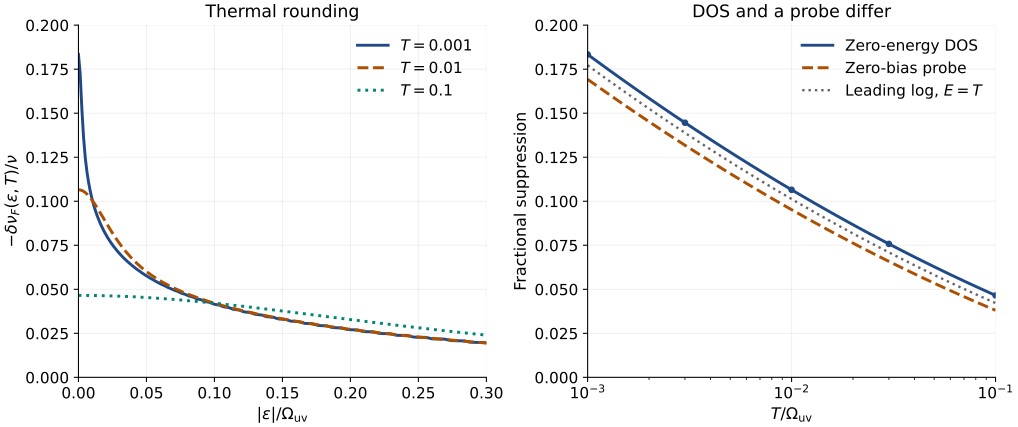
Dynamically screened Coulomb exchange for the parameters above. Left: the finite-temperature DOS depression narrows as the temperature decreases. Right: zero-energy DOS, ideal zero-bias tunnel conductance, and the sharp-cutoff double logarithm differ by terms beyond the leading logarithmic approximation. The tunneling curves assume a weak probe that does not alter screening on the lengths sampled here; a nearby metallic plane can change that assumption.
The companion in examples/condensed-matter/disorder-localization/diffusive-field-theory/ integrates logarithmic momentum and frequency variables with separate node and lower-endpoint checks. At , 96 through 512 quadrature nodes change the DOS ratio by less than ; extending the low-frequency and low-momentum integration ranges changes it by less than . Adaptive one-dimensional momentum integration independently agrees with the Gaussian quadrature over four frequencies. These checks establish numerical accuracy for the declared integral, not the size of discarded physical terms.
Why dimension and screening geometry matter
For a short-range exchange insertion, the general momentum integral is
Consequently the infrared energy integral has a power divergence in one dimension, a logarithm in two, and a finite three-dimensional zero-energy value with a square-root energy cusp. These powers characterize the diffusive exchange kernel. A physical short-range correction requires its direct and exchange channels together; in particular the spinless contact example still cancels exactly. The companion checks this dimension-dependent integral by direct radial quadrature in dimensions one, two and three.
Long-range two-dimensional Coulomb screening supplies the extra logarithm just derived. A metallic plane a distance away changes the bare interaction to
For it approaches a constant, so the second logarithm stops growing. This geometric cutoff, finite sample size, temperature, and failure of metallic perturbation theory are distinct limitations. The calculation also assumes no competing superconducting or magnetic instability and no additional spin or valley channels. A full interaction/disorder flow must evolve the density vertices, frequency coefficient and conductance consistently; the noninteracting beta function alone cannot do that.
Summary
Dynamic screening and diffusive density vertices yield a calculable Coulomb suppression of the tunneling DOS. The leading two-dimensional result is a negative double logarithm with coefficient fixed by the one-species conductance. Finite-temperature quadrature resolves its rounding, while Hartree terms and matching corrections remain relevant at single-log order. The DOS, compressibility, bulk conductivity and tunnel conductance are different observables, and the exact spinless contact cancellation is a useful guard against confusing them.
Exercises
- The measured zero-bias conductance. A weak local tunnel probe has an energy-independent DOS and matrix element. Assume it does not change the sample's screening in the relevant momentum window. At equilibrium temperature its normalized differential conductance is
Find the frequency window replacing at zero bias. Compare it with the window for the sample DOS at zero energy, and calculate the exchange conductance correction at for the benchmark.
Solution
Because is even and normalized, averaging the two terms in gives the same result. Set and :
To evaluate the integral, substitute and use the hyperbolic tangent subtraction formula. Near zero it is , whereas the intrinsic zero-energy window is . Both tend to one at high frequency. Thus thermal measurement averaging suppresses the low-frequency anomaly further.
Inserting in the same momentum/frequency integral gives
compared with
The companion verifies the closed window against direct energy integration. Neither number is a bulk conductivity correction, and both retain the exchange-only, finite-cutoff scope.
- Antisymmetrization before disorder averaging. Show that a spinless contact interaction vanishes in any one-particle basis, including a disordered eigenbasis. Explain why the general-dimensional exchange kernel above does not contradict this statement.
Solution
Let be arbitrary orbitals. The contact matrix element between antisymmetric two-particle states contains
The direct and exchange factors coincide point by point, before averaging over disorder or evaluating a diffusion pole. On a finite lattice the same result follows from and . Keeping only Fock terms would discard the equal and opposite direct contribution. A real short-range model can have nonzero matrix elements if the particles have different spin labels or the interaction has spatial range; those changes must be made explicitly before using its singular correction. The Coulomb kernel in the main calculation is nonlocal and dynamically screened, so this contact cancellation does not remove its leading anomaly.
References
- A. Kamenev and A. Andreev, “Electron-Electron Interactions in Disordered Metals: Keldysh Formalism,” arXiv:cond-mat/9810191v1 (PDF), §IV.A, Eqs. (78)–(82), p. 10: finite-temperature DOS, screened phase fluctuations and the leading double logarithm. Their differs from our sheet conductance by , and their unitary setting excludes the Cooperon correction.
- A. Kamenev and A. Levchenko, “Keldysh Technique and Non-Linear Sigma-Model: Basic Principles and Applications,” arXiv:0901.3586v3 (PDF), §7.4, Eqs. (250)–(253), and §7.6.1, Eqs. (283)–(290): screened phase propagator, DOS and leading Coulomb anomaly. Their conductance is , and their phase propagator differs from our screened potential as specified above.
- P. A. Lee and T. V. Ramakrishnan, “Disordered Electronic Systems,” Reviews of Modern Physics 57, 287–337 (1985), PDF, §§III.B.3–III.C, pp. 306–307, especially Eqs. (3.35)–(3.38): Hartree cancellation, dimensional dependence and the screening-plane limitation. Their spinful convention is not used for our one-species prefactor.
Scrollable formula. Use Left and Right arrow keys to reveal hidden content.
Scrollable table. Use Left and Right arrow keys to reveal hidden columns.
Scrollable figure. Use Left and Right arrow keys to reveal hidden content.