Doping a Mott Insulator
Removing an electron from a large-repulsion Hubbard system creates an empty site that can move without paying the interaction energy. The low-energy theory therefore contains hopping at first order, exchange at second order, and another second-order process in which a particle crosses two bonds through a virtual doubly occupied site. Dropping this last contribution changes the approximation at the very order used to derive exchange.
We derive all three terms and test them on an open three-site chain with two particles. This genuinely doped cluster is small enough to solve exactly. It distinguishes controlled elimination of charge excitations from the separate problem of finding a phase of a macroscopic doped system.
Preparation: Use the projection and fermionic signs in superexchange, and the charge-sector distinctions in the Hubbard dimer. We use .
Holes restore motion inside the low-energy space
Take the repulsive Hubbard Hamiltonian
Hopping is real, each undirected bond is counted once, and .
The hole fraction is . We consider energies well below the cost of a real doubly occupied site, at small hopping compared with .
Let project onto configurations without double occupation. At half filling, hopping cannot connect two states in . With holes, an electron can hop onto an empty neighbor, and is nonzero. Define constrained fermion operators
Within the projected space they annihilate an electron without permitting a doubly occupied endpoint. Their local anticommutator is not that of an unconstrained canonical fermion:
Consequently, replacing constrained hopping by a free band and merely changing its filling would discard part of the problem. The projected space retains spin and hole constraints even in the limit of very large repulsion.
Retain every second-order process
Decompose hopping according to the change in double occupation, as in the superexchange derivation. The result through second order is
Here and below the remainder denotes the hopping expansion on a fixed finite cluster; is a characteristic bond amplitude. The first term is
The second term can be resolved by the path of the two hops. If both use the same bond, the result is
If the first hop creates double occupation at a site , the second can remove it by filling a different hole at a neighboring site . For distinct neighbors and of , define the two possible spin transfers by
The corresponding three-site Hamiltonian is
The first term in transfers the same spin across , conditioned on the opposite spin being present there. The second exchanges which electron leaves the intermediate site; its relative minus sign follows from anticommuting the two fermion operators at that site. The sum is over ordered neighbors. Reversing and , with the spin sum, supplies the Hermitian conjugate; no extra conjugate term or factor two is to be added.
Thus the complete answer at this order is
One can verify the formula without relying on the interpretation of individual paths: construct the hopping matrix between the no-double-occupation states and the one-double-occupation states, multiply , and compare every entry with . The companion performs precisely that comparison, including unequal hoppings and both open and triangular three-site geometries.
At half filling, vanishes because its distinct endpoint requires a hole. Away from half filling it is of the same order as exchange. Arovas et al., §5.2, Eq. (21) write these processes as projected hopping, exchange and singlet-pair transfer. Here we reserve “the – truncation” for , with deliberately omitted. Terminology varies, so the displayed Hamiltonian specifies the approximation.
A one-hole chain exposes the missing matrix element
Consider three sites with bonds – and –, both of strength , at . The hole fraction is . There are 15 states in the full fixed-number Hilbert space and 12 without double occupation. The latter contain three singlets and nine triplet states.
For , define
In the singlet basis , projected nearest-neighbor hopping connects the first state to the second, and the second to the third, with amplitude . Exchange shifts each adjacent singlet by and leaves the separated pair unchanged. Finally, two virtual paths through the central site add to a matrix element between the two adjacent singlets. The full second-order matrix is
The – truncation sets its two corner entries to zero. These are physically different spectra, even though both models have the same projected nearest-neighbor hopping and exchange constant.
The antisymmetric combination of the two adjacent singlets is an eigenstate. Diagonalizing the remaining two-dimensional block gives the three full projected singlet energies
Without the three-site term they become
Every triplet has an antisymmetric spatial wavefunction and hence zero amplitude for on-site double occupation. Its three spatial energies are exactly
each with three spin projections. These triplet energies are the same in the full Hubbard model and both projected models. The singlet sector is therefore a targeted test of the virtual processes, rather than a comparison dominated by unaffected states.
Test the order of the approximation
The numerical comparison fixes , diagonalizes the complete 15-state Hubbard matrix, and compares its lowest 12 ordered eigenvalues with the two projected spectra. Define the error by
Selected results are
| Full second order: | Without : | |
|---|---|---|
As hopping decreases, the full error approaches cubic scaling, while omitting the three-site term leaves a quadratic error. In particular, the antisymmetric singlet is shifted incorrectly by already within second order. Decreasing hopping makes both errors small in absolute energy, but only the full Hamiltonian reproduces the Hubbard coefficients through that order.
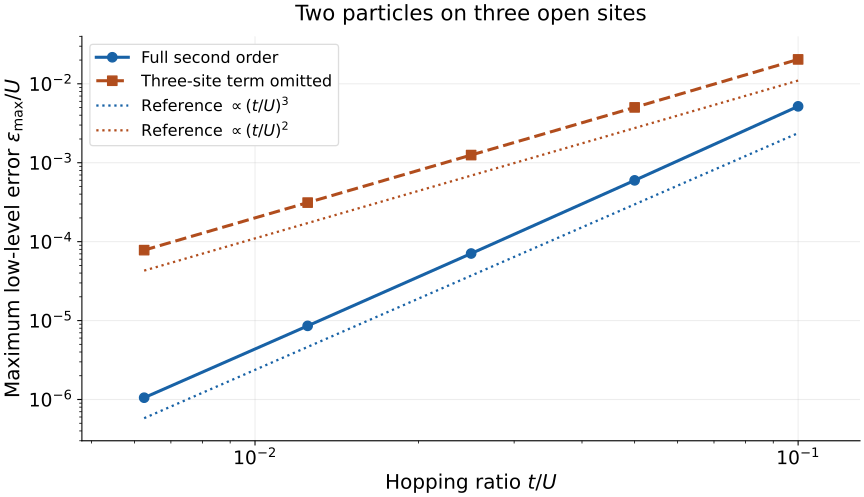
The open three-site chain at two particles, with . Points come from exact finite-matrix diagonalization; connecting lines guide the eye. The dotted lines show reference powers with arbitrary vertical offsets, not fitted continuum limits.
Several checks distinguish this result from re-evaluating one analytic formula. The full Fock-space construction supplies the exact spectrum. A separate constrained-fermion construction of exchange and three-site hopping agrees entry by entry with the virtual-state matrix product. The singlet/triplet decomposition above independently supplies all 12 projected eigenvalues. The program then measures convergence toward the exact low levels as decreases.
This is a hopping-order test at fixed cluster size and fixed hole number. It establishes neither a thermodynamic limit nor a finite-density phase diagram. The projected eigenvectors also live in rotated coordinates: a physical electron or current operator must undergo the same transformation as the Hamiltonian before spectral weights or response functions are compared.
What the effective Hamiltonian leaves to solve
For the Hubbard-derived parameters, the ratio of exchange to hopping is
Thus increasing repulsion does not suppress the allowed hole motion relative to spin exchange; it makes exchange slow compared with that motion. The resulting constrained many-body problem can remain difficult even though eliminating real double occupation is controlled.
The – Hamiltonian is also a useful model in its own right, with specified parameters and approximations. Its identification with the Hubbard model through second order, however, requires the three-site contribution unless an additional hierarchy or an observable-specific argument removes it. A proposed ordered state, paired state or unusual metal must then be tested within the stated model and thermodynamic regime. None follows from the projection alone, and a bound or low-lying level on one small cluster is insufficient to establish one.
Summary
Doping activates first-order constrained hopping and second-order transfer across distinct bonds. Retaining exchange while dropping that transfer changes the Hubbard expansion at second order. The one-hole chain makes the difference explicit in a single singlet matrix element and in the measured convergence of all low levels. Reproducible matrices, selected spectra and the figure generator are in examples/condensed-matter/correlated-fermions/hubbard-projection/.
Exercises
Identify the leading error of the truncated model
Using the displayed singlet matrices, derive the lowest energies of the full second-order and – Hamiltonians through cubic order in . Why does their leading difference survive even if their ground-state vectors become close as decreases?
Solution
The antisymmetric adjacent-pair combination decouples. The symmetric combination mixes with the separated pair with amplitude . Its diagonal energy is in the full model and in the truncated one, yielding the square roots stated above. Expanding them gives
Their difference begins at , the expectation of the omitted operator in the leading hopping ground state. In the stated singlet basis that normalized state has components , so the two corner entries contribute . Both ground-state vectors approach this same vector, but their energy corrections differ at the order one is trying to calculate.
The cubic coefficients above belong to exact diagonalization of the two truncated Hamiltonians. They are not the full third-order Hubbard coefficients: an additional third-order effective operator is needed for that accuracy.
Use a fully polarized control
Put two spin-up particles on the same open three-site Hubbard chain. Show directly why the interaction and all virtual-double-occupation corrections vanish. Find its three energies, and explain why this fact does not prove a ferromagnetic ground state for the unrestricted problem.
Solution
Pauli exclusion prevents two spin-up particles from occupying the same site, so annihilates every state in this sector and has no allowed action. In the projected expression, occupied bonds have , while both terms of require the absent opposite spin. Thus separately.
The one-particle open-chain energies are , zero and . Filling two distinct levels gives the three sums , zero and , independent of . Spin rotation generates the other projections of each triplet.
This establishes an exact sector spectrum. It does not compare all spin sectors. Indeed the singlet ground energy is lowered by virtual hopping, as the full matrix and its strong-coupling expansion show. A statement about the global ground state requires that comparison; a statement about a bulk magnetic phase requires substantially more.
References
- D. P. Arovas, E. Berg, S. A. Kivelson and S. Raghu, “The Hubbard Model,” Annual Review of Condensed Matter Physics 13 (2022) 239–274, doi:10.1146/annurev-conmatphys-031620-102024. arXiv:2103.12097v2, §5.2, Eq. (21) and the following discussion: the three-site term and the extra approximation involved in dropping it.
- S. Bravyi, D. P. DiVincenzo and D. Loss, “Schrieffer-Wolff transformation for quantum many-body systems,” Annals of Physics 326 (2011) 2793–2826, doi:10.1016/j.aop.2011.06.004. arXiv:1105.0675v1, §§3.1–3.2: the unitary low-energy projection used here.
Scrollable formula. Use Left and Right arrow keys to reveal hidden content.
Scrollable table. Use Left and Right arrow keys to reveal hidden columns.
Scrollable figure. Use Left and Right arrow keys to reveal hidden content.