Bose Condensation and Long-Range Coherence
A large population in one momentum state can be striking without being a thermodynamic condensate. In a small one-dimensional box at nonzero temperature, more than half the particles can occupy the lowest mode; that fraction can nevertheless vanish as the box grows. The useful question is how the largest eigenvalue of the one-body density matrix scales with particle number.
This article calculates that scaling for ideal periodic boxes in three and one dimensions. It then separates coherence from the current response studied in superfluid stiffness.
Preparation. We use bosonic second quantization, a homogeneous box of volume , and units . Let be the particle mass, the total density, and the single-particle energy. The ideal-gas calculation is at fixed temperature and fixed mean density in the grand canonical ensemble; a fixed-number comparison is included below. Interactions enter in the next article.
Condensation without assigning a phase
Define the integral kernel
It is Hermitian and positive: for every test function , the quadratic form is the expectation of , where . Consequently it has nonnegative eigenvalues and orthonormal natural orbitals:
Order the eigenvalues so that is largest. Bose condensation means that the largest eigenvalue is extensive along a thermodynamic sequence at fixed density and geometry. When the condensate fraction has a limit, this reads
The more general Penrose–Onsager criterion requires extensive scaling with a positive lower bound on the fraction; it does not require convergence to a single constant. It also accommodates an inhomogeneous condensate: the distinguished orbital need not be a plane wave. More than one extensive eigenvalue is called fragmentation. These are statements about a density matrix, not about the choice of a phase for a wavefunction. Penrose and Onsager, §§2–3, Eq. (4) (PDF).
For example, the state with exactly particles in one orbital has , because changes particle number, but it has an eigenvalue .
With , a symmetry-breaking description is a useful thermodynamic construction: introduce a phase-selecting source, take the large-volume limit, and only then remove the source. It must not replace the number-conserving criterion in a finite system.
In a translation-invariant state the natural orbitals are normalized plane waves. Thus
An extensive zero-momentum population contributes the constant . When the remaining momentum distribution has a decaying Fourier transform, taking the thermodynamic limit before the large-separation limit gives . This is off-diagonal long-range order. The eigenvalue definition is more general than this homogeneous special case.
The finite box has a strictly negative chemical potential
Periodic boundary conditions give , with integer components of . For an ideal gas at ,
At every finite , the solution satisfies . The lowest-mode occupation is
Setting before solving this finite sum would make that occupation infinite. Below the bulk condensation temperature, it is instead the sequence of negative chemical potentials that approaches zero while grows extensively.
To find the bulk excited density, replace the nonzero-mode sum by an integral. Expanding the Bose distribution as a sum of exponentials and performing each Gaussian momentum integral yields
where . At , the low-momentum number integral behaves as . It is finite only for .
In three dimensions the excited states therefore have a finite capacity at fixed . Equating that capacity to the density gives
The lowest mode contains the excess particles.
Thus implies . Above , the density equation instead has a strictly negative bulk solution; tends to a finite constant, so its fraction vanishes. These ideal-gas formulas and their infrared restriction are derived in Andersen, §II, Eqs. (14)–(18) (PDF).
A volume sequence, not a single impressive occupation
Set , so that . Directly solving the discrete number equation gives:
| at | at | in 1D at | |
|---|---|---|---|
| 8 | 0.549475 | 13.206412 | 0.538588 |
| 16 | 0.481329 | 13.271532 | 0.276272 |
| 32 | 0.447517 | 13.271586 | 0.138159 |
| 64 | 0.430823 | 13.271586 | 0.069079 |
The first column approaches a nonzero fraction, . The second approaches a finite occupation while the total number grows as . The last column is a different thermodynamic sequence: in one dimension the total number is , and at this temperature the bulk solution is
Thus a fraction greater than one half at gives way to . There is no finite-temperature ideal-gas condensate in this homogeneous one-dimensional thermodynamic limit. This conclusion does not address a trap with a different thermodynamic limit, or the strictly zero-temperature gas.
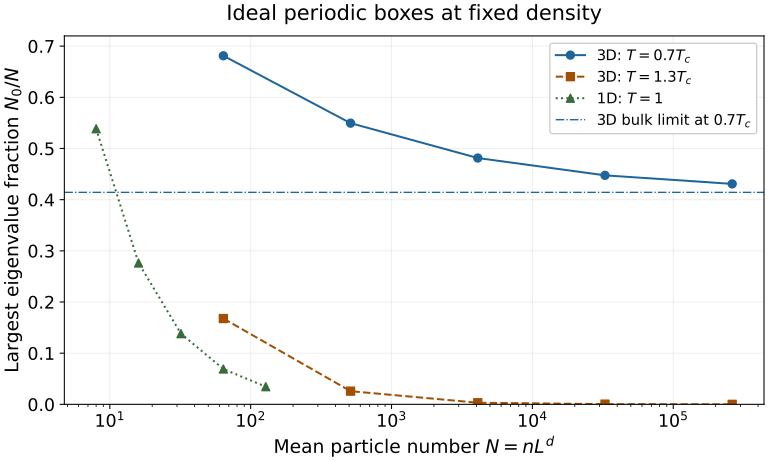
A size sequence distinguishes condensation from a large finite occupation. All curves use ideal periodic boxes with . The three-dimensional temperatures are fixed multiples of the bulk ; the one-dimensional temperature is . Points solve the discrete number equation. The horizontal line is the three-dimensional thermodynamic limit below .
The calculation in examples/condensed-matter/bose-fluids/dilute-gas/ retains integer momentum modes until each face of the momentum cube has energy greater than . Raising that boundary to changes the reported three-dimensional fractions at by less than . The error is in a separate position-grid diagonalization of all occupation eigenvalues, with the integration weight included. These are numerical checks of this ideal model, not estimates of interaction effects.
The grand canonical ensemble is convenient for mean occupations but gives anomalously large condensate-number fluctuations. It is not a faithful model of fluctuations in an isolated fixed-number sample. An independent canonical calculation uses the cycle recurrence
Here the zero-mode energy is zero. For the below- boxes with , the canonical fractions are , , and . They differ from the finite-box grand canonical means and approach the same bulk condensate fraction. No ensemble equivalence for condensate fluctuations has been assumed.
Coherence and flow ask different questions
Condensation measures a one-body occupation. Superfluid stiffness measures the free-energy cost of a phase twist or the appropriate current response. A critical velocity asks whether a moving state can lower its energy by creating excitations or defects. These quantities can be related within a particular theory, but their definitions are different.
The ideal three-dimensional gas at zero temperature illustrates the distinction. It has complete condensation and can have a nonzero equilibrium twist stiffness, yet its quadratic excitation spectrum gives a zero Landau critical velocity. Conversely, a Galilean-invariant interacting gas at zero temperature can have superfluid density equal to the total density while its condensate is depleted. In two dimensions, algebraic coherence and a nonzero stiffness can coexist without a thermodynamic condensate; the two-dimensional gas article specifies that limit.
Summary
The largest one-body eigenvalue is an ensemble-independent definition of what is being measured, although its finite-size value depends on the ensemble. In the ideal three-dimensional gas below , that eigenvalue is extensive; above and in the finite-temperature homogeneous one-dimensional gas, it stays finite at fixed density. Neither a finite-system order parameter nor a large low-mode fraction alone establishes the thermodynamic scaling. Current response and critical flow require additional calculations.
Exercises
Two occupied orbitals
Let and annihilate orthogonal orbitals. For even , compare the one-body eigenvalues of with those of the normalized state proportional to
Does a vanishing field expectation distinguish them?
Solution
The first state's one-body matrix is diagonal, with entries . Both eigenvalues are extensive: this is a fragmented state. The second state places all particles in the normalized orbital created by . Its one-body matrix is times the projector onto that orbital, so its eigenvalues are . In both states the total number is exact, and therefore both field expectations vanish. The off-diagonal matrix element, or equivalently the eigenvalues of the full one-body matrix, distinguishes them.
Coherence length in a degenerate one-dimensional ideal gas
For , approximate the low-momentum Bose distribution by
and obtain the leading chemical potential, spatial coherence length, and largest-mode occupation in the thermodynamic limit.
Solution
The approximation requires , which will be self-consistent in the stated limit. The density integral gives
Fourier transforming the same Lorentzian yields
The zero-mode occupation is approximately . It can be large at low temperature but is independent of . Once , its fraction vanishes as .
For the earlier example, this degenerate-limit approximation is not quantitative.
References
- J. O. Andersen, Theory of the Weakly Interacting Bose Gas, Rev. Mod. Phys. 76, 599 (2004), version 2 (PDF). Section II, Eqs. (14)–(18), gives the ideal-gas number integral and transition; the source sets .
- O. Penrose and L. Onsager, Bose–Einstein Condensation and Liquid Helium, Phys. Rev. 104, 576 (1956), DOI, paper (PDF). Sections 2–3, especially Eq. (4), define condensation through thermodynamic eigenvalue scaling.
Scrollable formula. Use Left and Right arrow keys to reveal hidden content.
Scrollable table. Use Left and Right arrow keys to reveal hidden columns.
Scrollable figure. Use Left and Right arrow keys to reveal hidden content.