Topological Invariants of BdG Hamiltonians
Why does one zero-energy boundary state survive a local perturbation while another moves away from zero? The answer depends on which perturbations are allowed. A real Kitaev chain has more symmetry than a generic superconductor; its integer winding number and its class-D parity are related but not interchangeable. In two dimensions the relevant integer counts chiral Majorana branches, with a different physical response from an electronic Chern insulator.
We calculate these invariants for complete lattice Hamiltonians and compare them with open-boundary spectra. A low-energy cone without a large-momentum completion is insufficient for this task.
Preparation: The Kitaev chain fixes the Majorana and parity conventions. Berry band geometry supplies the occupied-state projector. We use lattice spacing and .
State the symmetry before choosing an invariant
For a spinless Nambu basis , the intrinsic relation between its entries gives
Here denotes complex conjugation. This particle–hole constraint is a redundancy of the BdG description. It is not an assumption that a microscopic charge-conjugation operation is a symmetry of the normal material. If is an eigenvector with energy , then is the redundant eigenvector at with energy .
Additional antiunitary time reversal has the form and satisfies
For the real spinless chain, and . Combining the two constraints produces a unitary chiral operator with . This real representative is in class BDI. Removing that time-reversal and chiral constraint while preserving BdG redundancy gives class D.
The distinctions used here are a small subset of the free-fermion classification:
| Bulk dimension and class | Additional constraint | Invariant used here | Boundary consequence |
|---|---|---|---|
| 1D BDI | , chiral symmetry | Integer winding | Signed count of end Majoranas protected against allowed bilinears |
| 1D D | No imposed time reversal | Majorana number | Parity of the end-mode count |
| 2D D | No imposed time reversal | Occupied-BdG Chern number | Net chiral Majorana branches |
These are gapped quadratic Hamiltonians with local couplings; the table is not an interacting classification theorem. Ryu, Schnyder, Furusaki and Ludwig, §1.1 and Tables 1 and 3 specify the symmetry classes and dimensional dependence. The interacting-boundary article explains why imposing the same symmetries on interactions requires further analysis.
A winding number for the real chain
The chain Hamiltonian is
Diagonalize using the real unitary matrix
A gap means . Dividing by its magnitude leaves a map from the Brillouin circle to the phase circle, whose degree is
This uses the flattened off-diagonal construction in Ryu et al., §2.2.1, Eqs. (18)–(23). For the same off-diagonal block, their Eq. (23) in one dimension has the opposite overall sign; our displayed integral uses the phase-degree orientation. This sign choice does not affect the winding parity. For several channels, replace the integrand by in a fixed chiral basis.
For positive , our ellipse is traversed clockwise. It encloses the origin for , so there and zero outside. Reversing the spatial orientation or interchanging the two chiral blocks reverses the integer's sign. The physical boundary counting must use the same orientation.
A constant phase of the pair amplitude does not by itself remove BDI structure: a constant Nambu rotation also rotates its time-reversal representation. An actual symmetry-breaking perturbation can instead give different bonds incompatible phases. For example,
In the real-space chain this arises from the additional annihilation term and its Hermitian conjugate. Together with real nearest-neighbor pairing it cannot be removed by one constant phase rotation. It respects , but breaks the displayed and . Computing the old planar winding after discarding this new component would not classify the perturbed Hamiltonian.
The Pfaffian keeps the surviving parity
At the particle–hole-invariant momenta , define . The constraint makes this matrix antisymmetric. In our fixed two-component basis,
Thus the class-D invariant is
The nontrivial value is . For the real representative, . The new term vanishes at both special momenta and adds a nonnegative term to , so it leaves the full gap and intact. This gives an explicit path from the real representative into generic class D.
In a multiorbital calculation one must maintain a common particle–hole-compatible basis and orientation. The rule
shows why independently sorting or rephasing bases at the two momenta can manufacture a sign change. In a general Nambu representation, the fixed conversion to a real Majorana basis also carries a convention-dependent phase. The two-by-two formula above has already fixed that conversion; it is not permission to take the sign of an arbitrary complex numerical Pfaffian. Kitaev, §2, Eqs. (19)–(26) derives the oriented Pfaffian construction.
There is a direct physical check. For an even uniform ring, antiperiodic momenta occur only in pairs, whose paired vacuum has even parity. Periodic momenta additionally contain and , where odd pairing vanishes. An unpaired orbital is occupied exactly when . Therefore
The boundary sign is imposed on both hopping and pairing across the closing bond. This compares two specified finite-ring Hamiltonians; it is not the unconstrained relaxation history of a flux-threaded device with a self-consistent condensate.
Compare the invariant with the interval
At , , , and , the lowest central BdG level on open chains of 16 and 32 sites is
The sampled bulk gap remains above . At 64 sites the end splitting is below the reliability of ordinary double-precision diagonalization; reporting a tiny signed central eigenvalue as an accurately resolved positive energy would be misleading. For the trivial comparison with the same couplings, the lowest energy tends instead toward the nonzero bulk gap, taking values , , and at those lengths. The companion independently checks the periodic/antiperiodic physical parities of the real representative.
Why does only parity survive? Two Majoranas at the same end can acquire a local term in class D, yielding an ordinary level with excitation energy . At the left end of two identical real chains both Majoranas are time-reversal even, so this bilinear is time-reversal odd and forbidden in BDI. A numerical two-chain example at the exactly localized point has four zero eigenvalues before such end couplings and eigenvalues afterward. An odd number at one isolated end cannot all be paired by an antisymmetric bilinear.
A two-dimensional paired lattice
Consider a distinct, spinless two-dimensional model with
Its upper off-diagonal entry is . This fixes chirality explicitly; the restriction to the direction differs from the preceding chain by a constant Nambu phase. The model obeys and is in class D. Its gap can close at .
For the negative-energy band use the same connection as in Chern-band response:
Since , the invariant becomes
The occupied BdG subspace is used once. Dividing this integer by two would be incorrect; Nambu redundancy instead affects the number of independent boundary excitations and their physical response.
The four Dirac masses are . Their two velocity orientations are opposite in and , giving orientation signs at . Summing the half-integer cone contributions with the lattice completion gives
The formula is undefined at a closing. Near the bottom of the normal band, define , and . The continuum form is
The quadratic term fixes at infinity. With that completion the weak-pairing side has and the strong-pairing side has zero. Keeping only a linear cone and declaring its half-integer contribution a complete bulk invariant would lose this information. Alicea, §II.2, Eqs. (24)–(35) develops the continuum weak/strong-pairing distinction; our explicit off-diagonal chirality and Berry connection determine the signs here.
Solve the strip rather than assuming the edge
Open the direction and retain . The on-site and forward hopping blocks are
Thus
For a left mode choose the normalized spinor , with . Substituting gives
The recurrence is exactly the chain end problem with an effective chemical potential. It has a normalizable semi-infinite solution when
The right edge has . At the left profile is simply proportional to . At the endpoints of the existence interval it merges into bulk states.
For , the left crossing occurs at with positive velocity; for , it occurs at with negative velocity. These are the two signs of . This statement fixes the boundary orientation: material occupies increasing to the right of the left edge.
The companion obtains the Chern number from gauge-invariant eigenvector links and independently from the interband curvature formula
At , , , the latter quadrature gives , , and on 16, 32 and 64 point meshes per direction. The link sum is integer-valued to roundoff already on these grids, and is unchanged under random eigenvector phases. Integer-valued link sums alone would not establish a resolved curvature: the shrinking plaquette flux and the independent quadrature provide that additional check.
The strip calculation varies its width separately. At , , the semi-infinite prediction is . Widths 12, 20 and 32 give errors , and . More than 99.9 percent of the left mode's weight lies in the first four sites. The corresponding most boundary-weighted states in the trivial comparison spread through the strip as its width increases.
The figure compares spatially separated chain ends with a propagating edge band. The two panels describe different geometries of the same BdG bulk–boundary logic.
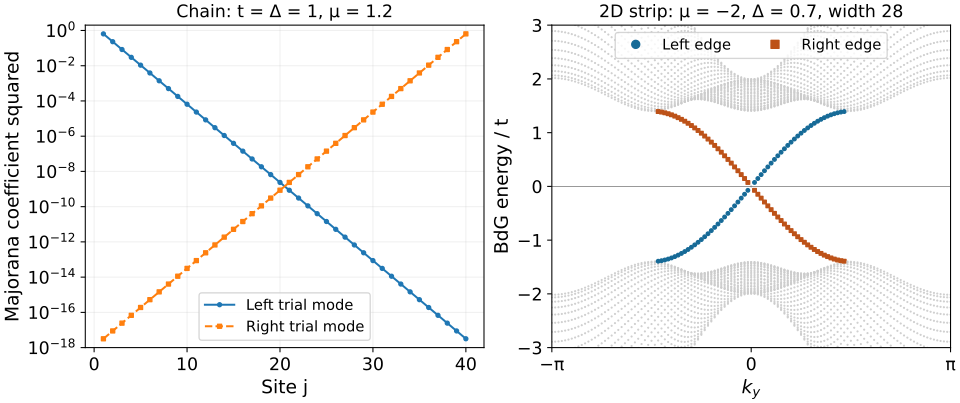
Left: normalized truncated semi-infinite profiles for a 40-site chain with , . These are trial Majorana profiles, not exact finite-chain zero modes. Right: a directly diagonalized width-28 strip with , , . Circles and squares identify states with more than 60 percent weight in the four sites nearest the left and right edges; gray points are the remaining states. The bulk invariant is .
What the Chern number does and does not measure
At a boundary, particle–hole redundancy identifies the state at with the conjugate state at . A single crossing therefore describes one chiral Majorana field, with half the independent degrees of freedom of a complex chiral fermion. Counting the two Nambu eigenvalues as two edge channels doubles the result incorrectly.
This has a useful thermodynamic check. For one positive-velocity Majorana branch, independently occupied positive-energy modes carry equilibrium energy current
The branch direction sets the directed sign. This is the ideal low-temperature ballistic edge result, with negligible bulk excitations and equilibrated reservoirs. It is not an electrical Hall conductance: the condensate and particle–hole charge mixtures invalidate the direct replacement of a superconducting BdG Chern number into the charge-conserving formula . Thermal transport, contact equilibration and finite-frequency electromagnetic response require their own source and boundary conditions.
Summary
A symmetry class and dimension determine the invariant one may use. The real chain's winding reduces to an oriented Pfaffian parity after time reversal is removed. A two-dimensional class-D model instead has an integer Chern number whose boundary branches are Majorana, not complex electronic channels. Bulk formulas and open-boundary calculations agree only after fixing basis, orientation, termination and Nambu counting.
All calculations and figure generation are in examples/condensed-matter/topological-superconductors/chain-invariants/. Chiral pairing and vortex modes develops the defect problem, which requires additional information beyond a straight-edge spectrum.
Exercises
1. Two chains and the symmetry that matters
Take two identical chains at , , with left end operators . Determine whether is allowed by physical parity and by the real-chain time reversal. What happens to the end spectrum if only class D is imposed?
Solution
The product contains two fermion operators and is parity even. Under spinless time reversal, and therefore are unchanged, while . The bilinear changes sign and is forbidden when that time reversal is required.
In class D it is allowed. With , it becomes , with positive excitation energy . An analogous right-edge coupling removes the other pair. The two BDI windings add to , but their class-D invariants multiply to . This explicit boundary calculation illustrates the loss of integer protection; it does not require closing the bulk gap to break the extra protecting symmetry.
2. Change the chirality, retain the gap
Replace the two-dimensional model's by . Determine its bulk Chern number, left-edge propagation and low-temperature energy current. Does its positive bulk dispersion change?
Solution
The replacement reflects the target vector in one direction. The triple product defining changes sign while , and thus every positive bulk energy, is unchanged. Hence the interval now has .
The -direction recurrence and decaying spinor remain unchanged, but the on-site term is now . Contracting with gives
The left branch propagates in the negative direction near its crossing. Its directed equilibrium energy current is , with the same magnitude of differential thermal conductance. Equal excitation gaps do not imply equal topology or equal edge direction; the eigenvectors and orientation carry essential information.
References
- J. Alicea, “New directions in the pursuit of Majorana fermions in solid state systems,” Reports on Progress in Physics 75, 076501 (2012), doi:10.1088/0034-4885/75/7/076501. Preprint v1, §§II.1–II.2 in the HTML, especially Eqs. (14)–(17) and (24)–(35), treats the invariant and weak/strong-pairing constructions. Explicit Nambu matrices fix the chirality translation.
- A. Yu. Kitaev, “Unpaired Majorana fermions in quantum wires,” Physics–Uspekhi 44, 131–136 (2001), doi:10.1070/1063-7869/44/10S/S29. Preprint v2, §2, Eqs. (19)–(26) derives physical parity and the Majorana number from oriented Pfaffians.
- S. Ryu, A. P. Schnyder, A. Furusaki and A. W. W. Ludwig, “Topological insulators and superconductors: ten-fold way and dimensional hierarchy,” New Journal of Physics 12, 065010 (2010), doi:10.1088/1367-2630/12/6/065010. Preprint v2, §1.1, Tables 1 and 3, and §2.2.1 gives the symmetry constraints, classification and off-diagonal winding construction.
Scrollable formula. Use Left and Right arrow keys to reveal hidden content.
Scrollable table. Use Left and Right arrow keys to reveal hidden columns.
Scrollable figure. Use Left and Right arrow keys to reveal hidden content.