Haldane Chains and the AKLT State
A spin-1 chain can have a unique, rotation-invariant ground state on a ring, exponentially decaying spin correlations, and spin-half degrees of freedom at its open ends. None of these statements requires hidden Néel order. The AKLT model makes them calculable with three small matrices.
We construct its exact ground state, obtain the correlation length and string order, and determine how symmetry acts on an edge. This separates the existence of a gap, the behavior of a particular correlator, and the symmetry protection of a phase.
Preparation: Antiferromagnets and Nonlinear Sigma Models explains the integer/half-integer distinction and boundary Berry actions. Basic spin addition and matrix eigenvectors suffice for the exact calculation here.
A Hamiltonian that removes total spin two
Let each site carry spin one and define .
Two neighboring spins have total spin , so
The polynomial that is zero in the first two sectors and one in the last is
Our energy unit is the coefficient of this projector.
The bond form equals , not . Its gaps are twice those quoted in units of here. This normalization agrees with Wei, Raussendorf and Affleck, arXiv:2201.09307v1, Eqs. (1)–(2) (PDF).
Represent each physical spin one by two auxiliary spin halves projected onto their symmetric triplet. Put one auxiliary singlet across each neighboring bond. The two sites then contain a fixed singlet and only two remaining spin halves, whose combined spin is at most one. Projection onto the physical triplets cannot create total spin two. Consequently every annihilates this valence-bond state.
Since the Hamiltonian is a sum of positive projectors, an annihilated state is an exact zero-energy ground state. This is the meaning of frustration free: all local terms reach their minimum simultaneously, even though the terms do not commute. The auxiliary spins specify a wavefunction; they are not extra microscopic degrees of freedom.
Three matrices contain the wavefunction
In the physical basis , choose
On a ring of sites the unnormalized state is
Contracting the virtual singlets and physical triplet projections gives these matrices. Their overall scale was chosen so that the transfer map is unital. Compared with Wei et al., §2.1, Eqs. (10)–(15) (PDF), they are related by conjugation with and a common factor ; all physical normalized expectations are unchanged.
Define the transfer map and an operator insertion by
Multiplication of the explicit matrices gives
The unique leading eigenvalue is one. The right fixed point is , and the normalized left functional is . On a finite ring,
Writing for the physical lattice spacing, the three subleading eigenvalues give the correlation length
This length belongs to the AKLT state. It is not the much longer correlation length of the pure spin-1 Heisenberg chain.
Calculate ordinary and string correlations
For , the two useful insertion identities are
Thus , and at separation in the infinite chain,
Rotation symmetry supplies the other components. At zero separation instead; the distinct-site formula is not to be extended to . Summing the three components on a bond gives .
Now insert the physical rotation between the two endpoint spins. Its transfer map has
The string removes the decay in precisely the channel selected by the endpoints. With a minus sign in the definition,
Some references define the string without the leading minus sign and obtain . Neither choice indicates ferromagnetic local order. In the spin basis, nonzero values alternate after zeros are omitted: , and inserting any number of diagonal matrices between equal raising or lowering matrices still gives zero. The string keeps track of this alternation.
The calculated local and string channels are compared below. The right panel shows an edge profile derived in Exercise 1.
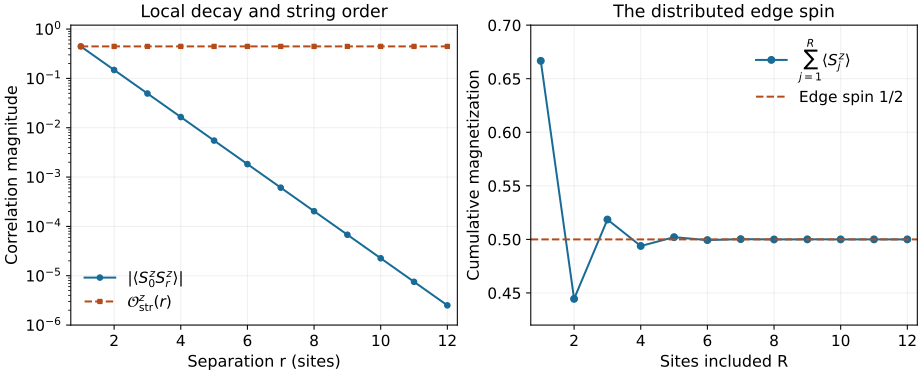
Exact infinite-chain transfer results, with in lattice sites. Left: the magnitude of the local spin correlator and the positive string convention used here. Right: the cumulative magnetization from a polarized left virtual spin approaches with alternating corrections.
String order is a useful observable, but its magnitude is not a quantized invariant throughout a phase. A nonzero string alone does not replace the symmetry analysis. Pollmann et al., arXiv:0909.4059v3, §§II–III (PDF) explains the distinction between hidden order, edges, and symmetry protection.
The edge transforms as a spin half
For an open chain, replace the trace by . The two free two-dimensional virtual spaces give four independent ground states for . At the exact AKLT point these are degenerate even at finite length. Generic perturbations can couple the two ends through the gapped bulk and produce an exponentially small splitting.
The physical rotations by about and commute for integer spin. Acting on the tensors, however, they are represented virtually by
Their commutator is
Rephasing either cannot remove this minus sign. It is the nontrivial projective representation of the physical rotation subgroup. The full rotation action is a spin-half action on each end. Two ends together transform linearly, as required for the whole integer-spin chain.
This gives a direct protection argument. Any operator on one edge that commutes with both and is proportional to . It cannot split an isolated edge doublet. Adding an actual external spin half can screen the edge, but that changes the boundary degrees of freedom. Keeping the original local Hilbert spaces and a protecting symmetry, the bulk AKLT phase cannot be smoothly deformed into a trivial product phase through unique gapped symmetric bulk ground states.
The rotation subgroup is one sufficient protecting symmetry. Time reversal or bond-centered inversion can also protect the Haldane phase, with different boundary interpretations; inversion alone is not an on-site operation at one isolated end. Pollmann et al., §§III.A–C (PDF) discusses these separate cases. Here the explicit projective calculation establishes the rotation-protected case.
What establishes the spectral gap?
An exponential ground-state correlator is not by itself a lower bound on every excitation energy. The AKLT spectral gap is a theorem about this parent Hamiltonian. One proof controls the overlap of local ground-state projectors on growing intervals and obtains a bound on the complement of the global ground space in terms of the Hamiltonian. Other proofs use finite-interval gap criteria. The needed uniform operator inequality is additional information beyond the transfer eigenvalues.
Wei et al., §7, Eq. (45) and the following gap discussion (PDF) describes the original AKLT argument and later finite-size criteria. We use that established gap result; we do not infer it solely from the few spectra below.
The companion in examples/condensed-matter/quantum-magnetism/chains-topology/ constructs the full spin-1 Hamiltonian from local spin matrices, separately constructs the matrix-product state, and diagonalizes the periodic and open chains:
| Sites | Periodic gap | Open ground states | Open gap above them |
|---|---|---|---|
| 4 | 0.33333333 | 4 | 0.44895587 |
| 6 | 0.34786573 | 4 | 0.39845123 |
| 8 | 0.34984912 | 4 | 0.37934913 |
The independent Hamiltonian annihilates the constructed state to below in these finite calculations. Direct wavefunction expectations reproduce the finite-ring formula
The correction winding around the ring is appreciable for four sites. Increasing the chain size checks its disappearance rather than pretending the finite chain already equals the infinite one. Sparse-eigenvector residuals are below ; this is numerical accuracy at fixed size, separate from the finite-size drift of the gaps.
The pure spin-1 Heisenberg chain is not this exactly soluble model. The AKLT point is an exact representative of the Haldane phase, and its construction explains how a disordered bulk and projective edges coexist. Establishing that a different microscopic Hamiltonian lies in the same phase requires control of the intervening path or other appropriate evidence.
Summary
The AKLT projector Hamiltonian has an exact valence-bond ground state. Its transfer eigenvalue yields , while a string insertion changes the relevant transfer channel and gives . The edge matrices anticommute even though physical integer-spin rotations commute. That projective sign identifies the protected boundary representation; the bulk gap requires a separate parent-Hamiltonian theorem.
Exercises
1. Resolve the edge spin in space
Take a semi-infinite chain whose left virtual boundary has , with the right bulk in its fixed point. Calculate for and the total edge magnetization.
Solution
Insert at site and propagate its virtual component to the left boundary:
It is not a single physical spin half sitting on the first site. The first site carries , the second , and the polarization alternates and decays. Summing through site gives
The integrated profile matches the virtual spin-half representation. The opposite virtual polarization reverses the profile.
2. Which symmetry can split an edge?
Let a perturbation act only within one isolated edge doublet. Determine its most general Hermitian form and what remains if it must preserve both rotations, or only the rotation.
Solution
Write , with real coefficients. Commutation with sets . Commutation with additionally sets . With both symmetries only remains, so the doublet cannot split.
With only the rotation, is allowed and splits the levels by . Thus a visible edge degeneracy has protection only relative to stated symmetries. Coupling the two distant edges by a symmetric exchange is also allowed and can split their combined singlet and triplet; locality makes that coupling small in a long gapped chain rather than forbidding it identically.
References
- Pollmann, F., E. Berg, A. M. Turner and M. Oshikawa. “Symmetry Protection of Topological Phases in One-Dimensional Quantum Spin Systems.” Physical Review B 85, 075125 (2012). arXiv:0909.4059v3, §§II–III (PDF). Distinguishes the protecting symmetries and the meaning of boundary degeneracy.
- Wei, T.-C., R. Raussendorf and I. Affleck. “Some Aspects of Affleck–Kennedy–Lieb–Tasaki Models: Tensor Network, Physical Properties, Spectral Gap, Deformation, and Quantum Computation.” In Entanglement in Spin Chains (2022). arXiv:2201.09307v1, §§1, 2.1, 4.1, 5.1 and 7 (PDF). Parent-projector normalization, tensor construction, symmetry action and the additional gap argument.
Scrollable formula. Use Left and Right arrow keys to reveal hidden content.
Scrollable table. Use Left and Right arrow keys to reveal hidden columns.
Scrollable figure. Use Left and Right arrow keys to reveal hidden content.