Theta Equals Pi and Spin-Chain Limits
Why can a half-integer-spin chain be gapless, yet another chain with the same spin per site have exact dimer ground states? The Berry phase explains why integer and half-integer spins produce different topological weights. A symmetry constraint then excludes a unique symmetric gapped state for a half-integer spin per cell. Neither statement, by itself, chooses between a critical chain and a chain that breaks translation symmetry.
We derive the continuum matching with an explicit orientation, then compare the spin-one-half Heisenberg chain with the Majumdar–Ghosh point using exact dimer states and finite-ring spectra. This separates semiclassical matching, a rigorous constraint, and a dynamical identification of an infrared theory.
Preparation: Antiferromagnets and Nonlinear Sigma Models derives the canting expansion. Sigma-Model Instantons and Theta Dependence fixes the degree and sector phase. Spin operators here obey and .
Derive the angle without losing its sign
Start with the nearest-neighbor antiferromagnet
on a chain of spacing . In a slowly varying coherent-state configuration, write
The vector is spin density per unit length. The staggered factor differs by a minus sign from the linked condensed-matter derivation: our is its negative. This reverses the degree and translates that page's Euclidean topological sign into the convention used in this chapter.
For the north-patch solid angle , the Euclidean spin action contains . Its variation is
Pair the even site with the following odd site. Their alternating solid angles are , equal to modulo the allowed solid-angle ambiguity. There is one pair per length . Hence
Canting and exchange give, to quadratic order,
Completing the tangent-plane Gaussian in adds the positive term . The resulting action is
Rescaling Euclidean time by the positive velocity gives the isotropic sigma-model action without reversing orientation. These are bare leading large-spin coefficients; substituting is not a controlled small-coupling expansion. Gozel, Mila and Affleck, Eqs. (2)–(10) (PDF) state the matching and the long crossover scale beyond which perturbation theory fails.
On closed smooth spacetime, integer spin gives sector weight one, while half-odd-integer spin gives . Reversing the chosen staggered field leaves these physical weights unchanged. On an interval, boundary Berry phases must be retained: replacing every integer-spin angle by zero discards information about possible boundary representations. The Haldane and AKLT discussion develops that boundary question separately.
What the symmetry constraint says
Assume finite-range interactions, one-site translation, spin rotation symmetry, and zero magnetization. A half-odd-integer spin per cell is a projective representation of physical SO(3): a spin rotation acts by minus one on a site. The one-dimensional Lieb–Schultz–Mattis constraint forbids a unique, symmetry-preserving, gapped ground state in the infinite chain under these assumptions.
One can already see the obstruction on a periodic ring. Let
where is the number of sites and translation sends site to . At zero magnetization,
The wraparound factor is one because each is integer. Thus the twisted singlet has a different momentum for half-integer spin. A slowly distributed twist changes the energy by , rather than a nonzero gap in the limit. The detailed finite-volume estimate and its infinite-chain hypotheses are given in the LSM article and Tasaki, Lemma 3.1, Theorem 3.4 and Corollary 3.6 (PDF).
This is a constraint on the possible infrared realizations. Gapless excitations satisfy it. Degenerate ground states that break one-site translation also satisfy it. The twist argument does not compute a velocity, central charge, or excitation spectrum. In field-theory language the continuum spin and translation symmetries must reproduce this obstruction; anomaly matching does not select a unique conformal field theory.
For integer spin the obstruction is absent. Absence of an obstruction is not a theorem that every integer-spin Hamiltonian is in a Haldane phase: interactions, anisotropies, unit cell and protecting symmetries still matter. A gapped Haldane phase, a dimerized phase, and tuned critical points are different possibilities.
Critical dynamics needs more than the angle
The spin-one-half nearest-neighbor chain has an independently established critical low-energy description: the SU(2) level-one Wess–Zumino–Witten theory, with central charge . The O(3) continuum model at is also supported by integrability-based predictions and continuum-extrapolated lattice calculations to flow to that theory. The lattice mass-gap and scaling comparisons in de Forcrand, Pepe and Wiese, Eqs. (6)–(7), Figs. 2–3 (PDF) test this dynamical statement; it is stronger than the symmetry constraint alone.
A useful local description of the fixed point is an SU(2) matrix field . Under physical spin rotations it transforms by conjugation, while the low-energy action of one-site translation is . The spin vector and dimerization are components of this primary field. Their scaling dimension follows from the level-one conformal weights:
A term linear in the dimerization is forbidden by one-site translation. A scalar product of left- and right-moving currents is allowed and marginal. Its flow, and other microscopic couplings, determine whether a particular chain approaches the critical theory or develops translation-breaking order. At the nearest-neighbor point it gives logarithmic finite-size corrections. Strong frustration is not accounted for by retaining only the nearest-neighbor values of and in a minimal sigma-model action.
This explains two common pitfalls. A vanishing perturbative theta beta function does not make the infrared theta dependence negligible. Conversely, destructive sector phases at do not by themselves derive an exact cancellation of every mass-generating process. The infrared identification requires dynamics in addition to topology.
An exactly dimerized chain with the same spin per cell
Consider a periodic spin-one-half chain with even ,
At , define . Three spin-one-half particles have total spin one-half or three-halves. Consequently
Expanding the squares checks every factor: each nearest-neighbor bond occurs in two triples and each next-neighbor bond in one. This is a sum of positive projectors plus a constant.
Let denote the oriented normalized singlet
Construct the two coverings
Every three-site block contains a full singlet in either covering. The remaining spin then has total spin one-half, so every projector annihilates the state. Both coverings attain the lower bound exactly. This is the Majumdar–Ghosh construction; Michaud et al., Eqs. (1)–(4) (PDF) explain it and its extension to projector Hamiltonians.
The coverings are not orthogonal on a finite ring. Contracting the single transition loop gives
With the displayed orientations, translation exchanges the coverings. The normalized translation eigenstates are therefore
Define the intensive dimer operator
A singlet bond has expectation , while a bond connecting independent dimers has zero expectation. Hence and the other covering has the opposite sign. Each translation eigenstate instead has , but
An arbitrarily small alternating bond field, applied before the infinite-volume limit, selects a covering. Doubling the unit cell places an integer total spin in each cell, so this translation-breaking realization satisfies the LSM constraint. It does not contradict the critical behavior of the nearest-neighbor model or the minimal continuum O(3) model at theta pi.
Finite spectra and a conformal check
The companion constructs the spin Hamiltonian in fixed magnetization sectors and diagonalizes it for four ring sizes. Energies below use . The reported triplet is the lowest state in the sector, additionally checked to obey ; thus its total spin is one, rather than merely at least one.
| Sites | Heisenberg triplet gap | Dimer-point triplet gap | Heisenberg |
|---|---|---|---|
| 8 | 0.52267435 | 0.40451696 | 1.030227 |
| 12 | 0.35584751 | 0.31913377 | 1.015843 |
| 16 | 0.27018968 | 0.28571714 | 1.010452 |
| 20 | 0.21794554 | 0.26887230 | 1.007771 |
At the dimer point the two lowest singlet energies equal the exact bound to numerical precision. The gaps shown are finite-volume observations, not an extrapolated proof of a nonzero infinite-chain gap. The exact ground-state construction already supplies the distinct realization of the symmetry constraint that we need.
For the nearest-neighbor chain, the Bethe solution fixes the bulk energy per site and velocity:
On a periodic ring, a critical theory predicts
The last column approaches one. These short rings retain irrelevant-operator and logarithmic corrections; the calculation checks consistency with the known fixed point, not an independent proof of its existence. The same code also checks the entire six-site spectrum at unequal changed couplings using a separate tensor-product construction. Eigenvalue agreement is better than ; the largest retained-eigenvector residual in the larger rings is below .
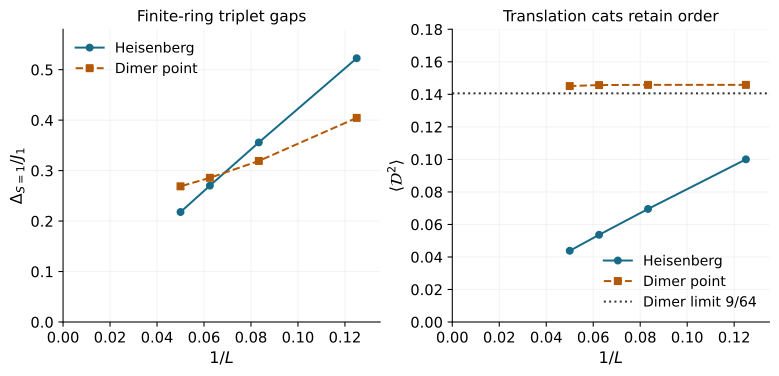
Both chains have spin one-half per site and one-site translation symmetry. Left: computed triplet gaps on four finite rings. Lines only join data; no infinite-volume gap fit is imposed. Right: the dimer squared expectation in the Heisenberg ground state and the normalized plus translation eigenstate at the dimer point. The horizontal line is the exact dimer-order limit , derived from the covering states. A zero dimer mean in a translation eigenstate does not imply absence of dimer order.
Summary
The Berry-phase derivation fixes the topological angle and its orientation, while the large-spin expansion fixes the leading kinetic coefficients. LSM forbids a unique symmetric gapped state for a half-integer spin per cell; it allows both critical and translation-breaking outcomes. The nearest-neighbor chain and the exact dimer point show these different possibilities concretely. Identifying the SU(2) level-one infrared theory requires dynamical information beyond the sector sign.
The program, selected spectra and figure sources are in examples/nonperturbative/sigma-models/topology-spins/. The companion keeps the finite-ring comparison separate from the semiclassical continuum mapping.
Exercises
1. Select a dimer state before taking the limit
Add to the dimer-point Hamiltonian, with real in energy units. Calculate the leading energy densities in the two coverings and identify the selected state. For the unperturbed covering , calculate at even . Explain the difference between a covering and a translation eigenstate.
Solution
First-order shifts per site are in and in . Thus positive selects in the thermodynamic limit; negative selects . Finite overlap and mixing must be retained if diagonalizing the two-state problem at fixed finite length.
In , every strong bond is an eigenoperator with value . Each weak bond has mean zero and variance : its two spins are independently maximally mixed, and the squared scalar product has normalized trace . Distinct weak-bond covariances vanish for these rings, since at least one external dimer supplies an unpaired spin with zero mean. There are weak bonds. Therefore
The nonzero limiting value is already present in a symmetry-breaking covering. In a normalized translation cat the mean vanishes, while the variance tends to the same value: cross-covering matrix elements vanish exponentially up to polynomial factors in length. Taking at fixed finite volume and taking the volume limit before removing need not select the same state.
2. What a relevant dimer field would predict
Assume the SU(2) level-one fixed point, and temporarily omit the marginal current interaction. An explicit alternating bond couples to the dimer primary with scaling dimension . Derive the gap power in its dimensionless coupling , and explain why it is neither an LSM theorem nor a numerical prediction of the gap amplitude.
Solution
In two spacetime dimensions the leading scaling equation is
Starting at a short-distance cutoff , the coupling becomes order one at . Hence
The proportionality constant depends on how the microscopic bond perturbation matches the normalized continuum operator. Restoring the marginal interaction introduces logarithmic factors. The derivation assumes the fixed point and its operator dimension; the symmetry constraint alone supplies neither. Explicit alternation also reduces translation to a two-site cell, removing the one-spin-per-cell obstruction. This is consistent with opening a gap, but does not calculate it.
References
- P. de Forcrand, M. Pepe and U.-J. Wiese, “Walking near a Conformal Fixed Point: the 2-d O(3) Model at theta near pi as a Test Case”, Physical Review D 86, 075006 (2012), arXiv:1204.4913v1 (PDF). Pages 1–4, Eqs. (3)–(7) and Figs. 2–3: proposed infrared description and nonperturbative finite-size tests. Their continuum coupling squared is our ; the sign of the displayed topological action is translated by reversing the degree.
- S. Gozel, F. Mila and I. Affleck, “Asymptotic Freedom and Large Spin Antiferromagnetic Chains”, Physical Review Letters 123, 037202 (2019), arXiv:1810.02626v2 (PDF). Equations (2)–(10) give the chain normalization, leading sigma-model matching and crossover scale. We restore the lattice spacing and derive the Euclidean Berry sign explicitly.
- F. Michaud, F. Vernay, S. R. Manmana and F. Mila, “Antiferromagnetic Spin-S Chains with Exactly Dimerized Ground States”, Physical Review Letters 108, 127202 (2012), accepted manuscript (PDF). Printed p. 1, Eqs. (1)–(4), gives the spin-one-half dimer point and projector construction before its higher-spin generalization.
- J. Sirker, “The Luttinger liquid and integrable models”, International Journal of Modern Physics B 26, 1244009 (2012), arXiv:1207.2582v1. Sections 4–5.1, especially the root density in Eq. (39) and velocity in Eq. (42), give the Bethe inputs for the isotropic endpoint. The companion derives the energy normalization from the bare-root energy.
- H. Tasaki, “The Lieb–Schultz–Mattis Theorem: A Topological Point of View”, arXiv:2202.06243v1 (PDF) (2022). Lemma 3.1 gives the local-twist energy estimate; Theorem 3.4 and Corollaries 3.5–3.6 specify the obstruction and its hypotheses.
Scrollable formula. Use Left and Right arrow keys to reveal hidden content.
Scrollable table. Use Left and Right arrow keys to reveal hidden columns.
Scrollable figure. Use Left and Right arrow keys to reveal hidden content.