Compact Bosons and Fermion Sectors
Two theories can have identical local current correlators and different states on a circle. A fermion boundary condition determines whether a zero-energy mode exists, which charges can occur, and which trace is being computed. An unrestricted compact scalar does not automatically reproduce those choices.
We construct the antiperiodic Dirac Hilbert space, match its spectrum to bosonic charge and oscillator states, and then change the spin structure. This gives a concrete meaning to the sector restrictions behind bosonization.
Preparation: The canonical fields, currents and vertex operators of Abelian Bosonization. The circle has circumference , the limiting velocity is one, and charges are measured relative to the specified sea.
Fill a sea before counting its excitations
Start with antiperiodic, or Neveu–Schwarz (NS), boundary conditions,
Positive chiral excitation energies are , with . For one chirality, the least energy at excess charge is obtained by adding particles to the first levels. The sum is
Removing particles gives the same formula for negative integer charge. Particle–hole rearrangements at fixed charge are counted by partitions: a displacement of total integer weight costs . The complete free spectrum is consequently
Here , and the oscillator multiplicity is , with the integer-partition function. The vacuum term is the bulk-subtracted Casimir energy of one nonchiral Dirac field. It is not obtained from an unregulated sum of negative energies. The constructive energy formula appears in von Delft–Schoeller, §7, Eqs. (73)–(76), with their boundary parameter set to the antiperiodic case.
Define total number and axial number by
Both are integers, but they are not independent integers:
The minimum energy at fixed therefore has , while permits . A spectrum that retains only a quadratic charge energy misses this distinction.
The bosonic zero modes carry the same restriction
The current dictionary fixes the spatial changes of the canonical fields:
The zero-mode momentum of is . Substituting the constant gradients into the scalar Hamiltonian gives
For clarity, the physical momentum here is in the stated metric; it is positive for a right mover. These values reproduce the fermion sums precisely when the parity restriction is imposed. Neutral density oscillators cannot change either charge.
The local fermionic operator lattice also remembers this restriction. Vertices of the form
belong to the fermion operator algebra when the integers have the same parity, with appropriate cocycles. The joint shifts
leave these vertices unchanged. Shifting either field alone by changes a fermion's sign and is not the identity on the full fermionic algebra. The simpler period inferred from a neutral cosine therefore does not specify the complete theory.
An ordinary compact boson is a different starting point
Consider a genuinely bosonic scalar with the same kinetic term and period , without any spin-dependent projection. Its winding and momentum integer obey
In the notation above this means and . It has states with even and odd , which are absent from NS Dirac theory, and it lacks the odd- NS states. Its conformal spin is always integral. In the NS fermion theory, odd give half-integral spin, as required for a fermionic state.
One explicit construction recovers the NS lattice by adding a half-winding sector and projecting:
The untwisted sector has even ; the twisted sector has odd . The projection is represented by
It is essential to retain the sign involving . Merely averaging over ordinary bosonic sectors without specifying that phase is a different theory. On a torus this construction is the antiperiodic-spin specialization of an Arf-weighted gauge-field sum. Karch–Tong–Turner derive it in §3.5, “Dirac,” and Appendix B. Their angular field has period and action ; at their free point our field is . Thus its period is exactly the one used in this construction.
The explicit circle projection is enough for the spectrum below. General surfaces require their spin structure and the corresponding global signs, not just the flat-space vertex formula.
Partition functions that resolve the charges
Let and let record one chiral charge. Before including the vacuum energy, a direct fermion occupation trace is
The right side enumerates the charge minimum and all its bosonic descendants. This is the charge-refined Jacobi product identity; the sea construction explains why it organizes the physical states. Define . The full thermal NS trace is
For a general Euclidean torus the two chiral factors use and . A fixed-spin trace transforms to another spin trace under some modular transformations; it should not be mistaken for a spin-independent modular-invariant boson partition function.
A parity insertion weights the same states by . It changes temporal boundary conditions; it does not change the spatial NS Hilbert space. Projecting onto even parity means averaging the ordinary and parity-inserted traces. This projection removes the lowest single-fermion states but leaves the density current.
The companion independently enumerates fermionic occupations and bosonic charge/partition states through chiral weight , retaining charge labels. All 49 nonzero charge-resolved coefficients match as exact integers. The first few unrefined coefficients for one chirality are
| Number of states | 1 | 2 | 1 | 2 | 4 | 4 | 5 |
A separate thermal comparison retains the fugacity at . Increasing the mode cutoff from 4 to 8 to 16 to 32 reduces the NS product-versus-sum discrepancy from to to to . The charge-resolved integer test is stronger than agreement of a single unrefined thermal number.
Periodic fermions and the zero-mode multiplet
For periodic, or Ramond (R), spatial boundary conditions, each chirality has a zero-energy fermion. Charge-conjugation-symmetric normal ordering assigns it charges and . The charge lattice becomes
The energy formula still contains the same Casimir subtraction. The four least-weight states have and energy . Their total charges are . Restricting to total charge zero retains two states; filling a prescribed number of one-particle levels to compute one reference energy does not eliminate the other zero-mode occupations from the theory.
The chiral identity now reads
There is an exact zero in the parity-inserted full R trace: states pair under occupying a zero mode. With the empty-zero-mode state assigned even parity, the total parity is . Its overall convention changes neither that cancellation nor an ordinary thermal trace. Omitting the zero modes would produce a false nonzero result.
A flux can move the boundary condition
Choose a flat holonomy by
Following a state continuously from the NS sea shifts the chiral quadratic energies in opposite directions:
Oscillator energies are unchanged. Increasing by one relabels , so the spectrum is periodic. At the boundary condition is R. Minimizing over all charges gives the four states described above; minimizing at fixed gives two. This distinction is visible in the zero-mode lattice and energy branches below.
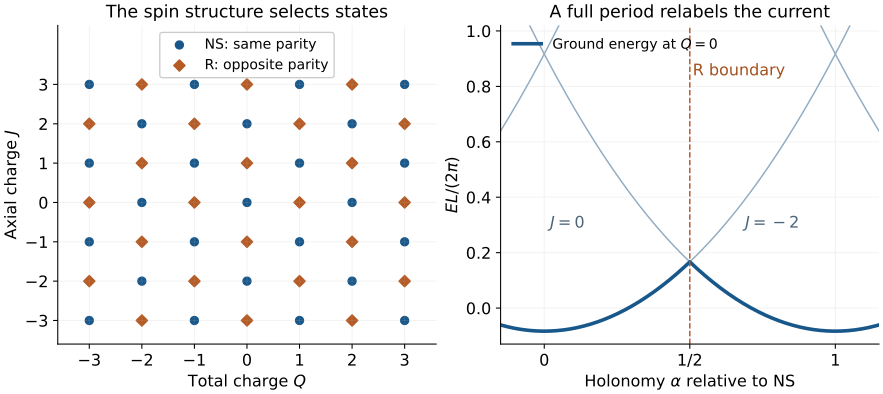
Left: allowed zero-mode pairs for NS and R fermions; oscillator descendants sit above each pair. Right: the exact continuum energies at fixed , in units , versus the holonomy in . Thin parabolas are the even- branches, and the bold curve is their minimum. At half a holonomy period there are two charge-zero ground states; allowing all charges adds two more.
An independent retained check diagonalizes an actual finite Wilson–Dirac Hamiltonian on the circle and subtracts its infinite-line bulk energy. At 96 sites and its NS Casimir value is , approaching , and its R value is , approaching . Refining the spacing reduces the errors approximately fourfold. Removing the Wilson term instead leaves two Dirac cones and doubles the Casimir coefficient. This distinguishes a regulator error from a spin-sector choice. The regulator breaks axial symmetry at finite spacing; it checks the free continuum spectrum, not a finite-cutoff current-algebra or general duality theorem.
Klein factors act on the charge lattice
For two NS chiral species order their integer charges as and define the lowering operations
Their oscillator operators commute. Applying the two charge ladders in opposite orders gives opposite signs, so . The same construction for any number of species uses . These operators are unitary shifts on the unbounded charge lattice; lowers the charge by two and is not the identity.
One may instead use auxiliary Majorana cocycles if the actual charge shifts are already encoded elsewhere. Treating such a cocycle as a substitute for the charge ladder while also omitting the zero mode loses states. The companion tests the ladder actions on 49 interior charge pairs. Their anticommutator vanishes exactly; omitting the phase gives residual magnitude two.
Summary
NS and R fermions use different charge lattices and have different zero-mode ground spaces. A compact scalar reproduces a chosen fermionic theory only after its sectors, projection and spin-dependent signs are specified. Charge-refined spectra, parity traces and holonomy spectral flow make these distinctions testable. Klein factors then enforce the exchange algebra while moving between the required charge sectors.
Exercises
1. A bosonic state that does not belong to the NS theory
The ordinary period- scalar above has a state with . Find its chiral weights and compare it with the lightest NS Dirac excitation. Explain exactly which part of the twisted-sector construction removes it and restores the missing single fermions.
Solution
This state has , hence
It is absent from NS Dirac theory because have opposite parity. The lightest NS states have , with one chiral weight and the other zero; they cost . In the untwisted bosonic sector the projector keeps only even , removing the spurious state. In the half-winding sector it keeps odd ; these supply precisely the odd-, odd- states. Changing the oscillator determinant alone cannot repair this mismatch.
2. Fixed charge versus the full Ramond trace
At , list all minimum-energy branches labeled from the NS sea. Restrict first to , then instead take a full trace with fermion parity inserted. Explain why these operations have different outcomes.
Solution
Minimize with the NS parity rule. Its minimum is one and occurs at
All four have . Fixed charge zero retains the first two and yields a nonzero two-state thermal contribution. In a full R trace the two neutral states have one zero mode occupied, while the charged states have zero or two occupied; their parity weights cancel. Restricting charge before tracing is not the same operation as inserting parity in the unrestricted theory. Both choices are legitimate, but they are different observables.
References
- A. Karch, D. Tong and C. Turner, “A Web of 2d Dualities: Gauge Fields and Arf Invariants,” SciPost Physics 7 (2019), 007, doi:10.21468/SciPostPhys.7.1.007, arXiv:1902.05550v3. Section 3.5, especially the Dirac torus trace, and Appendix B distinguish a spin theory from an ordinary compact boson; the field/radius translation is stated above.
- J. von Delft and H. Schoeller, “Bosonization for Beginners—Refermionization for Experts,” Annalen der Physik 7 (1998), 225–305, arXiv:cond-mat/9805275v3. Sections 4.F and 7, and Appendices B, D and F, address charge ladders, completeness, energies and finite-circle anticommutation.
The finite occupation counts, thermal sums, Klein-factor checks, Wilson-circle comparison and figure source are retained in examples/nonperturbative/bosonization-dualities/operator-sectors/.
Scrollable formula. Use Left and Right arrow keys to reveal hidden content.
Scrollable table. Use Left and Right arrow keys to reveal hidden columns.
Scrollable figure. Use Left and Right arrow keys to reveal hidden content.