Anomalies and Vacuum Constraints
Can a symmetry prevent a vacuum from being unique without determining the excitation spectrum? A particle on a circle at half a flux quantum supplies an exact example. Two symmetry operators anticommute on its states, so every energy level is paired. Removing one of those symmetries removes the conclusion. We will then identify the analogous obstruction for CP and the center symmetry of a precisely specified Yang–Mills theory.
Preparation: Theta-dependent rotor spectra and anomaly matching. The gauge example also uses the spin-manifold discrete theta term. An anomaly of global symmetries constrains possible infrared realizations; it is not an inconsistency of the dynamical gauge redundancy.
Half a flux quantum changes the symmetry algebra
Use periodic wavefunctions, and :
For the free rotor, has wavefunction and energy
Multiplication by relates the Hamiltonians at theta and theta plus two pi. At , the momentum states and have equal energy. The low pair consists of , but the algebra below does not depend on a free spectrum.
Let be reflection. It reverses momentum and maps to for an even potential. Combining it with the large shift gives the unitary symmetry
Now choose a potential with period pi as well as reflection symmetry, for example . Half-translation is
Both and commute with . Nevertheless,
The minus sign follows directly from evaluating . The transformations commute on the classical coordinate and on local operators after conjugation, but their Hilbert-space representatives realize projectively. Rephasing either operator cannot change this commutator. This is the half-translation subgroup of the rotor construction in Gaiotto et al., Appendix D.1, Eqs. (D.1)–(D.10), (D.17)–(D.18) (PDF).
Choose an energy eigenstate with eigenvalue . Acting with produces an eigenstate at the same energy with eigenvalue . The two are orthogonal. Every energy eigenspace therefore has even dimension. Within one doublet, a convenient representation is
A nonconstant Hermitian two-by-two Hamiltonian cannot commute with both matrices. The algebra fixes this degeneracy but neither nor the gap to the next doublet. This is not Kramers' theorem: the displayed reflection is unitary and squares to plus one. Nor is a protected finite-system doublet by itself an infinite-volume proof of spontaneous symmetry breaking. A symmetric mixed state exists; there is no unique symmetry-invariant pure ground state.
Test the protection by changing the Hamiltonian
Add an even potential with only period two pi:
The term proportional to epsilon preserves but breaks . Nothing in the remaining symmetry requires a doublet. This is precisely why the single-minimum cosine rotor in the preceding article has a generic avoided crossing, whereas the pi-periodic example here has a protected crossing.
For and small epsilon, projection onto gives
The first-order matrix element is one half, not one: . The second-order shift is common to the pair, so the first correction to the splitting is cubic. The remaining simply labels the two split eigenstates.
The companion diagonalizes the interacting momentum matrix
At theta pi, the cutoff closes exactly under , avoiding a spurious symmetry violation at the cutoff edge. It is compared with a separate coordinate-space second-difference Hamiltonian whose hopping carries the flux link on a grid of points. Both regulators approach the same low spectrum.
For and , epsilon zero gives exact paired levels within numerical precision. At the first two energies approach and , leaving a nonzero gap of approximately . Raising the momentum cutoff from 10 to 16 changes the first six energies by less than . The coordinate-grid maximum error in those six energies decreases from to to as : the independent discretization converges quadratically. The checks also evaluate both commutators and the projective anticommutator, so degeneracy alone is not mistaken for symmetry evidence.
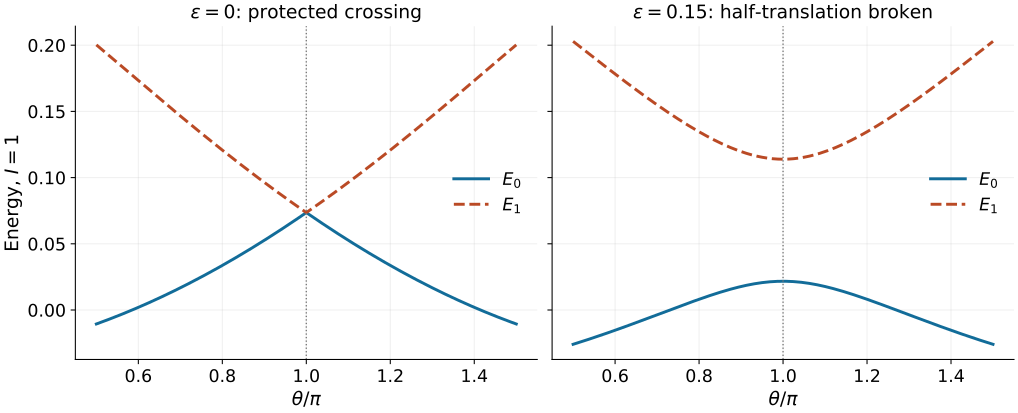
The first two levels for and , computed in the momentum basis. Left: preserves half-translation and the reflection at theta pi. Right: preserves the reflection but splits each protected pair. The two panels use the same energy scale; this calculation does not infer a gauge-theory mass gap.
A four-dimensional symmetry constraint with fixed global data
Now consider pure Yang–Mills theory on a closed oriented spin Euclidean four-manifold . There is no fundamental matter. The electric center is an exact one-form global symmetry: a fundamental Wilson line changes sign when linked with its symmetry surface. CP reverses the topological charge. We study their compatibility at .
Absorb the coupling into the Hermitian connection and set
The local Euclidean topological term is , giving weight . An ordinary bundle has integer charge in this normalization. The sign and trace agree with the explicit bundle calculation in discrete theta terms.
To probe the center symmetry, turn on a fixed background
The allowed gauge configurations are then twisted bundles with adjoint bundle satisfying . This does not mean that the center has been gauged: is held fixed, not summed. Also, the gauge obstruction need not vanish when the tangent bundle is spin.
Where an integral lift exists, introduce a bundle with curvature and first Chern class reducing to . Removing its trace part gives
Indeed the first trace integral is , and subtracting the trace part removes another quarter of . The fractional part is therefore one quarter of the square of the lift. For a general background without an integral lift, the invariant replacement is the Pontryagin square:
This is a characteristic-class statement; a globally defined Abelian lift must not be assumed for arbitrary . Its continuum derivation and background-counterterm interpretation are given in Gaiotto et al., §2.4, Eqs. (2.18)–(2.24). On a spin manifold the Wu identity gives even , so only the residues zero and two occur. The paper treats more general manifolds; the reduction here is deliberately restricted to closed spin backgrounds.
No allowed counterterm removes the CP obstruction
The background-dependent local phase in this setting can be chosen as
The integer quantization is required for independence of the representative of modulo four. The spin restriction identifies coefficients differing by two. B-independent gravitational terms cannot cancel a relative phase between different center backgrounds on the same manifold.
Write for the functional including this phase. Fractional charge implies
Thus the familiar two-pi periodicity at zero background has a nontrivial extension to background fields. Under CP, orientation reversal maps theta and the counterterm coefficient to their negatives. At theta pi, use the preceding shift to return to the same theta coordinate:
Equivalently the transformed functional differs by
with the background also pulled back by CP. No choice of the allowed local phase cancels this factor for every background. This is the mixed CP/one-form-center anomaly, derived in the broader even-rank setting in Gaiotto et al., §2.2, Eqs. (2.7)–(2.10) (PDF). On the restricted spin backgrounds the phases are real signs, so reversing the convention for the exponent would not change the obstruction.
There is a concrete detecting background. On choose classes with
Then modulo four, the allowed charges are half-integral, and CP contributes a minus sign for both counterterm choices. The background instead obstructs lifting the gauge bundle from to , despite having the integral lift ; it has and does not detect this anomaly. Having a nontrivial background and detecting a particular anomaly are different statements.
What the anomaly does and does not decide
A unique, symmetry-preserving, fully gapped vacuum with no topological sector would leave only a local background response after its massive excitations were integrated out. The counterterm calculation shows that such a response cannot match the ultraviolet symmetry transformation. This particular combination of infrared properties is excluded.
Several mechanisms can avoid it:
- CP can break spontaneously, so CP relates distinct vacua.
- The one-form center can be broken, changing the behavior of its charged lines.
- Gapless degrees of freedom can carry the anomalous response.
- An appropriate nontrivial topological infrared theory can match it while retaining the symmetries.
If confinement keeps the center unbroken, and the vacuum is also assumed gapped and topologically trivial, the remaining option is CP breaking. Those dynamical assumptions must not be smuggled into the anomaly calculation. The calculation alone gives no glueball mass, domain-wall tension, exact number of vacua beyond the symmetry requirement, or unique phase diagram.
Adding fundamental matter explicitly removes the exact one-form symmetry; moving away from theta zero or pi removes CP. Either change alters the premise. Changing the global gauge group and summing over also changes the theory and its discrete-theta choices. None is a counterexample to the fixed-theory constraint.
Summary
The rotor's projective symmetry algebra enforces doublets, while a symmetry-breaking potential supplies an explicit escape. In pure Yang–Mills theory, a half-integral-charge center background makes the CP obstruction visible. The same logic excludes a unique trivial symmetric gapped infrared state while leaving the dynamics to decide how the constraint is realized.
The companion examples/nonperturbative/vacuum-structure/susceptibility-anomalies/ checks the rotor algebra, independent spectral regulators, weak symmetry breaking, and the finite counterterm/background arithmetic. These checks do not compute the four-dimensional Yang–Mills path integral.
Exercises
1. Follow the avoided crossing. Set and keep a small nonzero epsilon. Derive the two-level Hamiltonian for and its gap. Identify which assumption behind the doublet proof fails.
Solution
In the ordered basis , the diagonal energies have opposite slopes, while the cosine couples the states:
To leading order in the projection, the gap is
At the crossing it is . The projection requires both energy scales and to be small compared with the gap of order to the discarded momentum levels. Half-translation is represented by sigma z, which no longer commutes with the epsilon term. At theta pi the reflection is sigma x and remains a symmetry. Keeping only that symmetry permits the avoided crossing.
2. Why not use a half-quantized counterterm? Formally allowing would make the CP map have a fixed point. Explain why this does not define an allowed local phase, even on spin manifolds. Check the detecting flux on .
Solution
The integrated Pontryagin square is a residue modulo four. Replacing a representative by changes the proposed phase by
It therefore depends on an arbitrary representative. The fact that the residue is even does not supply a preferred lift from zero or two to an integer. For , the allowed counterterms give and , and CP exchanges them; neither removes the anomalous minus sign. The half-quantized expression would require additional structure or inflow, which is a different specification from the standalone four-dimensional background functional used here.
References
- D. Gaiotto, A. Kapustin, Z. Komargodski and N. Seiberg, Theta, Time Reversal, and Temperature, Journal of High Energy Physics 05 (2017), 091, arXiv:1703.00501v3 (PDF), §2.2, Eqs. (2.7)–(2.10); §2.4, Eqs. (2.18)–(2.24); Appendix D.1, Eqs. (D.1)–(D.18). Here the rotor inertia is explicit, the protecting translation is its half-circle subgroup, and the gauge-background counterterm is restricted to closed spin manifolds.
Scrollable formula. Use Left and Right arrow keys to reveal hidden content.
Scrollable table. Use Left and Right arrow keys to reveal hidden columns.
Scrollable figure. Use Left and Right arrow keys to reveal hidden content.