Volume Independence at Large N
Could a gauge theory on a large lattice be replaced by a handful of matrices? At infinite color number, some observables can agree between these descriptions. The decisive qualification is that the relevant symmetries must be realized by the state. A reduced action can possess center symmetry while its dominant configurations invalidate the reduction.
We will calculate one of the extra terms in a reduced Wilson-loop equation, show its cancellation in a controlled finite-rank example, and exhibit a center-averaged ensemble in which the cancellation fails. This makes the symmetry and factorization requirements visible before invoking the general equivalence.
Preparation: Planar counting and normalized traces. The compactified instanton examples in fractional instantons provide a useful later comparison, but are not prerequisites.
Which observables can become volume independent?
Use pure Yang–Mills theory, with Hermitian generators, and . On a periodic four-dimensional lattice, the Wilson action, up to an irrelevant constant, is
The links parallel transport with the site's positive phase, . The 't Hooft coupling at the cutoff is held fixed while taking the rank limit. Setting every lattice extent to one gives the original Eguchi–Kawai matrix action,
There is simultaneous-conjugation gauge redundancy and an independent global center transformation in each direction:
A traced reduced word is invariant under the first transformation even if the corresponding path would be open on the extended lattice. Under the second it acquires a phase set by its net displacement:
Here and the ordered inverse link is used for a negative step. Contractible parent loops map to center-neutral words. Generic winding or open words do not belong to the common neutral sector. At finite a winding of is center-neutral; the usual planar comparison holds the contour length and winding fixed as grows, rather than including such rank-dependent probes indiscriminately.
The volume-equivalence statement compares mapped neutral observables, with the coupling and volume normalization matched, provided the translation symmetry used in the parent reduction and the relevant center symmetry in the daughter are unbroken. It also compares appropriately normalized leading connected correlators in the common sector; it does not equate arbitrary momentum spectra on unequal finite boxes. These conditions and the neutral-sector map are developed in Kovtun, Ünsal and Yaffe, §§2.1–2.3.
An extra term, calculated rather than discarded
Consider a reduced plaquette in two distinct directions, and abbreviate
Let differentiate under , and insert in the Haar integration identity. Unlike an extended plaquette, the reduced word contains both and at the same integration variable. Differentiating both gives
Completeness evaluates the second term:
Since , the exact result is
The finite- trace subtraction has combined with to give this simple coefficient. The Schwinger–Dyson equation is therefore
The action derivative inserts neighboring plaquettes. The term is an additional split contribution from identifying distinct links during reduction. On an extended plaquette the opposite link is a different integration variable, so that second differentiation is absent. Repeating the argument for longer loops generates analogous products of open or winding words.
If the center is unbroken and normalized traces factorize in a chosen phase,
Then this extra term disappears in the planar limit. Translation symmetry supplies the identification of parent loops based at different sites. The resulting loop hierarchies agree. Coinciding equations alone can have multiple solutions, so the phase and state selection cannot be omitted from the equivalence argument. The source explicitly discusses this limitation of loop-equation proofs in Kovtun, Ünsal and Yaffe, §2.3, footnote 19.
The companion checks the differentiated identity with explicit , and generators at generic noncommuting matrices. A central difference with step 0.02 through 0.0025 reduces the residual by four whenever the step halves. This checks the sign and the trace subtraction independently of the formal completeness manipulation.
A finite-rank cancellation and a counterexample
At the reduced links are independent Haar matrices. The first Haar moment gives
Consequently,
This is exactly the reduced Schwinger–Dyson equation with zero action derivative. The extended plaquette, made from four independent links, has expectation zero at . The two answers differ at finite rank but agree at leading planar order. Thus the explicit extra term is small, not identically absent.
A finite clock-and-shift unitary design reproduces the two Haar moments needed here. Summing the phases of all matrix pairs gives , , and at .
Now choose the ensemble
For any fixed nonzero winding ,
The probability distribution is center invariant because it averages all clumps. Nevertheless, its connected variance is order one. It behaves as a mixture of center-broken states and fails large- factorization. In a pure clumped state is nonzero. Averaging the broken phases does not repair the reduced loop equations.
For comparison, an equally spaced determinant-one holonomy has
This tests a possible center-symmetric eigenvalue pattern. It is not by itself a solution of the interacting reduced model. With several compact directions, mixed words must also be checked: setting two holonomies equal to this same clock gives despite every individual first trace vanishing. That word carries a relative center charge.
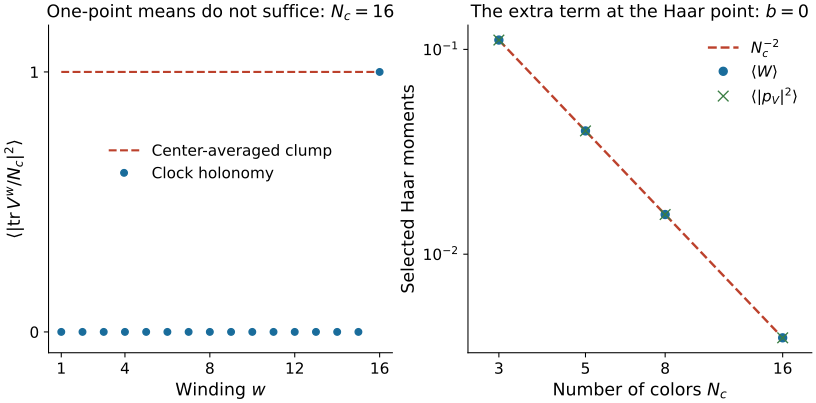
Left: exact for a sixteen-color clock holonomy and for an ensemble of center-averaged clumps. Their means vanish at the displayed nonzero windings below sixteen, but their variances differ. The endpoint at illustrates a finite-rank center-neutral winding. Right: the extra reduced-loop term at , obtained from the selected Haar moments.
Why small-volume pure Yang–Mills is obstructed
There is also a dynamical reason to worry about clumps. On , the perturbative gauge-boson determinant gives the holonomy-dependent four-volume energy density
up to a holonomy-independent constant. The two transverse polarizations supply the factor two. The negative sign favors coincident eigenvalues, not an equally spaced distribution. The compact circle here is spatial; periodic adjoint fermions would contribute differently from thermal antiperiodic fermions.
For a clump and a clock, respectively, the sum can be performed exactly:
Thus in the weakly coupled small-circle regime the pure-glue potential favors a broken-center configuration. This continuum diagnostic and the associated center-stabilizing deformations are derived in Ünsal and Yaffe, §2.1, Eqs. (2.8)–(2.9).
Double-trace deformations, twisted constructions and appropriate adjoint matter can change the symmetry realization. Each requires its own boundary conditions and symmetry analysis. For example, a deformation containing produces loop-equation terms proportional to
They vanish at leading order only when the charged factor has zero expectation and factorization holds. The explicit variation is given in Ünsal and Yaffe, §2.3, Eqs. (2.20)–(2.22). Merely adding the word “stabilized” to a model does not establish those conditions.
Reduction and semiclassics take different limits
In an equally spaced holonomy, an adjoint component with colors has compact momentum
Color differences provide momentum spacings of order . This is one way a large number of colors can retain information lost by reducing the geometric volume. It also explains a limitation of small-circle semiclassics: the lightest off-diagonal gauge excitation has
An Abelian semiclassical treatment needs this scale well above the strong scale, hence . At fixed , that condition eventually fails as grows. A small fixed-rank circle and a planar theory at fixed circle size are therefore different regimes, even if a suitable deformation keeps the center unbroken in both. The scale and order-of-limits distinction appear explicitly in Ünsal and Yaffe, §3, Eqs. (3.3)–(3.4), and §3.3, Eq. (3.48).
One first states the regulated equivalence at fixed coupling and contour data in a symmetry-preserving phase. A continuum or infrared limit then requires a trajectory that preserves those conditions and controls the corrections. The conclusion is a relation between neutral sectors, not an analytic solution of four-dimensional confinement.
Summary
Reduction identifies links that were independent and thereby creates extra loop-equation terms. Center symmetry removes their one-point factors, while large- factorization suppresses the remaining connected pieces. The Haar and center-averaged-clump examples distinguish these two requirements explicitly. The companion examples/nonperturbative/large-n/planar-gauge/ retains their exact finite-rank checks and the noncommuting-matrix derivative test.
Exercises
1. A vanishing first trace can hide partial breaking
For even , take a holonomy with half its eigenvalues at a phase and half at , with chosen to give determinant one. Compute and . What changes if all center images are averaged?
Solution
The two sets cancel for odd winding and add for even winding:
The eigenvalue distribution is invariant under a half-turn but not under the full center: it realizes at most a residual subgroup. Averaging all center images multiplies by all phases , so its mean becomes zero for . Its absolute square stays one. The second-winding connected correlator remains order one, so the mixture does not restore the required factorization. Checking only would miss the obstruction.
2. Stabilize one Fourier mode, and state what is not proved
Add to the one-loop potential. For the large-rank eigenvalue density
find the change in energy and the condition for local stability of this mode. Is that condition enough to prove full volume independence?
Solution
The density is normalized and nonnegative in the stated range. Its only nonzero positive-winding Fourier coefficient is . Relative to the uniform density,
The first Fourier mode is stable at this order if , marginal at equality, and unstable below it. Higher winding modes, mixed words for additional circles, nonperturbative corrections and the parent translation symmetry have not been tested. Stability of this one quadratic direction therefore does not prove the full equivalence or select a unique phase.
References
- Pavel Kovtun, Mithat Ünsal and Laurence G. Yaffe, Volume Independence in Large QCD-like Gauge Theories, JHEP 06 (2007) 019, arXiv:hep-th/0702021v1 (PDF), §§2.1–2.3, especially printed pp. 10–12 and footnote 19: neutral sectors, symmetry requirements and the limitation of matching loop equations alone.
- Mithat Ünsal and Laurence G. Yaffe, Center-Stabilized Yang–Mills Theory: Confinement and Large N Volume Independence, Physical Review D 78, 065035 (2008), arXiv:0803.0344v2 (PDF), §2.1 Eqs. (2.8)–(2.9), §2.3 Eqs. (2.20)–(2.22), §3 Eqs. (3.3)–(3.4), and §3.3 Eq. (3.48): holonomy potential, charged-loop factors and the scale .
Scrollable formula. Use Left and Right arrow keys to reveal hidden content.
Scrollable table. Use Left and Right arrow keys to reveal hidden columns.
Scrollable figure. Use Left and Right arrow keys to reveal hidden content.