Sigma-Model Instantons and Theta Dependence
A field can approach the same direction everywhere at large distance and still wrap its target sphere once. In the two-dimensional O(3) model this produces a finite-action Euclidean saddle whose size costs no classical action. We will construct that saddle, measure its winding with two different regulators, and see why finding an instanton is not enough to justify a dilute instanton gas.
Preparation: Quantum Nonlinear Sigma Models introduces the constrained field; Sigma-Model Beta Functions supplies the running coupling. We use Euclidean coordinates and .
The bound knows the orientation
Let and require one fixed limiting vector at infinity. Compactifying the Euclidean plane then gives a map from a sphere to a sphere. Its degree and action are
The orientation is , the coupling is dimensionless, and a sector carries weight . Smooth maps with the stated boundary condition have integer charge. A finite subregion need not.
Because derivatives of a unit vector are tangent to its sphere,
Using the opposite sign gives the bound for negative charge. Thus
Equality in the positive sector requires . This first-order equation also implies the constrained Euler equation
The topological term does not alter this local equation under smooth variations that preserve the boundary condition. It changes the relative phase of sectors, which perturbation theory about a constant field never visits.
A unit map, including its gauge patches
For a center at the origin and a length , define and
The center is the south pole, infinity is the north pole, and the minus sign in the second component fixes positive degree in our spacetime orientation. Direct differentiation gives
The radial integral therefore yields
Reflection of one spacetime coordinate reverses the charge without changing the action. Translations, positive dilations and target rotations generate further solutions. Fixing the direction at infinity restricts the allowed target rotations; none of these operations supplies a preferred size.
The same configuration makes the CP(1) description explicit. A normalized local spinor is
With , its connection and curvature are
Consequently . At large radius the spinor approaches , although the physical vector approaches a constant. A second patch removes this phase near infinity; its transition function has one winding. There is no globally smooth spinor gauge on the compactified sphere. The identity also fixes the coupling translation: an action has .
What a finite regulator actually measures
Cutting the integral off at radius gives exact expressions:
The missing charge is a boundary tail, not evidence for fractional topology of the full map. At the enclosed charges are , respectively. The disk boundary is a circle of target directions, so its field has not yet been compactified to a point.
For a second check, triangulate a finite square and sum oriented target-sphere areas. For three unit vectors the area of a nonambiguous short spherical triangle is
The geometric charge is the area sum divided by . The construction, also used in de Forcrand, Pepe and Wiese, Eq. (9) (PDF), does not require finite differences. In the companion, a square of half-width is closed by explicit triangles from its boundary to the north pole. Its interior charge approaches about ; interior plus cap is one to rounding precision. The cap changes the finite-domain problem and must be included in the reported definition.
Centered Cartesian derivatives provide a separate local test. At and , halving their spacing from to to to decreases the charge error by approximately four each time, from to . This verifies the orientation and density against the analytic disk integral.
The scale modulus is not a finite Gaussian mode
Classical scale invariance makes every size a saddle with the same action. Nevertheless, treating size as an ordinary normalized zero mode on the infinite plane is problematic. Directly,
It grows logarithmically with the infrared cutoff. The field variation tends to zero pointwise, but too slowly for a finite norm. A collective-coordinate measure therefore requires a specified infrared regulator and a fluctuation calculation; the classical action alone does not determine the prefactor or the size distribution.
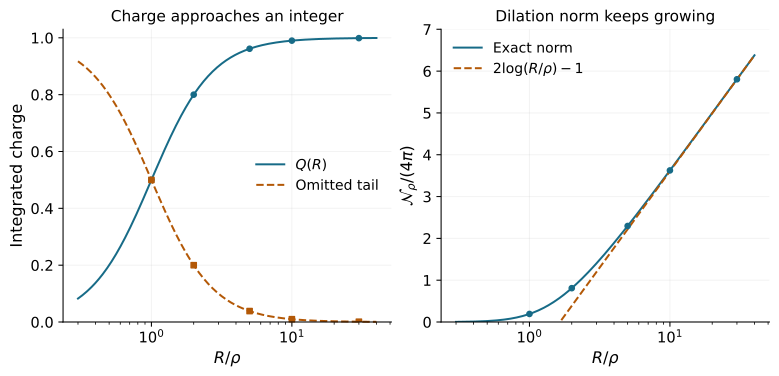
The same classical instanton has a rapidly converging integrated charge and a divergent dilation norm. Left: enclosed charge and omitted tail; points are numerical radial quadratures. Right: and its large-radius form .
Sector phases survive when the dilute gas fails
At a fixed regulator, the exact decomposition is
It gives periodicity without assuming a gas. If well-separated charge-one events and anti-events each had a finite fugacity per Euclidean area, their independent sums would instead give the additional approximation
Here is spacetime area. This conclusion requires a controlled size integral and small overlap probability, not merely integer charge.
The one-loop running supplies an instructive warning. In our convention,
at this order. The scale-covariant classical measure has power . Combining that power with the running saddle exponential gives
This is power counting, not a computation of the determinant and its logarithmic factors. The small-size behavior for CP(1) is stated explicitly in Bonanno, D’Elia and Margari, §2, Eq. (6). Their continuum study supports a logarithmic ultraviolet divergence of the conventional topological susceptibility. Thus a finite, regulator-independent gas fugacity cannot simply be assumed even where the running coupling at the instanton size is small.
At the opposite end, sizes comparable to leave weak coupling, and large events overlap. Extending the displayed measure to arbitrary large sizes would use semiclassics outside its domain. The ultraviolet small-instanton problem and the infrared loss of a dilute approximation are separate issues. Neither changes the degree of an individual smooth map. Nor does a divergent contact-sensitive susceptibility by itself determine the long-distance spectrum at a specified angle; the spin-chain comparison illustrates why the infrared question needs additional information.
Summary
An explicit oriented sphere map saturates the action bound and has unit charge for every positive size. Finite-radius charge, geometric charge with an explicit cap, and the dilation norm answer different regulator questions. Sector phases are exact at a fixed definition of the path integral; a cosine vacuum energy additionally requires a finite, controlled dilute-event measure.
The executable companion is examples/nonperturbative/sigma-models/topology-spins/. It compares analytic integrals with Cartesian differentiation and spherical triangle areas, including boundary tails and refinement.
Exercises
1. Stretch the instanton without changing its degree
For define . Compute its full-plane charge and action. Is the stretching a new minimum-action modulus?
Solution
Set . The measure contributes and the time derivative contributes , so the charge remains one. Rotational symmetry of the original map gives
Therefore
Only saturates the bound. Isotropic dilation changes the instanton size without cost; anisotropic stretching changes its shape and raises the action. Writing gives an excess . The companion checks the integral at three unequal stretch factors.
2. A gas with an explicit size window
Consider a deliberately regulated independent-event model with size density for each sign on , where is a fixed dimensionless input. Calculate its fugacity, theta-dependent free-energy density, susceptibility and summed event area per unit spacetime area, taking an event area to be . What happens as the two cutoffs are removed?
Solution
Integrating the density gives
The factor two counts both signs. Their summed event area per unit spacetime area is
This is a dilution parameter, not the actual covered fraction when events overlap. At fixed upper cutoff, the susceptibility diverges as the lower cutoff tends to zero, even though this parameter stays finite. At large upper cutoff it grows quadratically, violating the nonoverlap assumption; in the sigma model weak coupling has already failed around the strong scale. The regulated Poisson calculation is exact for the stipulated event model. It is not a derivation of a continuum O(3) gas.
References
- C. Bonanno, M. D’Elia and F. Margari, “Topological susceptibility of 2d CP(1) or O(3) non-linear sigma-model: is it divergent or not?”, Physical Review D 107, 014515 (2023), arXiv:2208.00185v2. Section 2, Eqs. (1)–(6), gives the charge, susceptibility and size-density power; §§4.2–4.3 discuss the regulated continuum and volume tests. Their CP coupling and connection require translation before comparison with our O(3) action.
- P. de Forcrand, M. Pepe and U.-J. Wiese, “Walking near a Conformal Fixed Point: the 2-d O(3) Model at theta near pi as a Test Case”, Physical Review D 86, 075006 (2012), arXiv:1204.4913v1 (PDF). Equations (1)–(2) define the continuum model; Eq. (9) gives the oriented spherical-triangle charge. Their coupling squared equals our .
Scrollable formula. Use Left and Right arrow keys to reveal hidden content.
Scrollable table. Use Left and Right arrow keys to reveal hidden columns.
Scrollable figure. Use Left and Right arrow keys to reveal hidden content.