Particle–Vortex Duality
A superfluid can lose order when its vortices proliferate. Describing that process with a vortex field exchanges a difficult phase fluctuation for an ordinary matter field coupled to a gauge field. The particle current then becomes gauge flux. We will derive the normalization of this statement from a regulated phase model, check the exact transformation on a finite cube, and calculate the response in its two long-distance phase regimes.
Preparation: Gaussian integration, conserved currents and compact gauge flux. The distinction between a gauge redundancy and a physical symmetry matters throughout. Units are , and the continuum velocity is set to one when evaluating the Gaussian response.
Begin with a finite phase integral
Take an oriented graph obtained from a cubic Euclidean spacetime lattice. A site variable is a compact phase. A link from to carries the background holonomy and a positive coupling . Use the normalized Villain kernel
Its normalization makes its zeroth Fourier coefficient one. The regulated partition function is
Each phase integral is over one period. There is no continuum limit or saddle approximation in this definition. The simultaneous replacement of by and by leaves it invariant. A pure-gradient source therefore has no physical effect.
Compute a Fourier coefficient by unfolding the image sum:
Consequently the same kernel has the exact expansion
Let be the incidence matrix: a link has at its tail and at its head. Inserting the expansion and integrating each phase gives a Kronecker delta, not a continuum delta function:
The integers are oriented conserved currents. The source phase is positive because we chose in the Fourier expansion. Reversing all current orientations produces the equivalent opposite convention. With the positive choice, the Euclidean worldline coupling is , as in the site's charged-matter conventions.
This is an exact change of representation of a specified finite regulator. It does not yet identify a critical continuum theory.
Solve conservation without losing global sectors
On a contractible cubic cell complex, an integer conserved link current is the boundary of an integer plaquette chain :
The coefficients are integers because the cells provide the integral chain complex, not merely a real-vector-space solution of . Plaquette chains differing by a closed two-chain give the same current. The sum must count each current once, either by fixing that redundancy or by choosing independent cycle coordinates.
In three dimensions a plaquette is dual to a link. Thus becomes a dual gauge field and the boundary becomes a curl. The redundancy becomes a gauge transformation. On a periodic lattice the extra classes in describe currents winding around the three cycles. A representation using only curls of a globally periodic potential misses them. One must retain the winding sectors, equivalently the appropriate dual flux sectors and holonomies.
To see where vortex matter enters, apply Poisson summation once more to the independent integer variables. They become real integration variables with a periodic comb of Fourier insertions. Set ; the insertions have unit integer charge under . Restoring the redundant description enforces closed vortex worldlines. This second transformation is also exact with the same finite regulator, gauge quotient and cycle sectors retained. Replacing its detailed loop weights by the local action of a complex field is a subsequent long-distance step.
The conventional continuum notation is
In a smooth patch the Gaussian current cost becomes
Here is the continuum phase stiffness, with mass dimension one; it need not equal the bare dimensionless lattice . The Maxwell coupling is when the kinetic term is written as .
A complementary local derivation introduces a real auxiliary current in the smooth phase action:
Integrating the single-valued part of imposes conservation. For a positively wound singular phase, , the remaining term is . Thus this orientation assigns positive phase winding dual charge . A charge- vortex field describes the opposite winding. Conjugating that field changes this naming convention without changing the physical current–flux map. The lattice derivation supplies the integer and global information that this local auxiliary-field argument alone omits.
What charge does a flux insertion create?
The Lorentzian continuation of the source term is
Varying the background, with , gives the coupling current
A flux through a spatial slice carries one unit of microscopic charge. In Euclidean spacetime a monopole insertion changes that flux and is the charged particle operator. Exact microscopic conservation forbids adding a monopole creation term to the action. It does not forbid defining a charged monopole operator in a correlation function.
This explains a terminology trap. The dual connection has a compact charge lattice and quantized flux, but no monopole fugacity in the action. It is often called “noncompact” in condensed-matter usage because flux is conserved. That usage does not authorize dropping large gauge transformations or flux sectors. The distinction is explicit in Seiberg et al., §1.1 and footnote 1 (PDF).
Calculate the phase response
First consider the regime with gapped vortices. The leading action is the Maxwell action above. Equivalently, integrate the smooth phase out of
For nonzero Euclidean momentum , define the transverse projector
Completing the square in gives
Here and . The local is the quadratic-source contact term. Omitting it would spoil transversality. Gaussian integration over the dual Maxwell field gives exactly the same kernel because each source vertex supplies one curl and the transverse gauge propagator supplies .
For a vortex condensate, retain its phase and add
Integrating gives a transverse Higgs term. The dual inverse propagator and the resulting particle response are
These formulas are Gaussian effective-theory results away from the interacting critical region. The superfluid kernel is nonanalytic at because it contains the Goldstone pole. The Higgs-phase kernel is analytic there: its leading term is proportional to . In particular the static density response approaches in the superfluid and vanishes as the square of spatial momentum in the gapped insulator. The value at exactly zero momentum requires the thermodynamic ensemble and global sectors, rather than substitution into an undefined projector.
The proposed critical theory uses a charge-one vortex field :
For , massive vortices leave a photon, dual to the particle Goldstone mode. For , a charge-one condensate Higgses , giving the particle insulator. The particle order-parameter mass and the vortex mass therefore tune opposite sides of the transition. One phase is gapless; calling both mass-sign deformations “massive phases” would hide the broken continuous symmetry. Matching the Wilson–Fisher critical point to the critical vortex gauge theory is the infrared particle–vortex statement, not an exact equality of their ultraviolet Lagrangians. See Karch–Tong, §§1 and 3.1 (PDF).
An exact finite-cube response check
The companion uses the eight vertices and twelve edges of one open cube. Its cycle space has dimension five. Choose a spanning tree; each of the five remaining chord currents is an independent integer. Conservation uniquely fixes the seven tree currents, so the finite-dimensional cycle sum implements the constraint exactly.
For link labels , the nonuniform benchmark is
Direct periodic phase quadrature evaluates the image-sum kernels and contracts the graph by eliminating one phase at a time. This method does not use the current expansion. Both methods give
The integer cutoff gives at and at . Raising it to five changes the ratio by less than . Phase quadrature with 10, 16 and 24 points per integrated phase converges to the same value. A nonconstant background gauge transformation changes the final answer by less than .
At zero source, differentiating the exact current representation gives
For , the curvature is . Symmetric finite differences of the independently integrated phase partition function have errors decreasing by approximately four when is halved. This tests the source normalization and its contact contribution, not only the partition function at zero source. A single cube has no thermodynamic transition and supplies no numerical test of the conjectured critical fixed point.
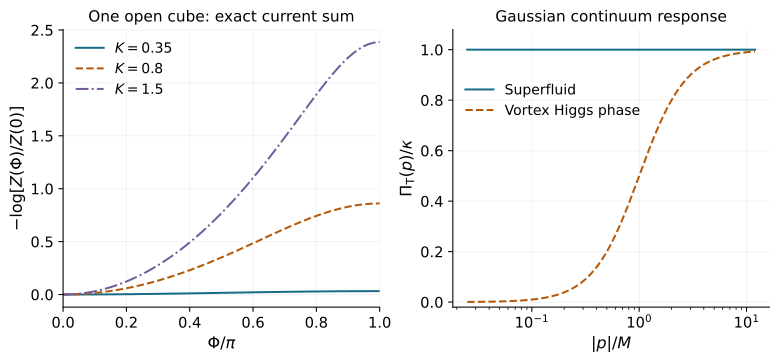
Left: the exact finite-cube current sum with a background angle on one edge and uniform on all edges. Increasing raises the free-energy cost of this gauge-invariant loop frustration. The five integer cycle sums are truncated only after convergence checks.
Right: the transverse response coefficient divided by . The superfluid is constant; a unit-charge vortex condensate gives . The Higgs gap is the common reference scale for the horizontal axis. This panel is the stated Gaussian continuum calculation, not a fit to the finite cube or a critical conductivity prediction.
Summary
Poisson summation turns compact phases into integer conserved currents with the source normalization intact. Their curl representation produces a dual gauge field, while global cycles retain winding information. The flux map fixes the charge of monopoles, and the Gaussian response distinguishes a superfluid photon from a Higgsed particle insulator. Identifying the two critical continuum descriptions requires an infrared duality statement beyond the exact regulated transformation.
The program, selected output and figure source are in examples/nonperturbative/bosonization-dualities/three-dimensional/. They reproduce the cube identity, source-curvature refinement and Gaussian response calculations.
Exercises
- Put the Villain phase model on a ring of oriented links with uniform . Give the links a total background angle . Derive and the curvature of at zero flux. Explain why solving the current constraint by discarding winding gives a wrong answer.
Solution
Conservation at each vertex requires the same integer on every link. It follows that
Only the total angle appears; redistributing it by a gauge transformation changes nothing. The terms are the harmonic currents. Keeping only the locally trivial sector would give and zero curvature at every . At fixed finite , the large- Gaussian approximation to the integer sum gives ; at small the leading result is . The crossover is finite-size physics, not a phase transition.
- In the vortex Higgs calculation, replace the unit-charge condensate by a charge- condensate, with integer . Find the Gaussian particle response and explain why a gapped photon no longer establishes a topologically trivial insulator.
Solution
Replace the condensate term by . Its transverse contribution is , so
The photon is massive, but the condensate leaves a gauge group. A minimal vortex of this condensate has and therefore particle charge by the current–flux relation. In the deconfined Higgs regime with the compact sectors retained, this residual gauge theory has nontrivial flux and charge lines; on a spatial torus it has ground states in the topological limit. Gaussian fluctuations around one vacuum cannot count those states. The unit-charge assumption in the main phase comparison excludes this residual topological order.
References
- Karch, Andreas, and David Tong. “Particle–Vortex Duality from 3d Bosonization.” Physical Review X 6 (2016), 031043. arXiv:1606.01893v2 (PDF), §1, Eqs. (1.1)–(1.2), §2.1, Eqs. (2.1)–(2.3), and §3.1: current normalization and the conditional continuum duality construction, including its stated holonomy limitation.
- Seiberg, Nathan, T. Senthil, Chong Wang, and Edward Witten. “A Duality Web in 2+1 Dimensions and Condensed Matter Physics.” Annals of Physics 374 (2016), 395–433. arXiv:1606.01989v2 (PDF), §1.1, Eq. (1.1), footnote 1 and its mass-deformation discussion: global charge, monopoles and the Goldstone/Higgs phase map.
Scrollable formula. Use Left and Right arrow keys to reveal hidden content.
Scrollable table. Use Left and Right arrow keys to reveal hidden columns.
Scrollable figure. Use Left and Right arrow keys to reveal hidden content.