Charge Lattices and Dirac Quantization
A proposed magnetic probe is allowed only if electrically charged probes can be transported around it consistently. This turns the two-patch monopole into a charge-quantization test. The same test explains why admitting a doublet Wilson line removes the smallest magnetic line available to an theory.
Preparation: Global gauge groups and monopole patching. We first use a real Abelian connection , transport and flux . Electric labels here are representation labels, not the external-source sign used in Gauss's law.
The Dirac condition is an overlap condition
The monopole potentials obey . A weight- field therefore obeys
Returning to the same point after requires
The same condition follows from comparing northern and southern cap definitions of a Wilson holonomy: their flux difference is . An unobservable choice of patch cannot change that phase. This is the Dirac quantization argument, without a physical string in either regular patch.
For an honestly normalized compact with a unit Wilson representation, and the transition itself requires . Seeing only even-charge matter does not erase the possible unit Wilson probe. If one instead changes the global probe normalization so only even electric weights are honest, the dual magnetic unit changes too. A matter spectrum alone does not decide which choice has been made.
A magnetic line in four spacetime dimensions can be defined by requiring this flux on each small sphere linking its worldline. It is a prescribed singularity of the fields at the line, often called an 't Hooft defect. This definition introduces a probe; it does not assert that the theory contains a finite-energy particle with that charge.
Two dyons test an antisymmetric pairing
A dyonic line has electric and magnetic labels . There are two contributions when the auxiliary patch surface for one insertion is swept past another: the electric coupling of the first to the second's magnetic transition, and the exchanged contribution with opposite orientation. Fix the positive sweep convention so the net phase is
For a purely electric first probe, this reduces to the Dirac phase just derived. Exchanging the two lines reverses the sweep and complex conjugates the phase, explaining the relative minus sign. Independence of the auxiliary surface requires
This is the Dirac–Schwinger–Zwanziger mutual-integrality condition. The surface formulation and its center-charge reduction are given in Aharony, Seiberg and Tachikawa, §1.1, Eqs.(1.3)–(1.4). Reversing every sweep orientation reverses but does not change the condition. It constrains which probes coexist, not the energy or abundance of dyonic particles.
Adding charges corresponds to combining insertions and reversing orientation changes both signs, so consistent charge sets form lattices. An integral shear preserves the pairing:
Preserving this pairing is necessary for a proposed relabeling, but does not prove a dynamical duality or show that it preserves a particular allowed line set.
Characters and cocharacters generalize the patch
Let be a maximal torus of a connected compact gauge group. An electric weight is a character . A magnetic patch winding is a cocharacter . Their composition has the form
Thus the character lattice and cocharacter lattice are paired integrally. This is the group-theoretic version of . The global group determines which infinitesimal weights exponentiate to characters and which magnetic paths close. Starting from a Lie algebra's full weight or coweight lattice without imposing that closure loses this information.
For a compact simply connected semisimple group the electric lattice is the weight lattice and the magnetic cocharacters form the coroot lattice. A central quotient restricts electric characters and can enlarge the magnetic lattice; for the adjoint global form these become the root and coweight lattices. The explicit calculation below proves the needed instance. Tong §§2.6.1–2.6.2 explains the broader lattice statement. Weyl-related labels describe gauge-equivalent orientations; they should not be counted as different charge types.
Work the SU(2)/SO(3) factor of two
Use . A Cartan-valued monopole transition is
It closes in only for even , but closes in for every integer . For an electric weight , set . The letter on this page is an integer charge label, not a coupling. Its patch phase is
All weights are allowed, so odd must pair with even magnetic . For , honest pure Wilson weights have even , permitting odd magnetic windings. In these integer coordinates the dyon condition is
These differ from the earlier unit- coordinates: the fundamental weight is .
Two simple mutually integral lattices are
A third is . For two points in the third lattice, write and ; then is integral. Its odd-magnetic generator is the dyon , not a pure Wilson representation. The discrete theta choice determines which of the two completions is used: an allowed cocharacter alone does not guarantee a genuine pure-magnetic insertion.
The figure shows the three lattices in the same coordinates. Compare the nearest nonzero point on each axis and the diagonal generator.
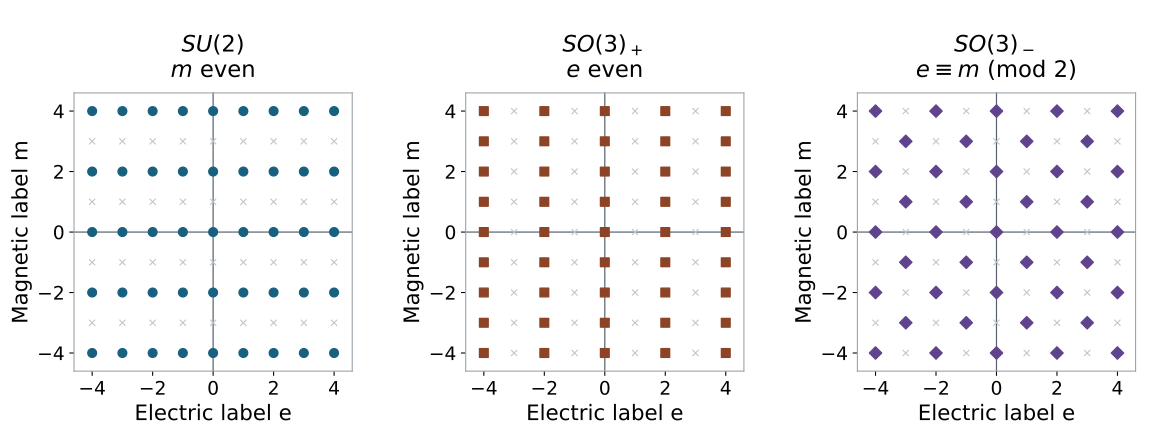
Allowed charge representatives at fixed local algebra : even, even, or . Filled markers are allowed; pale crosses are excluded. Each displayed lattice has integral pairing . Points related by simultaneous sign reversal are Weyl-related; the plot shows representatives, not distinct particle species. The third lattice's odd magnetic line needs an odd electric dressing.
All three are maximal among integral sublattices containing the even-even lattice. For example, a charge pairing integrally with must have even , so no point outside can be added. Pairing with similarly forces even ; pairing with forces even. This is a short completeness calculation, not a statement that every lattice point is a distinct stable particle.
Summary
Dirac quantization is the consistency of electric transport with magnetic patching. Characters and cocharacters retain this condition for a global gauge group. In units the pairing has a factor , making the three displayed line lattices distinct even though their local Lie algebra is the same.
Exercises
1. Test an inconsistent proposal. Can the fundamental electric probe and the minimal odd magnetic probe both be genuine in the same stated theory?
Solution
Their pairing is , so the surface sweep gives . They cannot both be independent genuine lines in this mutually local theory. Keeping one requires excluding the other as a genuine insertion, or retaining extra surface data. A local adjoint action alone does not remove this phase.
2. Apply a theta shear. For , find the images of the three displayed lattices and verify preservation of the pairing.
Solution
The magnetic parity is unchanged, so preserves the lattice. If is even, the new electric label has the same parity as , giving . If , the new electric label is even, giving . Two applications return either lattice. Substitution gives
so is unchanged, including its factor . The plus shear has the same action on parity labels; the integer sign is fixed only after a theta/source convention is declared.
References
- O. Aharony, N. Seiberg and Y. Tachikawa, Reading between the lines of four-dimensional gauge theories (2013), arXiv:1305.0318v5, §§1.1–1.3: mutual pairing and the three choices.
- D. Tong, Gauge Theory (2018), §1.1.2, pp.6–8; §§2.6.1–2.6.2, pp.89–97: Dirac patching and weight/co-root lattices.
Scrollable formula. Use Left and Right arrow keys to reveal hidden content.
Scrollable table. Use Left and Right arrow keys to reveal hidden columns.
Scrollable figure. Use Left and Right arrow keys to reveal hidden content.