Associators and Fusion Categories in QFT
Three Ising duality lines can fuse to a fourth duality line through two intermediate channels. Fusing the first pair first or the last pair first gives two bases of the same junction space. An associator is the matrix relating those bases. The requirement that four lines can be regrouped consistently is the pentagon identity.
We will give a complete set of Ising associators, evaluate a nontrivial pentagon, and explain what a full check tests. This makes clear why a fusion table is important but insufficient.
Preparation: The lines and multiplicities of Ising fusion, together with elementary changes of basis in a finite-dimensional vector space.
A junction space for each allowed fusion
Write for topological junctions that merge into . Its dimension is . All Ising junction spaces are zero- or one-dimensional, but composing them can produce larger spaces.
The two decompositions of a three-input junction with output are
Here and label different internal edges of a fusion tree. Choose a basis vector in each allowed one-dimensional space. Our convention is
This equation defines the row/column order and the direction of the basis change; it should accompany any list of symbols. A different convention can transpose, invert, or rephase the displayed matrices without changing the physical category.
For , both and can be or . The associator is a two-by-two matrix. In every other nonempty Ising case the matrix is one-by-one. Empty cases have no junction and no physical matrix entry.
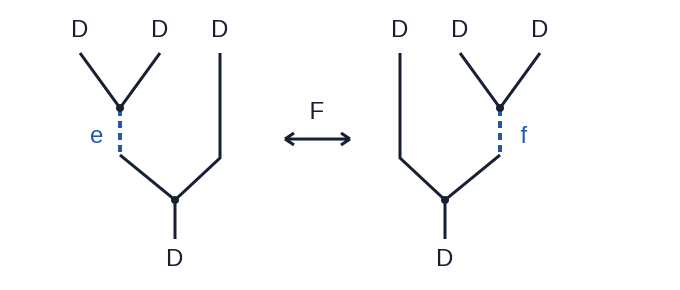
Two bases of the same junction space. The dashed labels range over . The matrix changes the fusion order; it does not add a new physical junction space. Lines run from the three inputs above to the output below; the geometry is schematic.
Complete Ising data in one gauge
Use the fusion rules , , and . The following specifies all admissible associators in a strict-unit gauge:
The only other negative scalar values are
All other admissible scalar associators are , including those containing the identity. For algebraic formulas that sum over labels, set inadmissible entries to zero. In the two negative cases the intermediate labels are forced: both are .
These data describe the positive Ising, or , choice. They are a concrete basis convention for the crossing data discussed by Chang et al., §6.1.1. The distinction between a sign in a chosen junction basis and an inequivalent category requires care: the same fusion table also permits a different Tambara–Yamagami choice. Fusion multiplicities alone do not decide between them.
Every listed matrix is unitary. For example , so probability amplitudes in an orthonormal junction basis are preserved. This is necessary, but unitarity of individual changes of basis does not yet establish their consistency when composed.
The pentagon as two routes between trees
Start with and end with . There is a route with two reassociations and another with three. Using the convention above, equality of their coefficients reads
The external labels are ; specify the initial and final trees. The intermediate label is summed. Only compatible fusion channels contribute. The identity says that a physical junction network has an amplitude independent of which sequence of local reassociations one used to describe it. It is not an additional associativity law for numerical multiplication.
Take four inputs and total output . The initial and final internal edges next to the output are forced to be , while . On the short route, the middle pair must have output opposite to , because . The short-route matrix is therefore
On the long route the first and last moves give . The middle move has value , equal to for and for . Thus the same pentagon is
For , the two paths on the right give , as required by the forbidden short route. For , they give . These cancellations are why the scalar signs cannot simply be omitted.
With total output , the middle scalar is instead in both channels, giving . Checking only this latter case would miss the essential sign test above.
A full finite check and what it establishes
There are only three simple labels, so all cases can be checked without truncating a physical Hilbert space. For each external tuple , enumerate all initial and final fusion trees. For each pair, evaluate the short and long routes using the complete table.
The accompanying exact-arithmetic calculation checks 136 admissible matrix entries of the pentagon, as well as all 33 nonempty associator blocks for unitarity. It also deletes the two negative scalar signs as a diagnostic: individual blocks remain unitary, but 12 pentagon entries fail. Thus the calculation tests more than or a rearranged copy of the fusion table.
This establishes consistency of the stated finite associator data with the pentagon and unitary bases. It does not independently construct the complete Ising CFT or prove all of its correlator sewing conditions. The physical identification uses the established Ising defect construction; the calculation verifies the junction algebra used on this page.
Changing a junction basis
Rephase each allowed junction by , with and trivial phases on unit junctions. The corresponding change is
Both routes around the pentagon acquire the same ratio of the initial-tree and final-tree phases; internal phases cancel. The pentagon therefore survives. The retained calculation also verifies it after an explicit nontrivial rephasing, which guards against mistaking one numerical table for a basis-independent observable.
The objects, junction spaces, fusion, identity, duals, and coherent associators form a fusion category. Here that language organizes operations already encountered in QFT. It does not assert that the underlying theory is nonassociative. Nor does it automatically equip two-dimensional defect lines with a braiding: exchanging their order would require additional data and a different geometric operation.
Summary
Ising's nontrivial two-channel associator is a Hadamard matrix, but two additional scalar minus signs are essential. The pentagon compares complete reassociation routes, and a four- example with total output detects a failure invisible in . Rephasing junction bases changes the table while preserving its coherent content.
Exercises
1. A plausible but inconsistent table
Keep and replace every scalar associator by . Compute the two sides of the four-, total- pentagon for . Why does unitarity fail to detect the error?
Solution
The short route is still zero: it requires , while . The long route is now , because the middle negative sign was removed. Each scalar remains a unit phase and remains unitary, so all individual changes of basis pass a unitarity test. It is their incompatible composition that fails.
2. A harmless change of signs
Rephase only by . Determine the new . Explain why this change, unlike the previous exercise, preserves every pentagon.
Solution
The left tree receives a minus sign if and the right tree if . With ,
All other affected entries must be transformed by the same junction-phase rule; they are not adjusted independently. In any pentagon, the ratios on successive moves telescope to the ratio of the outer trees. Both routes therefore transform equally. The negative scalar values cannot be discarded independently while keeping the rest of the table fixed.
References
- Chi-Ming Chang, Ying-Hsuan Lin, Shu-Heng Shao, Yifan Wang, and Xi Yin, Topological Defect Lines and Renormalization Group Flows in Two Dimensions, §2.2.2 and §6.1.1, especially Eq.(6.2): pentagon, junction bases, and Ising crossing data.
- Shu-Heng Shao, What's Done Cannot Be Undone: TASI Lectures on Non-Invertible Symmetries, §§3.4.1–3.4.2: the distinction between fusion and junction data.
Scrollable formula. Use Left and Right arrow keys to reveal hidden content.
Scrollable table. Use Left and Right arrow keys to reveal hidden columns.
Scrollable figure. Use Left and Right arrow keys to reveal hidden content.