The Chiral Anomaly
An electric pulse can change the difference between right-moving and left-moving fermion number even when the fermion mass is zero. We will count the levels that cross zero on a circle, then obtain the four-dimensional coefficient by resolving a magnetic field into one-dimensional channels. The vector current remains conserved throughout.
Preparation: Weyl fields and source Ward identities. The gauge field is a prescribed background. We use , the unit current , and the coupling current . These are not the alternative Maxwell-source current .
Follow a filled level through zero
Use the site's 1+1-dimensional extension, with
The massless Hamiltonian in temporal gauge is
Thus positive chirality travels to the right. On a circle of length , choose antiperiodic fermions to avoid an initial zero mode. Writing gives
Fill negative energies at . During a spatially uniform pulse the Hamiltonians are diagonal in the same mode basis, so occupation numbers in that basis stay fixed, even at the crossing. Increase from to . The right level becomes negative but remains empty: relative to the final filled sea it is a right hole. The left level becomes positive but remains occupied: it is a left particle. Consequently
where and . This subtraction compares states with the same vector-gauge-compatible vacuum prescription. A fixed symmetric cutoff on the canonical integer alone is not such a prescription: a large gauge transformation relabels and moves its endpoints.
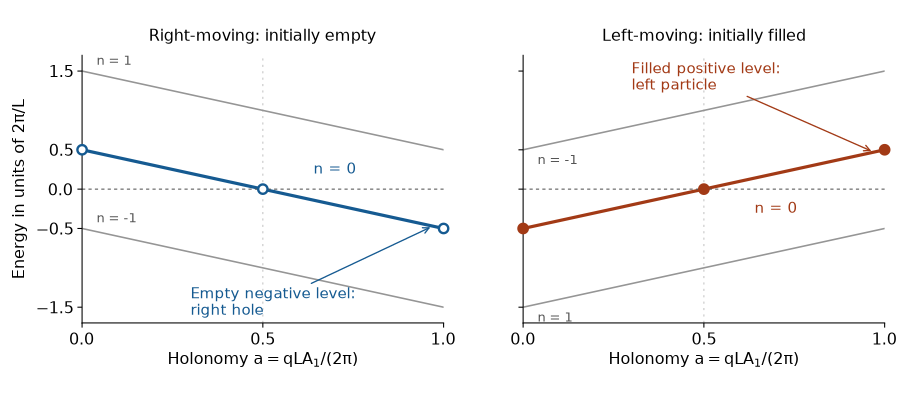
The exact circle spectrum during one flux insertion. Open and filled circles show the fixed occupation of the crossing mode; the dashed line is zero energy. Occupation follows the state, while particle and hole labels compare it with the final negative-energy sea. Gray lines are the neighboring modes. The result is , .
At the end, the backgrounds are gauge equivalent. The transformation preserves the spin boundary condition and shifts by one. The state obtained by the pulse is not the final vacuum, although the spectrum has returned after relabeling.
The integrated Ward identity counts the same flow
The density of longitudinal momenta is . For the unit-normalized axial current
the gauge-invariant current prescription gives
For the pulse, and there is no spatial boundary flux. Hence
The circle calculation establishes this integrated normalization for integer flux insertion. A local Ward identity for arbitrary smooth backgrounds additionally requires a local regulator; the measure calculation explains that step. Between integer holonomies, simply counting instantaneous crossings gives jumps rather than the complete regulated current expectation. The sea polarization supplies the rest; integer endpoint flow avoids that ambiguity.
A mass introduces a distinct breaking term. Under and ,
The quantum identity therefore includes in addition to the anomaly. Turning off the mass removes the explicit term; it does not remove the electric-field contribution.
Magnetic flux supplies the four-dimensional channels
Now use the four-dimensional site chirality and orientation . Take constant and a uniform longitudinal pulse , initially with . These are lower-index field-strength components; they avoid an implicit sign choice for a three-vector magnetic field.
For ,
The transverse oscillator has energies . Only its , sector has no transverse gap. The right Weyl Hamiltonian is and the left one is its negative, so these lowest levels have and . Each magnetic flux quantum supplies one copy of the circle calculation:
On a transverse torus this is an integer, with the potential described in patches. Higher Landau levels have paired longitudinal branches and no net axial flow. Multiplying the lowest-level degeneracy by the longitudinal crossing density gives
For , the lowest spin reverses and the same signed formula follows. In this background . Lorentz covariance, locality and the parity-odd dimension-four structure therefore give the Abelian Dirac identity
This is a vector-current-preserving prescription for a Dirac fermion. It is not the consistent gauge anomaly of one Weyl fermion. Insertions add the usual transformation contacts. For a non-Abelian background the corresponding expression has the representation trace of , with the current's internal generator included when appropriate.
The negative sign is tied to our chirality and gauge definitions. Tong's chiral-anomaly discussion uses the opposite four-dimensional chirality convention; his axial current must be reversed when using the site's convention. Two local calculations test the result. The triangle with two electromagnetic probes predicts the same coefficient and resolves the momentum dependence of the mass term. The fermion measure fixes it by counting chirality in a regulated Euclidean basis.
Summary
One unit of circle holonomy produces a left particle and a right hole, preserving vector charge while changing axial charge by . Magnetic flux counts how many such channels occur in four dimensions. The anomaly survives at zero mass and is distinct from both an explicit mass term and a gauge-consistency obstruction.
Exercises
- Repeat the circle experiment with decreasing from to . Count particles and holes and compare the integrated identity.
Solution
Two initially occupied right levels cross upward and remain occupied; two initially empty left levels cross downward and remain empty. Thus and . Vector charge is zero and . Since , the integrated formula gives .
- Put three positive flux quanta through the transverse torus and insert two positive longitudinal holonomy units. What axial charge is produced? What changes if the transverse flux reverses?
Solution
There are three lowest-level channels and each changes axial charge by , so . Equivalently integrate over the spacetime box, using the two flux integrals and . Reversing the transverse flux reverses the lowest spin and yields ; the number of channels stays three.
References
- Bilal, A., Lectures on Anomalies, §§3.3–3.7, especially Eqs. (3.18)–(3.22), for the regulated axial identity and its normalization. Its gamma/current conventions require translation.
- Tong, D., Gauge Theory, chapter 3, §3.1.1, printed pp. 122–126, for the spectral-flow mechanism.
Scrollable formula. Use Left and Right arrow keys to reveal hidden content.
Scrollable table. Use Left and Right arrow keys to reveal hidden columns.
Scrollable figure. Use Left and Right arrow keys to reveal hidden content.