Theta Dependence and Strong CP
A complex quark mass can be made real by a chiral field redefinition, but that redefinition also changes the topological term through the fermion measure. The physical strong-CP parameter is the coefficient left after all quark masses are positive. Once this invariant angle is identified, the two-flavor pion action predicts the leading curvature of the vacuum energy near zero angle.
Preparation: The axial anomaly, pion masses and scalar sources and theta-sector weights. Consider zero-temperature QCD with positive nonzero light-quark masses after alignment. The explicit vacuum calculation is leading-order two-flavor chiral theory, without electromagnetism. It does not determine a neutron electric dipole moment or the full QCD phase diagram.
State the mass and topological conventions first
Our local action contains
The site convention is . For an active constant change , the measure therefore has . One way to fix this sign is the local identity with .
Now make a passive change of integration variables, . Expressing the old action and measure in the new variables uses and gives
Flavor-dependent rotations give the same result with the sum of their angles. In the full quark theory use . Integrating out a massive quark transfers its phase into the remaining theta coefficient. This agrees with the earlier operational definition: is the coefficient in the positive-quark-mass basis.
The often printed uses a different complete mass/anomaly convention. For example, conjugating which matrix is called reverses its determinant phase. Importing that plus sign into the mass term and negative anomaly written above would fail the explicit change-of-variables test. No physical claim depends on this naming choice when the full dictionary is translated.
If a quark is exactly massless, its axial rotation can change theta without creating a mass phase; the corresponding invariant is then absent. CP reverses , so zero angle is CP invariant. The point requires a separate branch/vacuum analysis even though the parameter maps to itself modulo .
Move the angle into the two light masses
Begin in the positive-mass basis with angle . An equal passive rotation of removes the explicit theta term and produces
The leading potential is , where . For a neutral aligned field , introduce and . Then
The last equation follows by minimizing with respect to . Near zero angle the stable branch has
The lighter quark carries more of the vacuum phase. Setting both phases to for unequal masses would miss this relaxation and give the wrong curvature.
Minimize the potential and differentiate
Write the mass combination before minimization as
Its maximum over is the Euclidean norm of the two coefficients. Consequently the minimized leading energy is
Expanding gives
This positive quantity is the leading topological susceptibility. It has dimension four. The QCD mass scheme cancels between and the reduced mass, provided all quantities use a common scheme. The result is also the second derivative of the Euclidean vacuum energy defined by sector weights ; contact prescriptions belong to that definition of the susceptibility.
For illustrative GeV, GeV, GeV and GeV, one finds . The companion minimizes the original potential directly and obtains the curvature by successively smaller central differences, independently of differentiating the square-root expression. Keeping is a negative control: it gives , which disagrees whenever the masses differ.
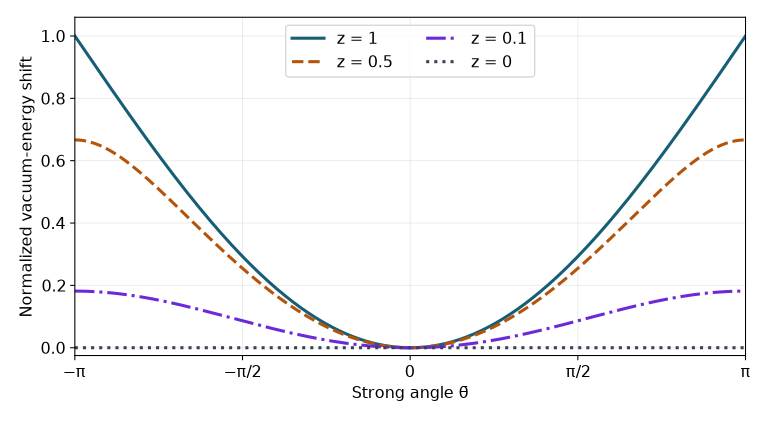
Leading two-flavor alignment at fixed , for . The equal-mass cusp belongs to this leading potential; higher-order terms require special care near . These curves are analytical chiral-model predictions, not numerical QCD data.
Limits, electric dipoles and an axion
For positive unequal masses the square root is smooth. At equal masses it becomes , with a cusp at . Near that point the leading restoring force can vanish, and terms neglected in the ordinary small-mass expansion can decide vacuum structure. As either mass tends to zero, vanishes, as required by the extra available field rotation.
A small nonzero permits CP-odd hadronic observables. For a neutron dipole, for example, , where is a separate nonperturbative matrix element. The susceptibility cannot replace it. Inferring a theta constraint from a measured dipole bound needs that hadronic input and its uncertainty.
If a model contains an axion with coupling and no competing explicit potential, its QCD potential is . Expanding around the aligned minimum gives . An additional potential can displace that minimum: at first order, . Thus neither a generic light pseudoscalar nor the chiral curvature alone establishes a solution of the strong-CP problem. The shift symmetry, anomalous coupling and control of explicit breaking are model inputs.
The neutron dipole matching calculation shows the different input required for a quark electric dipole: a neutron tensor charge at the same scale. The response to involves the topological source; the tensor charge alone cannot supply .
Summary
An anomalous quark redefinition moves phase between the mass matrix and theta. With the stated action and anomaly, the invariant is . Minimizing the two-flavor chiral potential then gives a curvature proportional to , distinct from the matrix elements needed for electric dipoles.
Exercises
- Take two nonzero complex masses and a theta coefficient . Find passive axial angles that make both masses positive, and verify the remaining theta coefficient. What changes if ?
Solution
Choose and . Each mass phase shifts by and the topological coefficient by , leaving . If , its phase is undefined and its axial rotation is unconstrained by a mass term. After removing the down-quark phase, choose the up rotation to remove the remaining theta coefficient. One should not apply an formula to a singular mass matrix.
- Derive the fourth derivative and its ratio to . Evaluate equal masses and explain why a single cosine is not generally the leading aligned potential.
Solution
Set . Expanding the square root through fourth order gives
For equal masses , so . A potential instead has ratio . It reproduces the same curvature only by construction and misses the higher derivatives because it omits the pion's vacuum realignment. In a strongly hierarchical mass limit the ratio approaches ; the curvature itself vanishes if that limit is obtained by sending the lighter mass to zero.
References
- G. Grilli di Cortona, E. Hardy, J. Pardo Vega and G. Villadoro, The QCD axion, precisely (2016), arXiv:1511.02867v2, §2, Eqs. (3)–(11), pp.4–5: mass-phase transfer and leading aligned potential; the discussion after Eq. (11) distinguishes it from a single cosine. Their angle/mass-phase convention is translated through the explicitly stated action above, while there is here.
- A. Pich, Chiral Perturbation Theory (1995), hep-ph/9502366v1, §4.3, Eqs. (4.6)–(4.12): anomalous source transformations. The local measure sign here follows the site's regulated Jacobian.
Scrollable formula. Use Left and Right arrow keys to reveal hidden content.
Scrollable table. Use Left and Right arrow keys to reveal hidden columns.
Scrollable figure. Use Left and Right arrow keys to reveal hidden content.