W-Pair Production and Electroweak Gauge Cancellations
A longitudinal polarization grows like its energy divided by its mass. Individual diagrams for therefore grow with energy. The complete tree amplitude stays finite at a fixed nonforward angle because the photon, and neutrino contributions have precisely related coefficients. We will calculate that cancellation rather than infer it from a symmetry slogan.
Preparation: Electroweak mixing, charged currents and gauge Feynman rules. We take , external on-shell bosons and tree level; this is the leading narrow-width production amplitude. Observable four-fermion final states and finite-width effects require further diagrams and a consistent unstable-particle treatment.
Rotate the non-Abelian action
Write and . The real field strengths reorganize as
Together with , their action is . It determines the cubic and quartic terms together. For example the quartic terms containing neutral vectors and the four-charged-vector term are
Expanding includes , and contact interactions. They are required, for example, in vector–vector scattering. They are not independent adjustable coefficients of the renormalizable action.
For all-incoming field legs define
Differentiating the cubic action gives the vertices in ,
For a direct sign check, the charged-basis color contraction is . Multiplying by and the projections gives these two coefficients. The fields and are conjugates: an outgoing negative particle contracts with , and conversely. This distinction fixes the momentum placement when using the all-incoming rule.
Write every production diagram
Let be the incoming electron and positron momenta and the outgoing momenta. Set , , and use outgoing polarization vectors . Suppress the stars below for real longitudinal polarizations. For electron chirality define and
The photon–electron vertex is , the –electron vertex is , with , . Combining them with the vector and neutrino propagators gives
For a right-handed electron . There is no contact in the renormalizable Dirac kinetic term, and no ghost exchange in this physical tree process. Higgs exchange is proportional to the electron Yukawa coupling and vanishes in the stated limit. Thus these three diagrams are complete at this order. Current conservation removes the gauge-dependent longitudinal part of the neutral propagator; electron Goldstone couplings also vanish in this limit.
Evaluate the longitudinal amplitudes
In the center-of-mass frame write , , , , . Choose
These obey and . In the Dirac basis, one explicit set of external spinor phases is
The subscripts on label the physical positron helicity. These give and . Direct contraction of the displayed tensors then yields
For the left channel the three contributions are , , and . For the right channel they are , , and zero. These formulas keep the finite masses and all longitudinal-polarization terms; replacing by too early would lose their finite limit.
At a fixed angle with , expand . The expressions above give
Since and , all growth cancels. Keeping the next term in the denominator and gives
The signs refer to the stated external spinor phases; relative diagram signs in each channel are essential. The fixed-angle expansion is not uniform in the forward region, where becomes small. It cannot be integrated over all angles term by term to obtain a total high-energy cross section.
A numerical cancellation with a negative control
For , and , direct gamma-matrix evaluation gives:
| 5 | ||
| 20 | ||
| 80 |
The differences from the asymptotic limits decrease by approximately four when doubles. The companion obtains the diagrams from spinor matrix products and separately evaluates the closed formulas above. Removing the neutrino graph leaves an amplitude growing as in the left channel; removing the leaves that growth in the right channel. Merely testing the sum at one energy would not reveal this structure.
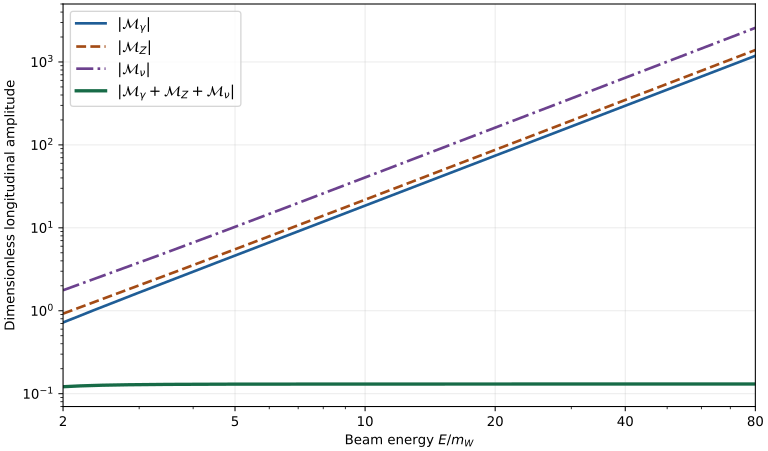
The calculated left-channel amplitudes at . Magnitudes are plotted for readability; the neutrino contribution has the opposite sign to the two neutral exchanges in this convention. The finite sum requires coherent addition before taking an absolute value. These are tree amplitudes for fixed polarizations, not measured production rates.
Changing the incoming particles tests a different cancellation. In longitudinal vector scattering, the contact and Higgs-exchange amplitudes have a residual high-energy term in the charged-to-neutral Goldstone channel, where is the single-Higgs coupling normalized to its doublet value. It vanishes for . The Higgs-exchange calculation takes the fixed-angle, high-energy limit and derives the coefficient.
Summary
One non-Abelian action fixes cubic and quartic vector couplings. In electron–positron production the complete photon, and neutrino exchanges cancel the longitudinal power growth. The finite fixed-angle limits provide a concrete check on charge signs, mixing relations and the treatment of polarization vectors.
Exercises
- Multiply only the vertex by , keeping all other tree inputs fixed. Find the leading right-electron longitudinal amplitude at large fixed-angle energy.
Solution
The uncanceled change is . Since , it has leading behavior
This isolated modification violates the renormalizable gauge relations. A consistent effective theory can modify vertices, but it also specifies additional operators, correlations and an energy range; this negative control is not such a completion.
- For the displayed fixed-helicity initial state derive the high-energy longitudinal differential cross section at a fixed angle. Include the correct final-state counting.
Solution
For distinguishable and a specified initial helicity there is neither an initial spin average nor a final . Thus . The two limits give
An unpolarized beam average would weight each nonzero initial helicity channel by . These expressions concern only two longitudinal final vectors and a fixed-angle limit, not the full polarization-summed cross section or its forward region.
References
- A. Denner, Techniques for the calculation of electroweak radiative corrections at the one-loop level and results for W-physics at LEP200 (1993), arXiv:0709.1075, §5.2.5 Eq. (5.14), §§11.1–11.2 Eqs. (11.9)–(11.15), Appendix A Eqs. (A.6)–(A.7), (A.13)–(A.14). The explicitly defined tensor and external-state phases above fix our invariant-amplitude signs; his standard-matrix-element expression has an overall opposite sign in this ordering.
- QFT.org gauge and ghost rules, for differentiation of the canonical non-Abelian action.
Scrollable formula. Use Left and Right arrow keys to reveal hidden content.
Scrollable table. Use Left and Right arrow keys to reveal hidden columns.
Scrollable figure. Use Left and Right arrow keys to reveal hidden content.