Radiative Corrections to Measured QED Rates
Two experiments can agree on the QED coupling and report different accepted muon-pair rates because they count nearby photons differently. We will specify such a measurement and calculate how its rate changes when the unresolved energy cut changes. The infrared regulator cancels; the detector cut does not.
Preparation. Use muon-pair production and soft-photon emission. Take pure QED, , physical charges , and . Stay away from narrow resonances and electroweak-dominated energies. Both masses remain nonzero in radiation denominators.
Define a rate that can be counted
In the beam center-of-mass frame, draw a cone of half-angle about each outgoing muon. Add the four-momentum of any photon inside a cone to that muon's four-momentum, including hard photons. Count the resulting dressed muon directions. Outside both cones accept the event only if the total photon energy is below . At relative order there is at most one real photon, so this condition is unambiguous. Consider the differential rate at the central Born direction, , or a sufficiently narrow symmetric bin about it.
The useful hierarchy is
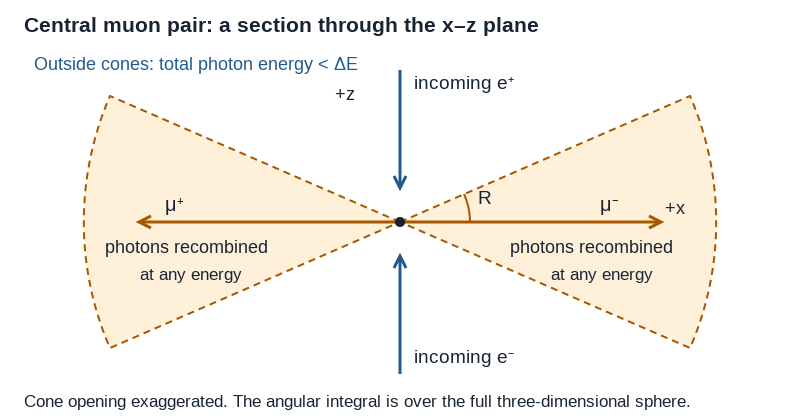
The central geometry. The shaded sectors are planar sections of three-dimensional cones, not their solid angles. The calculation integrates the full sphere outside the cones of half-angle .
The cones do not touch the incoming beams. A photon collinear to a final muon is recombined regardless of energy; a hard photon along an incoming beam is vetoed. Thus the measurement is inclusive in final-state collinear splittings but not in initial-state radiation. The high-energy Born normalization is
We calculate the complete leading-soft coefficient of at the chosen direction, including interference. Finite hard virtual terms and hard photons inside cones supply a cut-independent order- term that is not determined by the soft approximation. The difference between two small energy cuts isolates the calculated coefficient without pretending to know that term.
Keep the four-leg soft current
Let and . With for incoming and for outgoing particles, define
The relative signs follow from the external propagator poles. The null transversality makes nonnegative, but its pairwise interference terms are not separately positive. Denner, §§7.1–7.2, derives these external-line factors and the real soft phase-space normalization; his physical-charge vertex agrees with our .
Use beams along , the negative muon along , and . For a unit axis introduce the neutral-pair current
The full current is . Their scalar product is proportional to . The accepted angular region is invariant under , so its interference integral vanishes. This cancellation relies on the central geometry and symmetric cones. At a different scattering angle, or with asymmetric acceptance, the four-leg interference must be integrated rather than dropped.
Calculate the cone coefficient
Define and
A pair's full-sphere integral is , where
For the outgoing pair the cone cut is along its own axis. Direct integration gives
For the electron pair it is simpler to subtract the two muon cones from the full sphere. On a circle of fixed , put . The azimuthal average of its pair intensity is
To obtain it, use and differentiate with respect to . Counting both caps and the factor yields
This one-dimensional integral is regular even for tiny electron mass because the removed cones are far from the beam. It retains the finite cone geometry as well as both masses. The companion compares it with direct two-dimensional integration of the full four-vector current, including its interference, at finite masses and several cone angles.
In the stated hierarchy, the removed electron caps contribute only , whereas the muon collinear logarithm becomes a cone logarithm:
In contrast, with no recombination the central full-sphere coefficient is and contains . Taking at fixed is finite for the final-state contribution. Taking first recovers the mass-regulated logarithm. These limits do not commute.
Cancel the regulator and compare two resolutions
Use a common lower soft-photon energy separator and an upper soft matching energy , with . This is not a photon mass. In the leading eikonal region, unitarity supplies minus the integrated real-emission probability in the no-emission rate; the amplitude has half this real suppression. Consequently the logarithmic terms, in units of the Born rate, are
where . Radiation inside cones is accepted throughout this soft region; hard accepted radiation above belongs to matching. Adding the two terms cancels exactly and leaves . The arbitrary cancels against the finite hard contribution in a complete order- calculation. Denner's photon-mass regulator gives the same soft logarithm but different intermediate finite terms; we do not mix those finite terms with this energy-separator prescription.
The massive decay with a photon-energy cut carries out the real and virtual integrals with a different measurement. Here the accepted angular region inside each cone is what leaves multiplying the energy logarithm.
For two cuts in the soft hierarchy the unknown cut-independent term cancels:
The power remainder is at fixed masses, cone and smooth angular bin; its coefficients can contain collinear enhancements. The ratio equals one plus the displayed leading correction at this order. Increasing the cut increases the accepted rate. A large requires resummation. Hard initial-state radiation also changes the annihilation invariant mass and eventually requires an energy convolution, not one universal multiplicative constant.
Summary
Real and virtual soft photons cancel an auxiliary regulator only after the measurement is specified. Muon recombination removes final-state mass singularities from the soft slope and replaces them with cone dependence. A prepared electron beam retains its collinear logarithm. The calculated two-cut difference is a resolution prediction, not a full finite NLO rate.
Exercises
- If at fixed nonzero masses, recover . Then take at fixed in .
Solution
At the cap integral vanishes and . At fixed , instead, gives , with no muon mass. Its small- limit is .
- Show what regulator dependence remains if the real photons inside the cones are omitted, but the same virtual correction is retained.
Solution
One would obtain . Its derivative with respect to is , rather than zero. This is a different, infrared-unsafe definition that vetoes arbitrarily soft photons in a finite angular region. It is not the recombined observable.
References
- Denner, Ansgar. 1993. “Techniques for the calculation of electroweak radiative corrections at the one-loop level and results for W-physics at LEP200,” §§7.1–7.2, Eqs. (7.7)–(7.21), printed pp. 47–50. arXiv:0709.1075v1.
Scrollable formula. Use Left and Right arrow keys to reveal hidden content.
Scrollable table. Use Left and Right arrow keys to reveal hidden columns.
Scrollable figure. Use Left and Right arrow keys to reveal hidden content.