Three-Nucleon Systems and Efimov Physics
Neutron–deuteron scattering distinguishes two- and three-body inputs: its doublet channel needs one leading three-body datum; its quartet does not. Their spin–isospin exchange kernels explain why. We fit the triton binding energy and predict scattering with separate numerical and cutoff tests.
Preparation: The deuteron pole and the origin of a three-body short-distance phase. The calculation is leading-order pionless EFT with equal nucleon masses, no Coulomb interaction and zero effective ranges. It retains the unequal physical-like singlet and triplet scales; it does not replace nucleons by identical bosons.
Exchange remembers spin and isospin
An S-wave neutron and a spin-one deuteron have total spin (doublet) or (quartet), with total isospin . The doublet can propagate either a spin-triplet/isospin-singlet pair or a spin-singlet/isospin-triplet pair . In a convenient phase convention for the singlet pair, one-nucleon exchange acts on these channels as
Here . These factors follow from fermion exchange, not a multiplicity guess. For total spin projection , use the normalized three-spin states
Construct identical states for isospin. The pair-channel basis is and . Projecting gives . In the quartet all three spins can be up, so the spin overlap is one; the isospin overlap and fermion minus sign give . A singlet pair cannot couple to total spin .
The coupled integral equation
Measure total energy from three free nucleons. Set and . The exchanged-nucleon S-wave kernel and dressed zero-range pair functions are
The square root is positive below breakup. For an incoming triplet pair define the reduced column by
For quartet scattering replace the matrix by , retain only , and omit . The deuteron residue fixes the physical elastic amplitude at :
The same prefactor applies to the quartet reduced amplitude. To compare directly with Bedaque, Hammer and van Kolck, their Eqs. (17)–(18) can be written with and . Substitution gives and hence . Their Eq. (10) prints twice in the logarithm; the free-resolvent integral above requires . This correction also makes the kernel symmetric in .
At threshold is regular even though itself diverges. Numerically use
There is therefore no reason to remove an arbitrary finite interval near . At nonzero elastic momentum a pole prescription or a subtracted principal-value equation is needed; our retained scattering calculation is at threshold.
Why one counterterm suffices at this order
At momenta large compared with both and , the pair functions become equal. The doublet equation separates into eigenvalues and . A power ansatz in the scale-invariant homogeneous equation gives
For , with , so the short-distance solution oscillates in . One boundary phase must be fixed. For the right side at , , is negative; there is no imaginary scaling exponent and no corresponding leading limit-cycle ambiguity. This is the quartet channel and the repulsive doublet eigenchannel. The rank-one projector places the one leading counterterm in the attractive channel.
The physical doublet is not an eigenchannel at low momentum: . We keep that mixing when solving. The limit-cycle argument explains the number of leading inputs; it does not predict an infinite ladder of physical triton states at momenta outside pionless EFT.
Fit a binding energy and predict a scattering length
Use fixed illustrative inputs , , and . Thus and . At each cutoff choose so the homogeneous equation has a bound-state pole at .
The fit avoids tracking eigenvalue branches through poles of . After quadrature let be the identity minus the discretized zero- integral operator. The homogeneous matrix is , where is the all-ones vector and, in channel-major ordering,
The determinant lemma gives . This fits only the binding energy, not scattering. At an isolated singularity of use the continuous limit. The companion then solves the inhomogeneous threshold equation with that same .
| fitted | doublet (fm) | doublet with (fm) | quartet (fm) | |
|---|---|---|---|---|
| 8 | 0.027385 | 0.502527 | 0.724055 | 5.090972 |
| 16 | −0.669397 | 0.405116 | −6.535010 | 5.090791 |
| 32 | −3.866195 | 0.405057 | 167.699517 | 5.090781 |
| 64 | 1.683691 | 0.399788 | 9.500610 | 5.090781 |
| 128 | 0.355330 | 0.396403 | 3.019232 | 5.090781 |
| 256 | −0.285780 | 0.395705 | −2.160297 | 5.090781 |
| 512 | −1.393093 | 0.395673 | −19.182143 | 5.090781 |
| 1024 | 6.550696 | 0.395668 | 18.462839 | 5.090781 |
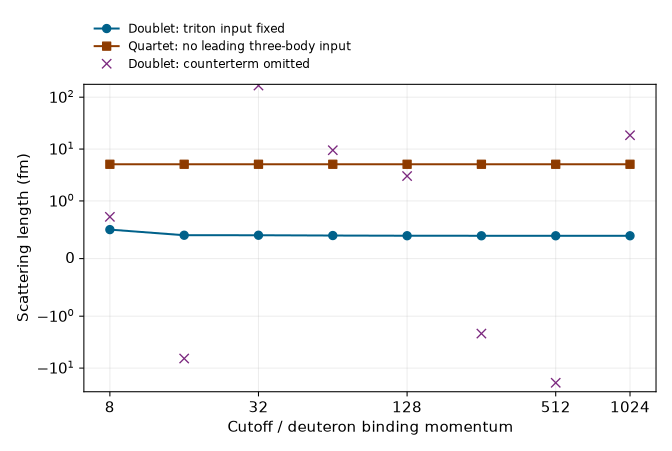
All three calculations use the same two-body inputs. Only the doublet fits a three-body datum: the triton binding energy. The vertical scale is linear near zero, logarithmic beyond. Unconnected zero-counterterm samples do not interpolate through poles. The curves show the cutoff dependence of the zero-range calculation.
The no-counterterm control shows that identical two-body inputs do not fix the doublet prediction. The fitted doublet approaches about in this LO model. The quartet approaches without a fit; its familiar LO value is also quoted in the review, §II.C.1. Effective ranges and other omitted interactions can substantially change these leading-order predictions. In particular, is not far below the pion scale; this LO triton fit carries appreciable finite-range uncertainty.
Three errors must be separated. At , increasing Gauss–Legendre nodes per interval from 8 to 12 to 24 changes the doublet result by less than . The intervals resolve and then grow geometrically. Removing instead gives : a distinct infrared integration error. Finally the cutoff ladder above measures residual ultraviolet dependence after refitting, not quadrature error. Taking the regulator far above the pion scale tests renormalization of the zero-range equations; it does not extend their physical range of validity.
Summary
Fermion exchange produces an attractive doublet eigenchannel and a repulsive quartet kernel. One triton input fixes the leading attractive-channel short-distance phase. A second observable then stabilizes under cutoff variation, while deliberately omitting that input does not.
Exercises
- Rephase the singlet pair by minus one. Does the sign change in the off-diagonal exchange kernel change the predicted elastic amplitude?
Solution
With , replace , and . The diagonal pair propagator commutes with , and , so the entire integral equation transforms covariantly. Its first component, hence , is unchanged. Changing the signs in while leaving the three-body projector unchanged is a different interaction and is not a phase convention.
- Show that the bound-state fitting formula really produces a null vector, and explain why a small residual alone cannot establish the physical accuracy of the scattering prediction.
Solution
Take . Then . This proves the finite-matrix condition. A numerical residual tests the linear algebra and quadrature realization at the chosen cutoff. It does not test omitted low-momentum integration, the residual cutoff limit, finite effective ranges, or the pionless breakdown scale. Those tests are separate, as the three convergence variations demonstrate.
References
- P. F. Bedaque, H.-W. Hammer and U. van Kolck, Effective Theory of the Triton, v4, §3, Eqs. (8)–(18). The kernel typo in Eq. (10) and the external-amplitude translation are discussed above.
- H.-W. Hammer, S. König and U. van Kolck, Nuclear effective field theory: status and perspectives, §§II.C.1–II.C.2, especially Eqs. (43)–(44).
Scrollable formula. Use Left and Right arrow keys to reveal hidden content.
Scrollable table. Use Left and Right arrow keys to reveal hidden columns.
Scrollable figure. Use Left and Right arrow keys to reveal hidden content.