Leptogenesis from Heavy-Neutrino Decay
A heavy Majorana neutrino can decay into either a lepton–Higgs pair or its antiparticles. If the rates differ and the heavy population is out of equilibrium, those decays can generate lepton number. Inverse decays erase part of it. The calculation therefore needs both a CP-odd decay amplitude and a kinetic history.
Preparation: Use seesaw matching and the electroweak selection rule. The required detailed-balance and chemical-equilibrium reasoning is developed below; the later treatments of collision integrals and sphaleron washout extend it. We study a specified hierarchical type-I extension, not a reconstruction of the observed baryon asymmetry.
Sakharov conditions in the decay model
Start with zero baryon and lepton asymmetry. In the conventional CPT-invariant thermal setting, dynamically producing a net baryon excess requires baryon-number violation, violation of C and CP, and a departure from thermal equilibrium. In this model the three requirements enter different parts of the calculation. Sakharov, 1967 and Davidson, Nardi and Nir, §1.2 and §4.
- The Majorana masses allow heavy-neutrino decays that violate lepton number. The resulting can survive those reactions. Electroweak sphalerons later change and together, converting part of that charge into baryon number.
- The chiral lepton interactions violate charge conjugation. A CP-odd Yukawa invariant must interfere with an absorptive loop contribution for the heavy neutrino to produce leptons and antileptons at different inclusive rates.
- As the plasma cools, the heavy-neutrino abundance can depart from equilibrium. With consistent inverse reactions the source vanishes at instantaneous equilibrium. Inverse decays also wash out part of an existing asymmetry; a nonzero decay asymmetry alone cannot determine the surviving charge.
A signed decay source
Take two positive Majorana masses and the two-left-handed-spinor interaction , with . This is the of the seesaw page. In the four-component decay amplitude , the coefficient is , up to a common amplitude phase. Explicitly, in Davidson–Nardi–Nir, so the decay coefficient is ; their Higgs expectation value is in our notation.
Define and the lepton asymmetry
The total tree width sums both weak-doublet components and both conjugate decay channels, with the initial Majorana spin averaged. It is important to use this same total width in the CP asymmetry and washout parameter.
To see where CP violation enters, write a tree-plus-loop amplitude as . Subtracting its conjugate-coupling rate leaves a product of an imaginary coupling invariant and an absorptive loop part. The latter is supplied by the on-shell lepton–Higgs cut. A complex Yukawa phase alone, with no absorptive interference, gives no decay-rate asymmetry.
For massless decay products at zero temperature, summing vertex and Majorana wave-function contributions gives
The vertex cut can be written as : the two-body cut angular variable supplies , the spin contraction supplies , and the uncut heavy propagator supplies . Integrating gives the last two terms in . The lepton-number-violating wave-function term gives . The two-body phase space, channel sum and tree-width normalization produce the common above. The additional flavor-dependent wave-function term has zero flavor sum and is absent from this inclusive source.
Expanding the two contributions separately gives and . Hence
The apparent pole near is not a resonant-leptogenesis formula: there the unstable-state mixing and widths require a different kinetic treatment.
Choose a reproducible hierarchy
Set , and
Then and . The leading hierarchical result is ; the full nonresonant loop function at gives , which we use in the numerical table. We chose the Yukawa couplings to illustrate hierarchical leptogenesis.
Assume radiation domination with constant and in . Define and . Choosing or fixes or . Both widths remain far below the mass splitting. The initial point is ; the two alternatives below specify either a thermal abundance or zero abundance there. No earlier reheating history is inferred.
Derive the reduced decay equations
Use Maxwell–Boltzmann distributions and kinetic equilibrium, neglecting quantum statistical factors, thermal masses, additional scattering and spectator redistribution during generation. Normalize densities to , so and . The equilibrium Majorana density and the thermal time-dilation average are
Here is a modified Bessel function, not the washout parameter. The first two formulas follow by integrating and over momentum. Detailed balance then makes the net heavy decay proportional to .
For the asymmetry equation, subtract the on-shell contribution from scattering when decays and inverse decays are counted explicitly. In the narrow-width limit its propagator squared contains , whose rate factorizes into an inverse decay times a branching fraction. Counting it again would double count the same history. Unitarity/CPT with this real-intermediate-state subtraction yields a CP source proportional to the departure from equilibrium, not to .
Neglecting the Higgs asymmetry and spectator relations in this reduced model, linearized inverse decays give
The factor in the last relation comes from linearizing the lepton/antilepton inverse-decay populations with the two lepton-doublet degrees of freedom. The source sign is negative because a positive lepton asymmetry creates negative . At and zero asymmetry, both source and washout vanish instantaneously. The equilibrium abundance itself changes as the Universe cools, so exact tracking is only an approximation to the evolving solution.
Weak and strong washout, actually integrated
With , the asymmetry equation has the integrating-factor solution
The companion solves the coupled equations with two different ODE methods and independently integrates the heavy-only solution against the survival factor. At , the results are:
| Initial | Later reduced | ||
|---|---|---|---|
The weak-washout thermal population mostly decays without erasure. Starting empty first produces heavy particles through inverse decays, generating an asymmetry with the opposite sign to their later decays; cancellation makes the final result small. Strong washout reduces memory of the initial population but also erases much of the early source. At that memory is reduced, not exactly absent.
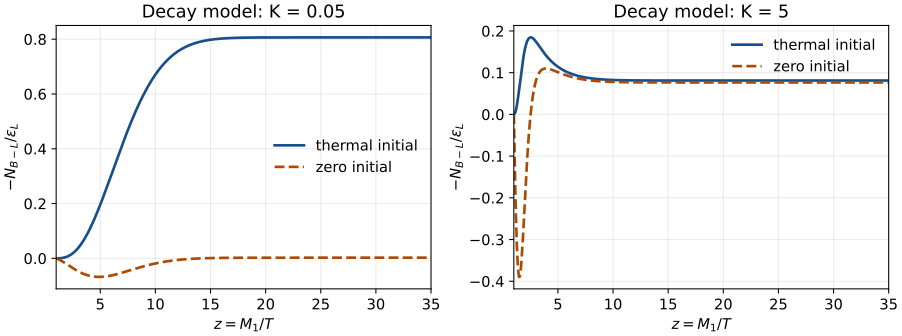
Solutions of the specified decay/inverse-decay model. The plotted quantity is ; the physical sign is restored by the negative benchmark . Thermal effects, additional scattering and spectator redistribution are omitted.
Check that flavor is unresolved
Charged-lepton Yukawa interactions can measure which flavor was produced. A useful rate estimate is . With illustrative , our benchmark has . At this is . It remains slow compared with expansion during the substantial generation interval; by the heavy population/source is already small.
Inverse-decay erasure has . At those same points this is for , and one hundred times smaller for . When flavor interactions compete with expansion and with inverse decays, a simple unflavored or fully projected treatment can fail; density-matrix kinetics then resolves the competition. In particular, lowering without reassessing these ratios does not preserve this approximation.
This flavor check does not justify dropping every other correction. The reduced calculation deliberately omits Higgs/spectator asymmetries, off-shell and other scattering, thermal dispersion and statistical corrections, and possible earlier production. Their importance must be evaluated in a quantitative cosmological prediction. The table shows how production, washout and the initial abundances affect the result in this model.
Convert the surviving charge later
After lepton-number violation freezes out, Standard Model sphalerons conserve . At a later temperature when electroweak symmetry is still unbroken and all Standard Model Yukawa reactions and sphalerons are in equilibrium, assume hypercharge neutrality and no additional light species. Let be chemical potentials and the lepton potentials. Yukawa equilibrium gives , , . Sphalerons require .
In common units , a chiral fermion contributes its multiplicity times its chemical potential; a complex scalar contributes twice that amount. Hypercharge neutrality is therefore
It follows that , , and
The thermal relaxation calculation follows a plasma toward a possibly nonzero equilibrium baryon number while the Chern–Simons transition rate changes with temperature. Here the second relation uses the model's Maxwell–Boltzmann normalization and conserved comoving entropy. It supplies the final column of the table. The relation is a later chemical-equilibrium conversion, not a spectator coefficient inserted into the high-temperature generation equations. Equal lepton-flavor chemical potentials were not assumed; only their sum entered the derivation.
Summary
A CP-odd decay interference and departure from equilibrium generate a charge; inverse reactions partly erase it. A consistent on-shell subtraction makes the source vanish in equilibrium. Flavor resolution, thermal corrections and later sphaleron conversion require separate conditions, so the seesaw mass relation alone does not predict the baryon abundance.
Exercises
- Set in the reduced equations. Relate the final asymmetry to the initial heavy abundance, and explain the cancellation for an initially empty population.
Solution
The two equations give . With zero initial asymmetry, . After all heavy particles decay, the result is . It is zero for an initially empty population: inverse production and subsequent decay cancel exactly in this reduced zero-washout limit. A calculation retaining only the late decays would miss the earlier source and violate this identity.
- Replace the phase in by . Determine the source's phase dependence and explain why the low-energy neutrino masses alone cannot fix it.
Solution
Now , so . The asymmetry vanishes at or and reverses under . The low-energy mass matrix constrains , whereas the decay source involves and the heavy hierarchy. Different heavy parameters can yield the same light mass matrix and different decay asymmetries. Even a specified source still needs the thermal history to fix the final charge.
References
-
S. Davidson, E. Nardi and Y. Nir, Leptogenesis, arXiv:0802.2962v3: §2.1, Eqs. (2.3)–(2.5), for the Yukawa convention; §§5.1–5.2, Eqs. (5.1)–(5.17), for the signed inclusive asymmetry; §6.2, Eqs. (6.16)–(6.31), for real-intermediate-state subtraction and the corrected kinetic equations; §9.1, Eq. (9.3), for flavor rates; Appendices 13–14 for density normalization and chemical equilibrium. The spectator-free reduction and benchmark inputs are specified here.
-
A. D. Sakharov, “Violation of CP Invariance, C Asymmetry, and Baryon Asymmetry of the Universe,” JETP Letters 5 (1967), pp. 24–27 (English translation), on baryon violation, charge asymmetry and an expanding background. Reprinted article.
Scrollable formula. Use Left and Right arrow keys to reveal hidden content.
Scrollable table. Use Left and Right arrow keys to reveal hidden columns.
Scrollable figure. Use Left and Right arrow keys to reveal hidden content.