String Breaking, Wilson Loops and Screening in QCD
Pull the same fixed fundamental color sources apart twice, first measuring their lowest energy and then measuring a rectangular Wilson loop for a finite time. In QCD a light quark–antiquark pair can screen the sources as two color-singlet static-light hadrons. A string trial operator can nevertheless produce a rising effective energy. We can calculate both observations with the same two levels.
Preparation: Use static energies and forces and the endpoint law of the transporter. The heavy sources are infinitely massive and their energies share one ultraviolet self-energy subtraction. For the center test take simply connected and state the dynamical matter representations. Changing the global gauge group can change the genuine lines.
Two states with the same external sources
Place a fundamental source at and an antifundamental source at , with . A spatial transporter makes a string trial operator gauge invariant. A second trial operator pairs each source with dynamical matter:
Choose light-flavor and spin combinations with the same conserved quantum numbers in the two operators. Otherwise symmetry forbids their mixing. These expressions specify operators creating a static-source sector, not propagating heavy-quark wavefunctions. After integrating the static sources out, their time evolution supplies temporal Wilson lines.
For a useful two-state approximation, orthonormalize the two trial states and write
Here is a string-like diagonal energy, approaches twice a static-light energy at large separation, and is the transition matrix element. Residual interactions between the two static-light hadrons can make depend on . A relative phase of the basis states makes real and nonnegative at a chosen . None of these diagonal entries is separately an exact energy eigenvalue when .
The characteristic polynomial is . Thus, defining and ,
One way to derive the probabilities without choosing an eigenvector phase is the Hellmann–Feynman identity at fixed . For , the ground state is mostly string-like; for , it is mostly a pair of static-light hadrons. At the unmixed crossing, , the two components have equal probability and the energy gap is .
This state content refers to the specified orthonormal trial basis. Changing that basis changes the probabilities while leaving the eigenvalues unchanged. In a full field theory, higher excitations and additional hadronic channels also contribute.
A complete avoided-crossing example
Set and use an illustrative positive string tension to define and . Consider
The dimensionless matrix entries are illustrative. The bare crossing is , and the gap there is . At the ground-state string probability is about ; at it is about . The energy evolves smoothly from to .
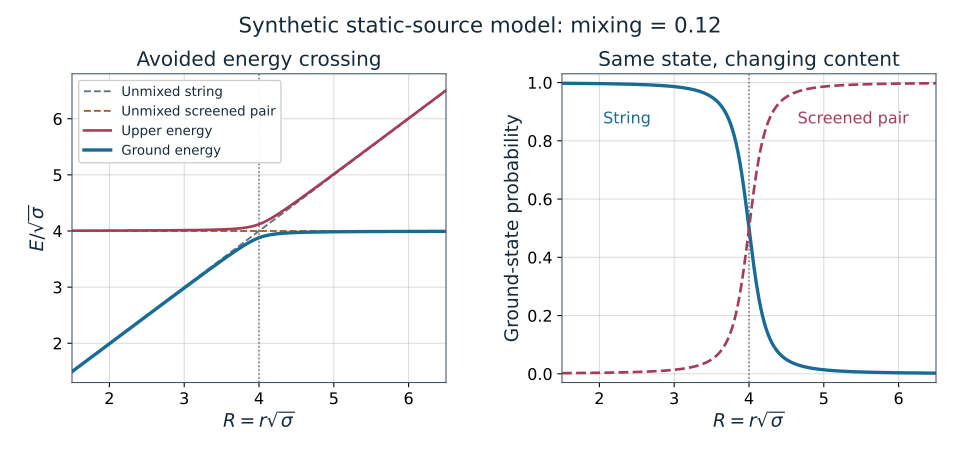
Because and are constant in this example,
The force decreases when the ground state becomes screened. At large positive , expansion gives . The small residual slope in this particular model is a mixing effect; its asymptotic power is not a universal prediction for interactions between real hadrons. If or changes, their derivatives also enter the force.
How the states enter an observable
A Euclidean correlation matrix separates energy levels from operator overlap. For , after a common static subtraction,
In an exact two-state truncation with an invertible overlap matrix , . The generalized eigenvalue problem
has eigenvalues . This follows by multiplying by and ; it does not require each trial operator to resemble an eigenstate.
A single string correlator can have very little overlap with the screened ground state. It then needs a much longer Euclidean time to reveal it. Including static-light operators addresses that problem rather than changing the spectrum. Bali and collaborators, Eqs. (22)–(25), (68)–(78) implement this distinction in a two-flavor lattice calculation. Their extracted mixing parameters belong to the chosen operator basis and simulation; the figure above is an independently defined teaching model.
String breaking and the apparent area law with dynamical matter
A rectangular fundamental Wilson loop can show an apparent area law at finite Euclidean time even when dynamical quarks can screen each static source. At fixed separation , the late-time slope measures the ground-state energy. A string-shaped operator can first pick out a higher level.
Take in our two-state Hamiltonian, where sets the string-tension scale. In units of the two energies are and . Choose a string trial operator with spectral weight ratio . These weights describe the operator used to measure the levels. The Hamiltonian separately fixes the string content of its eigenstates.
With and ,
The two contributions are equal only at
For , the measured energy stays near the upper, string-like level, even though the true ground state is already screened. For , it tends to . Repeating this construction at several with the same tiny ground-state weight produces an apparently rising energy over a finite observation window. The conclusion does not require a false plateau in the exact data: the deviation can simply be smaller than the available precision.
This example makes the order of limits explicit:
A larger basis including static-light operators can resolve both states through the correlation-matrix method. It is not enough to label a Wilson loop “gauge invariant”: gauge invariance does not guarantee good ground-state overlap. Bali et al., Eqs. (68)–(78) give the corresponding overlap structure in a lattice setting.
Fit a regulated Wilson-loop ensemble with the shared covariance to see how correlated sampling changes the uncertainty on a finite-time energy.
Calculate which center survives matter
Write a center element as . A representation of -ality acquires phase . Adjoint gluons have and cannot change an external source's -ality. Dynamical matter with -alities , together with its antiparticles, can change it by the subgroup generated by these integers modulo .
An exact center transformation must act trivially on every matter field:
To see the count, the subgroup of screenable charge classes consists of multiples of modulo , with elements. Its annihilator consists of , with elements. Unscreened charge classes are labeled by . This arithmetic states a center obstruction to screening. Constructing a low-energy screening state and determining its energy remain dynamical questions.
| Theory and matter | Exact electric center | Center obstruction |
|---|---|---|
| Pure , or adjoint matter only | Fundamental cannot be neutralized by adjoints. | |
| with fundamental quarks of finite mass | Trivial | A fundamental source can form a static-light singlet. |
| with matter of | Even charge classes have no center obstruction; odd classes remain charged. |
An adjoint source in pure Yang–Mills theory has zero -ality and can form a gauge-invariant gluelump with gluonic fields. Thus an adjoint loop need not retain an asymptotic area law even when fundamental loops do. Conversely, very heavy fundamental matter explicitly breaks the exact center at every finite mass, while making string breaking difficult to observe. The infinite-mass limit removes that matter from the low-energy spectrum and changes the exact symmetry statement.
These are electric one-form symmetries of line operators, not local gauge redundancies acting on colored fields. Gaiotto et al., §4.2 formulate the matter restriction and its dependence on global gauge structure.
What an area law measures
For a large rectangular loop in representation , define . An area law has leading behavior
The first coefficient gives a linearly rising static energy at large separation; the perimeter coefficient includes regulator-dependent source self-energies. Coulomb terms, string fluctuations and corner factors are among the omitted terms. The static-energy limit takes at fixed before studying large . A simultaneous large-loop scaling needs its aspect ratio specified.
If screening supplies a finite-energy pair of singlets, the asymptotic source energy can approach a constant instead. There is then no nonzero asymptotic fundamental string tension extracted from that ground-state limit. Calling this perimeter behavior does not mean the normalized loop becomes identically one or that intermediate-distance flux disappears.
Area behavior is a dynamical property, not a consequence of group theory alone. For an exact electric one-form center symmetry, area behavior of charged loops characterizes its unbroken confining realization under the usual large-loop assumptions. The symmetry can also have other realizations; its mere existence does not prove confinement.
A controlled example of both a photon gap and an electric string is the dilute monopole plasma in three Euclidean dimensions. In QCD with finite-mass fundamentals, look for transverse broadening of an intermediate-distance tube before its endpoints screen. The lightest color-singlet spectral gap is a different measurement.
Temporal circles and Polyakov loops
On a Euclidean time circle of circumference , the fundamental Polyakov loop is . In pure theory the temporal center transformation acts as . Its expectation value is related, after source renormalization, to the free-energy cost of a static source.
The thermal center is the ordinary symmetry obtained from the one-form symmetry along the compact time direction. In a finite spatial volume, an unselected center-symmetric ensemble has even if an infinite-volume phase would break that symmetry. A symmetry-breaking order parameter therefore requires the thermodynamic limit and a specified state-selection procedure.
Fundamental dynamical quarks explicitly break this center symmetry. Then can still diagnose thermal changes, but it is not an exact symmetry order parameter. A zero-temperature Wilson-loop limit and a finite-temperature Polyakov-loop measurement answer different questions. Neither alone establishes a gap in all gauge-invariant channels.
A thermal gluon determinant resolves the two center-related holonomies of pure hot . A dynamical fundamental quark lifts their degeneracy explicitly.
Exercises
1. Resolve the avoided crossing. Find the two normalized eigenvectors at and show what happens as .
Solution
At , the matrix is in string-tension units. For positive , the lower and upper eigenvectors are and , with energies and . Their string probabilities are both . At fixed , taking selects whichever unmixed state has lower energy. At the limiting matrix is degenerate, so no unique eigenbasis survives. The limiting ground-state energy has a cusp, whereas every nonzero smooths it.
2. Change the static subtraction. Add an arbitrary constant to both diagonal energies. What changes in the spectrum, correlation matrix, force and state content?
Solution
The Hamiltonian becomes . Both eigenvalues shift by , while their difference and eigenvectors are unchanged. Hence gains and its effective energy shifts by . The derivative is unchanged if is independent of . The crossing condition , the gap and the probabilities are all invariant. Shifting only the string energy would instead change a physical relative threshold in this model; it is not a common self-energy subtraction.
3. Screen with two matter representations. An theory contains matter of -alities and . Find the surviving center and decide whether and are obstructed by it.
Solution
Here . The only center elements trivial on both representations are , forming . The screenable charge subgroup is : for example , with the minus sign supplied by conjugate matter. Thus has no center obstruction, while is charged under the surviving element . This does not calculate a screening energy or prove an area law for the odd class.
4. Quantify the needed time. In the example, find the time at which the excited contribution is only one percent of the total correlator. Compare it with .
Solution
The excited fraction is . Setting it to gives , later than the equal-contribution time . At this time . An observed approximate string energy at earlier times is therefore compatible with the screened spectrum. Setting the ground-state weight exactly to zero would prevent its extraction at every time.
Summary
The Hamiltonian predicts the screened ground level; its overlap with a Wilson-loop source determines how much Euclidean time will expose it. Screening changes the lowest color-singlet state. The model does not determine its QCD parameters or establish the complete asymptotic particle spectrum. The matter representations, thermal ensemble and order of limits fix the interpretation of each line measurement.
References
- G. S. Bali et al., “Observation of String Breaking in QCD”, Eqs. (22)–(25), (68)–(78): correlation matrices, overlap factors and mixing.
- D. Gaiotto, A. Kapustin, N. Seiberg and B. Willett, “Generalized Global Symmetries”, §4.2 and §5.3: screening and center symmetry with matter.
Scrollable formula. Use Left and Right arrow keys to reveal hidden content.
Scrollable table. Use Left and Right arrow keys to reveal hidden columns.
Scrollable figure. Use Left and Right arrow keys to reveal hidden content.