Instanton Measures and the Running Coupling
The classical instanton action fixes an exponential, but it does not fix an instanton contribution. One must also integrate over the position, size and gauge orientation, normalize the fluctuation determinant, and decide how fermion zero modes are saturated. In four-dimensional gauge theory, the size integral is often the step that prevents an otherwise elegant semiclassical expression from becoming a controlled prediction.
We derive the scaling of the one-instanton measure, test its renormalization-scale dependence, and compute two size integrals: a deliberately cutoff-dependent vacuum example and a high-temperature example with a specified thermal determinant fit. An overall scheme-dependent constant remains explicit throughout.
Preparation: Yang–Mills Instantons and Self-Duality supplies the classical gauge saddle; Collective Coordinates and Zero-Mode Measures explains the replacement of Gaussian zero-mode integrals. We use Euclidean orientation and .
Fixing the gauge-field normalization
For an gauge theory, absorb the coupling into the connection:
The curvature and action are
With
a self-dual unit-charge saddle has action
Indeed, its curvature integral is , and the action contains the additional factor . This prevents a common factor-of-two error when translating between component and trace notation. The absorbed classical connection is independent of ; all inverse-coupling dependence is visible in the action and the fluctuation normalization.
Zero modes and the size measure
A charge-one instanton on flat space has four translations, one size, and orientation coordinates. For the latter count follows from the embedded solution and the stabilizer :
For there are three orientation coordinates. Thus the total is in either case. This is the framed description, in which transformations approaching the identity at infinity are divided out. Changing the normalization of the remaining compact orientation volume changes a constant in the measure, not its size or coupling powers.
To see the coupling power, expand about the saddle in background gauge. A normalized nonzero mode has Gaussian measure after scaling the fluctuation by . Along a modulus , the fluctuation is a gauge-orthogonal tangent to the saddle. Its Jacobian contains the norm of that tangent divided by . Each bosonic zero mode therefore contributes one inverse power of , or one factor proportional to . Their product gives
The tangent metric alone is not the complete measure. The nonzero gauge modes, Faddeev–Popov ghosts and the vacuum normalization must use the same regulator. Once combined, dimensional scale invariance at the classical level requires
Here denotes a chosen dimensionless orientation measure. The product of the position and size factors is dimensionless. Quantum scale dependence will replace this classical invariance by a running-coupling factor. These zero-mode and determinant factors are derived in Schäfer and Shuryak, §II.C.4, Eqs. (97)–(101); their finite coefficient depends on regulator and orientation normalization, and is not imported below.
The one-loop density and what running cancels
Take fundamental Dirac flavors with masses small compared with the inverse instanton size. At one loop,
For the asymptotically free running and strong-scale discussion below, assume , equivalently . The differential contribution of one instanton to the vacuum functional has the form
The coefficient includes finite determinant terms and the chosen orientation normalization. It cannot be inferred from dimensional analysis. This expression describes the vacuum amplitude when all fermion zero modes are saturated by masses. It is not the measure for every observable.
At this order,
The exponential and explicit power cancel their scale dependence exactly within the one-loop running law. The whole displayed density does not become exactly scale independent: differentiating its bosonic prefactor still gives
and running masses contribute at the corresponding relative order. Higher-loop determinant terms and running restore consistency to higher accuracy. Choosing avoids large logarithms; it does not turn the one-loop approximation into an exact expression.
The companion checks this distinction at fixed by changing by factors of two. The exponential-power combination is invariant to rounding error, whereas the separately recorded prefactor changes. Keeping that change is more informative than artificially enforcing exact invariance on a truncated result.
Mass factors versus fermion insertions
For a single fundamental Dirac flavor in a unit-charge background, the index theorem gives one unpaired chiral zero mode. The regulated determinant contains a factor from that mode; the nonzero eigenvalues occur in paired factors of the form . After the complete determinant is normalized at the size scale, its dimensionless small-mass factor is .
At the isolated-instanton vacuum amplitude vanishes. The classical saddle still exists. A correlation function with the appropriate fermion insertions can saturate the zero-mode Grassmann integrals instead. A source contraction supplies the zero-mode wavefunction projector and cancels the vanishing mass factor before the massless limit is taken. This is the distinction behind the induced fermion interaction; see Schäfer and Shuryak, §II.D.2, Eqs. (114)–(119).
For external fields varying slowly on the scale , dimensional analysis of the local vertex gives a factor in place of for each saturated flavor pair. The chirality, color contractions and numerical wavefunction integrals must still be calculated; the replacement states only the size scaling. In particular,
up to running logarithms, coupling factors and the required tensor structure. The second line is a coefficient of a local operator, not a vacuum number density. The fundamental representation of has additional pseudoreal flavor structure; its full vertex should not be identified with the generic flavor tensor merely because these dimensional powers coincide. Fermion Zero Modes and the ’t Hooft Vertex treats the spinor and source structure explicitly.
A size integral that exposes the infrared problem
Consider pure , integrate the normalized orientation measure into , and set the renormalization scale to . Write
Here denotes a contribution per Euclidean four-volume, not a particle density per spatial volume. Keep so that the action remains large. Cutting the integral off at gives
This follows from the substitution ; the integrand becomes . The upper incomplete gamma function is therefore an independent analytic check on direct size quadrature.
| Fraction from | ||
|---|---|---|
| 0.001 | 0.98630 | |
| 0.010 | 0.98237 | |
| 0.030 | 0.0134115 | 0.97799 |
| 0.100 | 5.74232 | 0.96592 |
Direct quadrature and the gamma-function result agree within relative for these examples. That numerical precision does not make the vacuum prediction precise: almost the entire result lies near the arbitrarily chosen upper cutoff. Extending a weak-coupling formula into is not a solution. There the running coupling is strong, and interactions among configurations or other nonperturbative physics must be included.
The ultraviolet end is integrable here. The problem is infrared sensitivity, even though the displayed integrals stop before the Landau scale. The logarithmic prefactor can alter numerical weights substantially without removing that conclusion.
Thermal suppression: a conditional controlled-scale example
A physical scale can suppress large instantons. At sufficiently high temperature, electric screening gives a leading Gaussian suppression in . To make the example reproducible, use the pure- one-loop thermal determinant parametrization in Schäfer and Shuryak, §VII.A.2, Eqs. (321)–(323):
The second expression is a rounded fit to the finite thermal contribution, not an exact elementary determinant. Both it and the zero-temperature running density are inputs to the following integral:
We use and check cutoff stability rather than extending the running formula through its strong-coupling singularity. The chosen ratios give:
| Mean | Smallest in the interval | ||
|---|---|---|---|
| 10 | 0.0180187 | 1.17324 | 22.67 |
| 30 | 1.22327 | 34.76 | |
| 100 | 1.25545 | 48.00 |
Increasing the cutoff from to changes these integrals by less than relative. A separate uniform logarithmic grid converges to the adaptive quadrature, with final relative differences below . Omitting gives only about 59–63 percent of the retained-fit result, so the Gaussian suppression alone does not reproduce the quoted numbers.
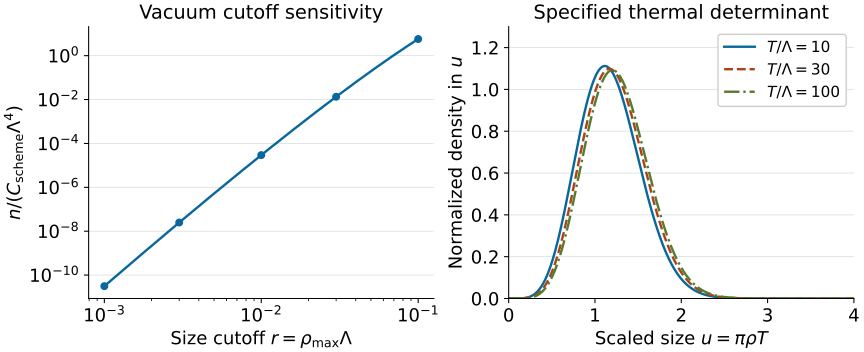
Left: the pure- one-loop vacuum integral remains dominated by its imposed size cutoff. Right: the specified thermal determinant fit suppresses large . The curves are normalized by dividing out the scheme-dependent coefficient.
The physical criteria remain , weak coupling at the dominant inverse sizes, and a dilute configuration ensemble. Large action and quadrature convergence are useful diagnostics, but neither supplies a bound on omitted loops or on the fit error. The example demonstrates how a physical infrared scale changes the size integral. It does not determine the absolute coefficient, establish the dilute approximation near a transition, or replace the finite-temperature saddle analysis in Finite-Temperature Instantons and Calorons.
Summary
The one-instanton measure combines zero-mode Jacobians, regulated nonzero-mode and ghost determinants, running coupling, and the observable's fermion saturation. Its universal size and coupling powers do not fix its scheme-dependent finite coefficient. Small-instanton control must be checked over the sizes that dominate the integral. A vacuum cutoff can expose infrared sensitivity; a physical thermal scale can suppress it, within stated semiclassical and thermal assumptions.
Exercises
1. A flavor that becomes heavy
One fundamental Dirac flavor has mass , with all other parameters fixed. Explain why the small-mass factor cannot be extrapolated to . Match the one-loop strong scales above and below the threshold , assuming continuity of the coupling there.
Solution
The factor retains only the leading small-mass behavior of the complete determinant. At large mass the nonzero eigenvalues also depend on ; the heavy flavor decouples after its effect is incorporated into the low-energy coupling and local operators. Keeping only its zero eigenvalue would falsely predict indefinite growth with .
Removing one flavor increases the beta-function coefficient by . Let and be the coefficients above and below threshold. Matching gives
Small instantons with use the high-energy theory. Large instantons relative to use the low-energy theory, provided they still satisfy . The crossover requires the massive determinant; it is not supplied by either asymptotic expression alone.
2. The leading high-temperature power
For the pure- example, now impose a fixed weak-coupling size cutoff rather than a fixed . Extract the leading dependence on as this ratio tends to infinity, while retaining the supplied function . What changes if only the Gaussian thermal factor is kept? Explain why dimensional analysis alone cannot fix the numerical coefficient.
Solution
With this changed prescription, tends to infinity. At fixed the logarithm is
The thermal factor makes the integral over convergent at large , and the factor makes its logarithmic moments integrable at the origin. Thus
This is the asymptotic weak-coupling expression with a fixed small size cutoff. The numerical integrals above instead retain ; their asymptotic coefficient has upper limit 4, differing by a small but nonzero constant tail. Their cutoff refinement tests the smallness of that tail over the stated temperatures. Neither prescription uses the running formula at its strong-coupling singularity. If , the remaining integral is
The power follows from and the logarithm from the six bosonic zero-mode pairs. The finite thermal determinant changes the dimensionless integral, while contains separate ultraviolet matching information. Neither constant follows from the power law.
References
- T. Schäfer and E. V. Shuryak, “Instantons in QCD,” Reviews of Modern Physics 70, 323–425 (1998), arXiv:hep-ph/9610451v3. Section II.C.4, Eqs. (97)–(101), gives the bosonic measure; §II.D.2, Eqs. (114)–(119), distinguishes mass-saturated determinants from fermion vertices. Section VII.A.2, Eqs. (321)–(323), supplies the finite-temperature factor and rounded fit used here. The present trace normalization is equivalent after absorbing the gauge coupling into the connection; the finite absolute measure coefficient is left unspecified.
Scrollable formula. Use Left and Right arrow keys to reveal hidden content.
Scrollable table. Use Left and Right arrow keys to reveal hidden columns.
Scrollable figure. Use Left and Right arrow keys to reveal hidden content.