Skyrmions and Topological Baryons
A field configuration can carry an integer winding without having a preferred size. In a three-dimensional nonlinear sigma model, a winding texture can shrink while lowering its two-derivative energy. The Skyrme term opposes that shrinkage. The resulting soliton has a finite classical mass and a calculable moment of inertia; a further quantum choice determines whether its rotational states have integer or half-integer spin.
We derive and solve the unit-winding SU(2) hedgehog in the massless Skyrme model. The calculation keeps three ingredients separate: the topological sector, energetic stabilization, and quantization of the configuration space.
Preparation: Soliton Stability and Derrick's Theorem, Collective Coordinates and Soliton Dynamics, Pauli matrices, and the degree of a map between three-spheres. We use natural units and the mostly-minus metric.
The field, its winding, and its energy
Let and define the anti-Hermitian left current
The massless model is
Here has units of mass and is a dimensionless Skyrme coupling, not an electric charge. For a static field both contributions to the energy are nonnegative:
Repeated spatial indices include both orders of each pair. The minus signs compensate the negative trace of the square of an anti-Hermitian matrix. These conventions agree with the static model summarized in Krusch, §2, Eqs. (1)–(2), after restoring the length and energy units specified below.
Impose a fixed vacuum at infinity, . Compactifying physical space gives a map from to . With , choose its integer degree as
Smooth deformations respecting the boundary condition preserve . A degree cannot, however, forbid a sequence of progressively smaller configurations whose limit becomes singular. This is why the energy functional still matters.
Take the scaling family . Direct change of integration variables gives
The two-derivative model alone lowers its energy as it shrinks. With both terms present, stationarity under this variation requires
This establishes resistance to the scale variation. It does not replace a fluctuation analysis in all directions of configuration space.
Reduce the unit-winding configuration to a radial problem
The hedgehog locks the spatial and isospin directions:
At the origin the angular dependence disappears because . Substitution into the winding integral gives
The same matrix substitution gives the physical radial energy
Introduce the dimensionless radius . From here until restoring units, a prime means differentiation with respect to :
The first two terms define the dimensionless integral and the last two define . This is also the degree-one specialization of the rational-map functional in Krusch, §2.1, Eq. (5). No rational-map approximation remains for a spherically symmetric unit hedgehog.
Varying the displayed one-dimensional functional gives
There is no closed elementary profile solving this equation. At small radius its regular expansion is
The slope must be determined by the far boundary. Linearization at large radius gives
The growing solution proportional to is excluded. The algebraic tail is a consequence of massless pion fields, not a numerical failure to reach the vacuum.
An actual profile and the importance of its tail
The companion solves the boundary-value equation with as an unknown, using the origin expansion and the outer condition . Here denotes a dimensionless numerical cutoff. It then integrates the energy and winding separately from the differential-equation residual.
The converged profile has
The table includes the leading analytic tail contributions. The inertia integral is derived in the next section.
| Outer radius | |||
|---|---|---|---|
| 20 | 11.606102271 | 6.37234097 | |
| 40 | 11.606102269 | 6.37234235 | |
| 80 | 11.606102269 | 6.37234241 |
The energy is already stable while the rotational integral converges more slowly. Indeed, inserting gives
Discarding the exterior field would therefore bias the inertia much more than the mass. The computation adds these leading tails and varies to test the remaining error. Separate mesh and tolerance refinements at fixed agree with the table. The integrated winding differs from one by less than even in the loosest reported run.
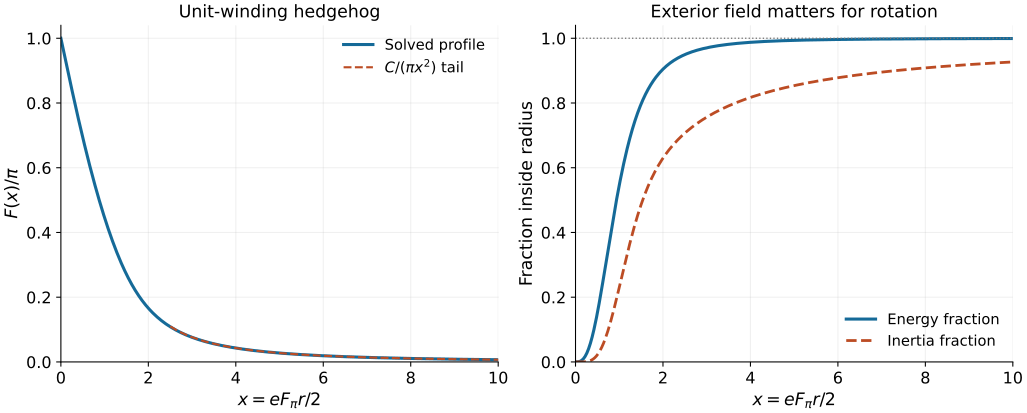
Left: the solved hedgehog profile, with the asymptotic tail shown only at large radius. Right: cumulative radial energy and inertia divided by their tail-corrected totals. The inertia receives a much larger contribution from the exterior massless field. The axes use .
As a check on the reduction itself, the companion also constructs the full SU(2) matrices in Cartesian coordinates, differentiates them by central differences, and integrates the original matrix traces with angular quadrature. Halving the Cartesian differentiation step reduces the energy, winding and inertia discrepancies by approximately four. This tests the trace factors and winding sign through a different representation of the same field, rather than merely reinserting the radial equation.
Rotate the soliton and calculate its inertia
Let the orientation vary slowly:
The hedgehog is invariant under a simultaneous spatial and isospin rotation. Consequently its independent orientation is one rotor. Introducing separate, independent spin and isospin rotors here would count the same motion twice.
For the two-derivative term, the time component of the current satisfies
The angular integral of the bracket is . The time-space commutators in the Skyrme term add a contribution with the same angular structure. Collecting terms gives
where is the static energy and
In the dimensionless radius this becomes
Thus the computed classical mass and inertia are
The first has units of energy; the second has units of inverse energy. These values apply in the massless classical model.
Topology permits a fermionic quantization; it does not impose it
Classically and give the same field. The orientation space is therefore SO(3), while SU(2) is its double cover. More generally, the fixed-winding configuration space has a noncontractible loop associated with a rotation of an odd-winding Skyrmion. Quantizing on its cover allows a sign around that loop.
The fermionic Finkelstein–Rubinstein choice for the unit Skyrmion is
A Wigner matrix of spin changes by under this operation. The allowed rotor representations are therefore half-integer, with equal spin and isospin magnitudes for the hedgehog:
In particular,
Choosing instead gives integer , including zero. Both choices are mathematically consistent quantizations of the bosonic field model; identifying the soliton with an underlying fermionic baryon selects the former. The topology supplies the possible sign representation, not the physical choice by itself. Krusch, §3.1, Eqs. (10)–(12) and footnote 2; §3.2, Eqs. (16)–(19) makes this distinction explicit.
The rigid-rotor treatment also has dynamical limits. Rotation must be slow compared with the relevant internal deformation scales. In the usual large-color counting, and give both and , so fixed- splittings are suppressed by . This organizes a semiclassical expansion. In the massless model the pion continuum extends to zero energy: a finite moment of inertia does not establish an exactly stable tower of rotating classical solutions. Radiation, deformation and quantum corrections can turn excited collective levels into resonances.
Finally, the Skyrme term is one higher-derivative operator in an effective theory. Its balance with the two-derivative term stabilizes this model, but does not prove that every omitted operator is small. Application as an EFT requires the inverse soliton size and gradients to lie below its cutoff with appropriate coefficients. Winding conservation within the smooth EFT and quantitative accuracy of its mass are separate claims.
Summary
The hedgehog calculation gives a unit winding, a converged radial solution, equal two- and four-derivative energies, and a finite rotational inertia whose tail requires special care. Quantization then adds a choice of sign on configuration space and a controlled range for collective motion. The companion examples/nonperturbative/solitons/charge-topology/ includes the boundary-value solution, radius and tolerance refinement, Cartesian matrix checks and both figures. Compare Q-balls: there the conserved charge alters the energy minimization, whereas here winding labels a sector and the Skyrme term sets the classical size.
Exercises
1. Add a pion mass and revisit the scale test
Add the positive static contribution
Find the modified Derrick relation and the decaying linear tail in physical radius. Does the winding formula change?
Solution
The mass term scales with the spatial volume. Thus
At a stationary profile the second scale derivative is . At small , the variation of the quadratic radial energy gives
The decaying solution is proportional to
This is the radial angular-momentum-one Yukawa solution. Its amplitude can depend on ; the limit of this expression cannot be taken while arbitrarily holding that amplitude fixed. A nonzero mass cuts off the long algebraic contribution to the inertia. It does not alter the degree integral or its value for the same endpoint conditions. The massive profile must nevertheless be solved anew before quoting a mass or inertia.
2. Keep the radius fixed while changing the quantum correction
Under and , compare the size, classical mass, inertia and first fermionic rotor splitting. What happens to the ratio of that splitting to the classical mass? Contrast the lowest rotor state with the bosonic quantization.
Solution
The product is unchanged, so the dimensionless profile corresponds to exactly the same physical radius. The mass scales with and the inertia with . Both decrease by a factor of four. Hence
The splitting-to-mass ratio grows by sixteen. A fixed classical shape and size therefore do not guarantee small collective quantum corrections.
For the fermionic choice, the lowest representation has and adds to the mass. For the bosonic choice it has and no rotor energy. The next bosonic representation has , giving a gap . These alternatives arise from the sign under the noncontractible rotation, not from a change in the classical profile.
References
- Krusch, S., “Quantization of Skyrmions,” arXiv:hep-th/0610176v1, HTML (2006). §2, Eqs. (1)–(2), and §2.1, Eq. (5): static energy, winding and radial normalization. §3.1, Eqs. (10)–(12), including footnote 2, and §3.2, Eqs. (16)–(19): configuration-space quantization, the bosonic alternative and rotation constraints. The present inertia is derived directly from the declared Lorentzian action; the companion records the restored units and current convention.
Scrollable formula. Use Left and Right arrow keys to reveal hidden content.
Scrollable table. Use Left and Right arrow keys to reveal hidden columns.
Scrollable figure. Use Left and Right arrow keys to reveal hidden content.