Magnetic Bions and Semiclassical Mass Gaps
An ordinary monopole can gap the photon in a compact three-dimensional gauge theory. In the periodic adjoint theory considered here, the same argument initially fails: each monopole carries fermion zero modes, so its amplitude is a fermionic operator rather than a bosonic potential. The leading bosonic effect instead comes from a correlated monopole and antimonopole of different types. Their magnetic charges add, their topological charges cancel, and fermion propagation supplies an attractive factor that competes with magnetic repulsion.
We calculate the separation integral of this magnetic bion, derive the resulting dual-photon mass, and distinguish it from a neutral pair. The calculation resolves a scale and a channel of confinement in a controlled limit. It neither gives a mass to every excitation nor supplies a general four-dimensional confinement proof.
Preparation: Center-Symmetric Compactification derives its perturbative vacuum and scales. The fractional-instanton construction fixes the constituent charges and zero modes. For the distinction between a separation coordinate and an exact modulus, see Quasi-Zero Modes.
Charges and fields
The model is SU(2) gauge theory with massless adjoint Weyl flavors, periodic on a spatial circle of circumference . We use the absorbed Cartan connection , with W charge 1 and fundamental weights . A unit monopole has flux . Its dual field has period and action
The coupling is evaluated near . We set ; magnetic bions have zero topological charge, so their leading amplitude has no theta phase.
What can saturate the zero modes?
At center symmetry the ordinary monopole and the affine monopole each have action . Their charges, in units of one monopole flux, are
| Event | Magnetic charge | Topological charge | Weyl zero modes |
|---|---|---|---|
| four | |||
| four | |||
| four conjugate | |||
| four conjugate |
Normalize the two neutral three-dimensional fermions canonically. Their engineering dimension is 1. A flavor-singlet zero-mode operator is
Up to matching coefficients, the two monopole insertions are and . An unsaturated one-monopole vacuum amplitude vanishes in the massless theory. A BPST combination still has eight zero modes and does not repair this problem.
By contrast, has magnetic charge 2 and zero topological charge. Its four fermions can contract with the four conjugate fermions. Zero net index alone would not prove the absence of accidental zero modes; here the explicit long-distance contractions show how the constituent modes are lifted. The original mechanism is developed in Ünsal, §2.3, Eqs. (2.21)–(2.23), PDF pp. 11–12.
The separation integral
Let be the constituent separation. Below the holonomy mass , scalar exchange is screened. At separations much larger than , the unscreened interaction is magnetic. With flux and gauge action , the cross term is
For the Coulomb field , the cross term for two centers a distance apart is
Equal magnetic charges give a positive interaction action and therefore a repulsive factor . The same factor follows from the normally ordered Gaussian dual-field correlator, since .
A massless three-dimensional fermion has propagator proportional to
The four propagators of the two-flavor contraction produce . Its angular and normalization factors belong to the short-distance matching coefficient. The two-flavor determinant can be checked explicitly: . For general integer the radial power is . Including the separation measure gives the long-distance integral
The substitution proves the last equality. The lower limit has been extended below the range of the effective theory only because repulsion suppresses that region. Its omitted weight can be calculated, rather than assumed small. The result is
This agrees with the Coulomb coefficient and fermion power in Anber and Poppitz, §§4.3.1–4.3.3, Eqs. (4.21), (4.31), (4.33)–(4.36), PDF pp. 17–21. Their interaction-action minimum and the radial-measure maximum are slightly different notions of size.
A broad correlated event
The normalized radial distribution for two flavors is
Minimizing the interaction action alone gives ; maximizing the radial integrand gives because of the measure. Both scale as , but neither makes the distribution narrow. Weak coupling creates scale separation, not a new large parameter suppressing its relative width. Performing the separation integral is preferable to replacing it by an unjustified sharp saddle.
The short scales are and . Therefore
Both grow at weak coupling. The probability that the long-distance distribution assigns to a separation below a chosen is
where the numerator is the upper incomplete gamma function. For , the fraction below is approximately ; at it is . These are checks on where this approximate measure is supported. They are not error bounds on the full fugacity: screened interactions outside this interval, corrections to the monopole profiles, and determinants still require matching.
The plotted distribution makes its finite width visible. The second panel tests the elementary wall predicted by the resulting effective action.
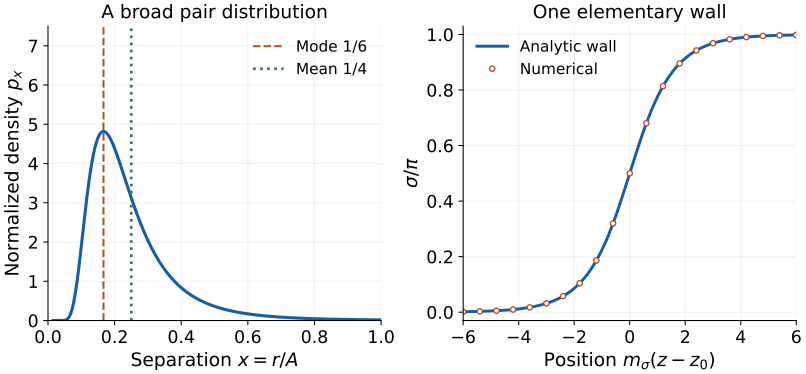
Two-flavor long-distance pair measure, with and normalized density . The mode and mean differ appreciably. At right, a numerical boundary-value solution for the elementary wall is compared with . Both panels concern the specified semiclassical effective theory; no absolute monopole determinant or large-circle spectrum is inferred.
From a bion gas to a gauge-sector mass
Let be the fugacity per magnetic sign, with mass dimension 3. Summing charge and charge events gives . After subtracting the vacuum constant, the effective action is
The two vacua in one period are . Expanding around either one yields
The matching coefficient has leading exponential behavior . The separation integral is one factor in it, not the complete prefactor. In particular, the holonomy potential perturbs constituent profiles and can produce corrections to the action smaller than but larger than an ordinary logarithm. We do not assign an absolute numerical value to from the radial integral alone.
A physical operator must accompany the mass statement. At the common base point of the holonomy and field strength, define
It is gauge invariant and odd under the circle center. At the center-symmetric background it reduces to the Cartan field strength. Its leading low-energy correlator therefore contains the dual-photon pole. The operator winds around the circle and is not local as a four-dimensional operator. A center-even local operator such as instead begins quadratically in the dual field; in the leading purely bosonic approximation its continuum starts at . Interactions and the massless fermionic sector must be considered before promoting this threshold to a statement about the full local spectrum. The two neutral fermions remain massless, so the full theory has no positive spectral gap.
An elementary wall is half a probe string
For a static profile connecting to , the first integral gives
Its tension is
A fundamental Wilson surface imposes a discontinuity, not a discontinuity. In this leading effective action it requires two elementary walls. Their well-separated tension approaches , and their separation is part of the probe-string problem. One cannot identify the single-wall tension with the fundamental string tension. The double-wall interpretation is described in Poppitz, §§5.3.1–5.3.2.
The companion solves the wall boundary-value problem independently of the analytic profile. Increasing the domain from to 10 and 14, while tightening the collocation tolerance, gives
Why a neutral bion is different
A pair has neither magnetic nor topological charge. It cannot generate a term. Its magnetic attraction also changes the separation factor to , and the real positive-separation integral diverges if the long-distance formula is extended to zero separation. There is no controlled real bound configuration obtained by balancing two attractive effects.
One useful model of the correlated-sector prescription continues the convergent repulsive integral. For two flavors,
At this integer power the two lateral continuations coincide: the result is a real relative minus sign, not an automatic imaginary ambiguity. In supersymmetric Yang–Mills the scalar remains light and doubles the Coulomb coefficient; the analogous one-flavor integral gives the relative sign needed for its holonomy potential. That is a distinct model, discussed explicitly in Poppitz, §6.3, Eqs. (150)–(153).
This continuation defines an asymptotic correlated contribution. It is not the value of a positive real integral with a small core cutoff. For fixed , the latter is finite and positive, depends strongly on the core, and is entire in the coefficient multiplying . Its core contribution cannot be discarded uniformly under analytic continuation. A full neutral-sector prescription requires the integration cycle and the separation from perturbative and other sectors; any imaginary ambiguities at other orders must cancel in a physical observable. Our calculation establishes neither that full decomposition nor a neutral-bion numerical prefactor in two-flavor QCD(adj).
Summary
Fermion zero modes suppress a bosonic one-monopole potential, but their exchange makes a magnetically charged pair integral finite. The resulting term produces two vacua, a gauge-sector mass and elementary walls. Its broad separation measure, its matching coefficient, the fundamental probe string, and a neutral pair are distinct objects. Keeping them distinct is essential to the controlled interpretation.
Exercises
1. Which moments of the pair size exist?
For the normalized measure proportional to , derive and its convergence condition. Compare the first two moments at and . Explain what this says about using a single “bion size.”
Solution
The normalization exists for . Applying the same substitution to the numerator gives
The restriction comes from the large-separation tail. At , the mean is and the second moment is , giving variance . At the distribution is normalizable but the mean and second moment diverge in this long-distance model. Moreover, the one-flavor supersymmetric theory retains a light holonomy scalar, so its Coulomb coefficient differs. Even when all moments of interest exist, the radial mode, interaction-action minimum and mean are different summaries of a broad distribution.
2. Change the magnetic charge of the gas
Consider a dilute gas of charge events with fugacity per sign and the same -periodic dual field. Find the small-fluctuation mass, adjacent-vacuum wall tension, and number of elementary walls needed for a fundamental jump. Treat the leading local potential only.
Solution
The potential is , with minima per period for positive integer . Therefore
Writing makes the kinetic coefficient . The adjacent-wall tension is consequently
There are walls in a total jump. Their separated tension is within this leading effective theory. At this gives and total ; at it gives the usual single sine-Gordon string. Additional interactions can determine the wall separation and modify this leading additive description.
References
- Mohamed M. Anber and Erich Poppitz, “Microscopic Structure of Magnetic Bions,” JHEP 06 (2011) 136, arXiv:1105.0940v1, PDF. Sections 4.3.1–4.3.3 derive the magnetic interaction, fermion overlap and radial measure; §4.4 discusses corrections beyond leading exponential accuracy.
- Erich Poppitz, “Notes on Confinement on : From Yang–Mills, super-Yang–Mills, and QCD(adj) to QCD(F),” Symmetry 14 (2022) 180, revised arXiv:2111.10423v4. Sections 5.1–5.3 give the symmetry and magnetic-bion effective action; §6.3 explains the neutral-pair prescription in the distinct supersymmetric theory.
- Mithat Ünsal, “Magnetic Bion Condensation: A New Mechanism of Confinement and Mass Gap in Four Dimensions,” Physical Review D 80 (2009) 065001, arXiv:0709.3269v3, PDF. Section 2.3 supplies the constituent correlator; §3.3 separates gauge-sector confinement and continuous chiral symmetry.
Scrollable formula. Use Left and Right arrow keys to reveal hidden content.
Scrollable table. Use Left and Right arrow keys to reveal hidden columns.
Scrollable figure. Use Left and Right arrow keys to reveal hidden content.