Thermodynamic Bethe Ansatz
The vacuum energy on a circle knows about particles that travel around the entire circle. A finite collection of Bethe–Yang particles does not include those processes. The thermodynamic Bethe ansatz obtains the circle vacuum energy by a different route: count scattering states in an infinitely long system at finite temperature, then exchange the two Euclidean directions.
We will carry out the state counting for sinh-Gordon, solve the resulting integral equation, and test both its infrared expansion and its slow approach to an ultraviolet effective central charge of one. A delicate free limit explains why a bosonic theory uses an exclusion-type entropy without becoming a free fermion.
Preparation: Bethe–Yang Quantization fixes the phase, rapidity and state labels. We retain one neutral particle of physical mass , periodic scalar boundary conditions, , and a subtracted infinite-volume bulk vacuum energy density of zero. The thermal trace has no chemical potential.
The density of states depends on the occupied roots
First take a spatial box of length at fixed temperature . The logarithmic quantization conditions become a counting function. Let and count occupied and empty Bethe labels per unit length and rapidity. Their sum is the density of available slots. Differentiating the counting function gives
For the shared sinh-Gordon amplitude,
We abbreviate the convolution by
All unbounded rapidity integrals below run over the real axis.
In a small rapidity cell there are available distinct labels, of which are occupied. The binomial count and Stirling's formula give the entropy per length
This entropy counts scattering labels at nonzero coupling. It is not a declaration that the local scalar field has fermionic statistics. Its essential difference from a free-fermion entropy is that changes when the occupied density changes. The binomial derivation and the general constrained variation are explained in van Tongeren, §§2.1 and 2.3.2 (PDF).
The thermal free-energy density is the stationary value of
The constraint implies and . Introduce a dimensionless pseudoenergy and its logarithmic occupation function:
Direct variation gives
Thus the stationary equation is
The convolution represents the change in the available states induced by occupying other rapidities. It is not a mean-field correction to a single-particle dispersion. The pseudoenergy is a variable in the exact thermodynamic counting problem specified by this scattering theory.
To evaluate the stationary functional, use
Symmetry of the kernel cancels the interaction terms between energy and entropy, leaving
The companion solves the linear density constraint as well as the nonlinear pseudoenergy equation and verifies this cancellation numerically. A converged pseudoenergy alone would not test the entropy or the normalization of the free energy.
Exchanging the two Euclidean cycles
Now consider the periodic scalar theory on a Euclidean torus with circumferences and . Quantizing with Euclidean time length gives
Interchanging the axes describes a thermal system of spatial length at . Relativistic Euclidean invariance and the same periodic scalar conditions give
The infinite-length limit is taken in this thermal channel; no large- approximation has been made. Fermionic spatial spin structures would require care about which thermal trace appears after the exchange. The construction and that qualification are developed in van Tongeren, §3.1, Eqs. (3.1.1)–(3.1.4) (PDF).
With , the ground-state equations are
For a relativistic conformal limit with vacuum conformal weight zero, . More generally this extracts when the lowest left and right weights both equal . An additive bulk energy density would add a term proportional to and must be fixed before interpreting this finite-size function.
Infrared and free-theory checks
At large the occupation is dilute. The first iteration gives
where . The leading term counts one virtual particle winding once and does not depend on . Interaction effects and repeated winding enter later. This is the vacuum example in Bajnok and Janik, §3.1, Eqs. (17)–(18) (PDF).
The weak-coupling limit is subtler. For every fixed nonzero rapidity, as . Nevertheless,
For example, setting turns the kernel measure into over . This proves its unit area and shows that it concentrates at zero. Consequently the limiting equation is local:
The function in the energy becomes the Bose logarithm,
Dropping the kernel instead would leave . That is the free Majorana thermal result, with ultraviolet ; it is not the weakly coupled scalar. The companion resolves the narrow kernel numerically and approaches the Bose answer. At the energies for decreasing are:
| 0.1000 | −0.21137726 |
| 0.0500 | −0.21482189 |
| 0.0250 | −0.21695601 |
| 0.0125 | −0.21815722 |
| free scalar | −0.21946589 |
The difference along this column is a physical coupling dependence. It is separated from the discretization error of each integral equation.
The ultraviolet limit is logarithmically slow
For any fixed interacting in the stated range, the ultraviolet effective central charge tends to one. The noncompact field zero mode makes the approach slow. In the small-circle description by reflection between the two exponential walls, the ground-state zero-mode momentum obeys, to leading logarithmic order,
Thus
An additive offset inside the logarithm and subleading terms matter at accessible sizes. This asymptotic statement follows from the zero-mode quantization in Bajnok and Smirnov, §2.2, Eq. (2.6) (PDF). Here the zero-mode momentum is translated to the conventional cylinder energy written above. The solved integral equation can now be compared with this asymptotic prediction.
For the executed calculation gives:
| 1 | 0.38934929 |
| 0.1 | 0.81661869 |
| 0.01 | 0.92353107 |
| 0.98236074 | |
| 0.99236762 | |
| 0.99864005 | |
| 0.99964713 |
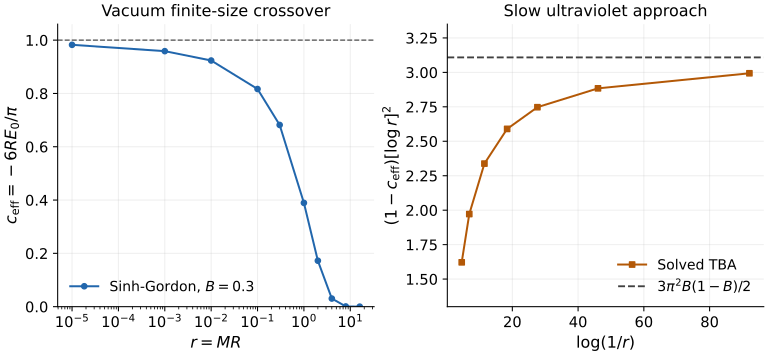
The ground-state TBA at , with the bulk energy density set to zero. Left: the finite-size effective central charge. Right: the ultraviolet deficit multiplied by , compared with its limiting coefficient . The points are independently converged solutions; connecting lines guide the eye. The slow remaining approach is physical, not a failed rapidity-grid limit.
The program examples/nonperturbative/integrable-qft/finite-volume/checks.py uses a finite rapidity interval with negligible occupation at its endpoints. It solves for the correction to , avoiding loss of precision from subtracting large tail values. At selected radii it halves the mesh twice and enlarges the interval separately; changes in are below in those refinements. A separate dense Gauss–Legendre discretization at 160, 320 and 640 nodes reproduces the energies at and , with final relative differences below .
Summary
Thermal state counting keeps the interaction dependence of the density of available roots. Its stationary entropy problem yields the TBA, and the Euclidean cycle exchange turns that thermal free energy into the vacuum energy on a circle. The sinh-Gordon calculation passes dilute-winding, Bose-limit and independent-quadrature checks, while resolving a genuinely slow approach to ultraviolet .
Exercises
- Derive the ultraviolet central charges of the free scalar and free Majorana formulas above directly from their integrals. Explain why discarding the shrinking sinh-Gordon kernel would fail this test.
Solution
At small , use and . In the region contributing at order , the dispersion becomes . Hence
Expanding the logarithms and integrating term by term gives respectively and . Thus the effective central charges are one and one-half. The scalar kernel has finite integrated weight even when its width vanishes. Retaining that weight converts the exclusion logarithm to the Bose logarithm; pointwise deletion would incorrectly keep the second answer.
- Set and write the dimensionless vacuum energy as . Show that its derivative is the thermal energy density. Give a numerical check that tests more than the integral-equation residual.
Solution
With and ,
Compute from the density constraint with the solved filling, then integrate
Independently resolve the nonlinear equation at and . Its centered energy difference should approach this density integral with an error. The companion performs both calculations at three radii and three step sizes. For example, at the density route gives , and the entropy route gives ; their difference reproduces . This check connects the state count, thermal functional and circle-energy normalization.
References
- Bajnok, Zoltán, and Romuald A. Janik. “Four-loop perturbative Konishi from strings and finite size effects for multiparticle states.” Nuclear Physics B 807 (2009), 625–650. arXiv:0807.0399v4 (PDF), §3.1, Eqs. (12)–(18): sinh-Gordon TBA and the leading vacuum winding term.
- Bajnok, Zoltán, and Fedor Smirnov. “Diagonal finite volume matrix elements in the sinh-Gordon model.” Nuclear Physics B 945 (2019), 114664. arXiv:1903.06990v1 (PDF), §2, Eqs. (2.1)–(2.3), and §2.2, Eq. (2.6): finite-size energy and small-circle zero-mode quantization. Their parameter equals our .
- van Tongeren, Stijn J. “Introduction to the thermodynamic Bethe ansatz.” Journal of Physics A 49 (2016), 323005. arXiv:1606.02951v3 (PDF), §2.1, Eqs. (2.1.10)–(2.1.16); §2.3.2, Eqs. (2.3.32)–(2.3.37); and §3.1, Eqs. (3.1.1)–(3.1.4): entropy, constrained variation and the Euclidean cycle exchange. The single sinh-Gordon kernel is specified and derived here rather than inherited from that review's multicomponent examples.
Scrollable formula. Use Left and Right arrow keys to reveal hidden content.
Scrollable table. Use Left and Right arrow keys to reveal hidden columns.
Scrollable figure. Use Left and Right arrow keys to reveal hidden content.