Entanglement Spectra and Boundary Physics
A spatial cut in a Chern insulator produces low entanglement levels resembling its physical edge modes. Which part of that resemblance is exact? For a Gaussian ground state, the exact relation is to the boundary of the bulk spectrally flattened Hamiltonian. The original physical edge has related topology but generally different energies.
Preparation: Fermion correlation matrices and the Chern-band model. We retain that model's Berry sign, orbitals and hopping conventions.
Occupation levels and the normalized modular Hamiltonian
For number-conserving Gaussian fermions, use . Restricting the occupied one-particle projector to a spatial region gives with eigenvalues . In its natural modes,
The single-particle entanglement energies and normalized generator are
The constant is required by . A plotted is not a many-body eigenvalue of . Many-body eigenvalues are sums of occupied plus that constant. An occupation exactly zero or one gives an infinite single-particle energy, rather than a finite level that can be assigned arbitrarily.
Flatten before restricting
For a gapped one-particle Hamiltonian at zero chemical potential, fill its negative-energy states. With their projector,
Spectral flattening leaves the eigenvectors and occupied state unchanged. For a finite-range gapped band Hamiltonian, has exponentially decaying matrix elements, so cutting its couplings defines a boundary problem. Restricting to gives
This is an exact algebraic identity. Crucially, is generally different from . Restriction and spectral flattening do not commute. Thus the identity does not equate with energies of the original open sample, or imply that every arbitrary entanglement spectrum is a physical boundary theory.
A matched Chern-band comparison
Take two orbitals per cell, unit lattice spacing and hopping, and the lower band filled:
With Berry connection and orientation , the lower-band Chern number is at and zero at . The four Dirac masses and their oriented chiralities give these bulk integers. Here they are inputs to two boundary measurements on the same band state.
Keep momentum and a 64-cell periodic ring in . Its correlation matrix is
Restrict to 32 consecutive cells for the entanglement cut. Separately, open a 64-cell physical strip, using onsite matrix and upper-neighbor hopping
A wave gives , checking the orientation. The semi-infinite left edge has spinor , amplitude ratio and
The right edge has the opposite energy. At , both the physical strip and the entanglement cut have crossing branches. At , neither has a central crossing in this model. Each geometry has two boundaries; opposite branches are not evidence for cancellation of the bulk Chern number.
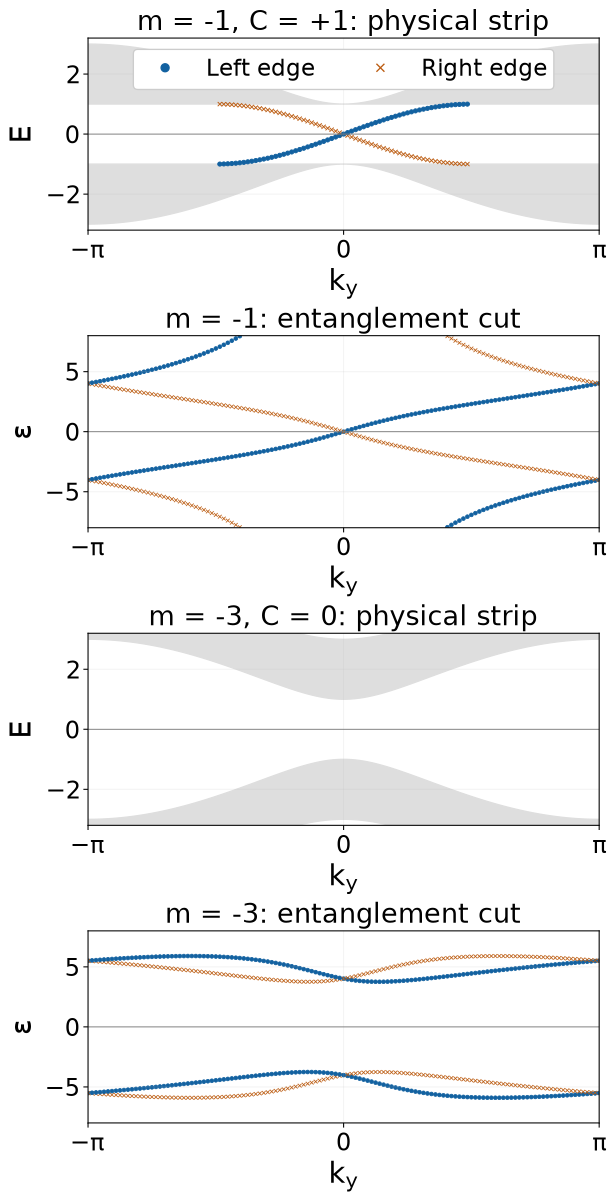
Matched lattice models, with above and below. Physical panels show in-gap strip levels and shaded infinite-system bulk bands. Entanglement panels retain only ; they use a 32-cell half-ring cut. Blue circles and orange crosses distinguish predominantly left and right localized eigenvectors. Exactly degenerate vectors can mix their boundary labels. The vertical energy scales are different quantities.
At the positive levels closest to zero illustrate the unequal dispersions:
| Physical left edge | Entanglement | |
|---|---|---|
The entanglement values are stable within when the cut is increased from 32 to 64 cells at these momenta. Independently diagonalizing small real-space periodic Hamiltonians reproduces the Fourier projectors within . Flattening those independently constructed Hamiltonians and restricting them verifies the matrix identity and finite energy relation. These are checks of this lattice model and its widths, not an interacting or continuum theorem.
Summary
The exact Gaussian correspondence links entanglement levels to the restricted bulk-flattened Hamiltonian. The Chern example shares crossings and boundary localization with its physical strip, but their dispersions differ. State, cut, spectral normalization and physical boundary conditions must all be specified.
Exercises
1. A zero mode and its many-body degeneracy
What does of imply for the reduced state? What happens when two independent such modes are present?
Solution
One mode has and , so its reduced density matrix is . Filling or emptying it gives the same many-body eigenvalue, doubling every other level's multiplicity. Two independent zero modes give four choices and a factor-four degeneracy. Their contribution to entropy is . The normalization constant supplies the corresponding per mode even though each single-particle energy vanishes.
2. Change the physical energy without changing the state
Multiply the bulk and strip Hamiltonians by a positive constant . Determine what changes in , and the physical edge energies.
Solution
Positive rescaling preserves every occupied eigenvector and the sign of every bulk eigenvalue. Therefore , , and all entanglement energies remain unchanged. Physical strip energies instead become . This simple operation already disproves any universal equality of physical and entanglement energies. The equality with survives because the flattened Hamiltonian is unchanged.
References
- Fidkowski, Entanglement spectrum of topological insulators and superconductors, §II.1–II.2, Eqs. (8)–(16): the exact correspondence to a flattened boundary Hamiltonian; the introduction distinguishes it from the original physical edge.
- Qi, Wu and Zhang, Topological quantization of the spin Hall effect in two-dimensional paramagnetic semiconductors, §II and Fig. 2. The Pauli and mass parametrization is translated to the fixed model displayed here and in the linked Chern-band article.
Scrollable formula. Use Left and Right arrow keys to reveal hidden content.
Scrollable table. Use Left and Right arrow keys to reveal hidden columns.
Scrollable figure. Use Left and Right arrow keys to reveal hidden content.