Interval Entropy on a Scalar Lattice: Cutoff, Mass and Size
A sharp interval in the regulated scalar vacuum has an ordinary entropy. Which part changes when the ultraviolet spacing is halved, when its endpoints move or when the correlation length changes? One harmonic ring answers all three questions. We also subtract entropies with matched endpoints before taking a continuum limit.
Preparation. Use bosonic symplectic eigenvalues and the distinction between sharp and buffered regions. We use natural logarithms, a noncompact real scalar in one spatial dimension, and its periodic-ring vacuum at positive mass.
A lattice with physical units
Start from the continuum Hamiltonian
On a periodic lattice of spacing , define and . Since the lattice delta function is , these obey . The Hamiltonian becomes
The ring length is , the interval length is , and
The vacuum correlation rows are
The sine terms in the equivalent complex-exponential Fourier sums cancel between opposite momenta. These finite sums include the constant mode. We always take before choosing a limiting sequence. Comparable lattice formulas and their relation to continuum scalar entropy are developed in Casini and Huerta, §3.1.8.
Restrict both matrices to the interval after computing the full vacuum covariance. If are the positive square roots of the eigenvalues of , its Gaussian entropy is
Here the covariance is half the anticommutator and . A canonical transformation within the interval turns its Gaussian state into independent thermal oscillator states with occupations , explaining the sum. Casini and Huerta, §3.2, equations (3.7)–(3.10) give this construction; the single-mode spectrum gives the corresponding probabilities.
For numerical stability, factor and diagonalize the real symmetric matrix , which is similar to . This avoids treating a generally nonsymmetric product as symmetric.
Removing the cutoff while holding the physics fixed
For the real scalar, the ultraviolet fixed point has central charge one. A two-endpoint interval therefore has
at fixed positive mass and physical geometry. The cutoff-independent function and additive convention are not determined by the logarithmic coefficient. The interval CFT coefficient follows from replica geometry; Calabrese and Cardy, §III.1 give the continuum derivation.
Take , , and , in units where the scalar propagation speed is one. Increase both the interval site count and the ring site count as decreases:
The ring site counts are in row order.
| in nats | ||
|---|---|---|
| 16 | 1.290320159 | |
| 32 | 1.521326196 | |
| 64 | 1.752364005 | |
| 128 | 1.983410069 |
The successive slopes are , , and . They approach while the mass-dependent finite part is held fixed. Doubling to 128 at the finest spacing changes the entropy by about , much less than the cutoff increments. This separates a volume check from a cutoff check; agreement at one lattice spacing would not do so.
The sequence establishes the expected logarithmic coefficient in this regulated example. It does not produce a finite absolute entropy for the sharp continuum region.
The conformal interval coefficient and nonuniversal additive constant are reviewed in Eisert, Cramer and Plenio, §III.4, equation (24). Their entropy uses bits; multiplying it by gives the nats convention here.
The shared computation also checks the Fourier covariance against direct finite-matrix diagonalization and checks the two-oscillator entropy against a wavefunction Schmidt calculation.
Change the region or the mass instead
Now hold and . First fix and enlarge the interval:
| 1.634435338 | ||
| 1.752363650 | ||
| 1.842565672 | ||
| 1.897784792 |
The increments shrink as the interval becomes comparable to the correlation length. At fixed cutoff and a much larger interval than , the two boundaries become effectively independent and the vacuum entropy saturates, rather than growing in proportion to .
Alternatively fix and vary the mass:
| 1.865481894 | ||
| 1.752363650 | ||
| 1.558969908 | ||
| 1.371488291 |
Larger mass suppresses correlations and reduces the entropy in this vacuum family. Doubling the circumference to changes these two sweeps by at most ; the largest shift occurs at the smallest mass. The table reports the values on the finite rings.
Crossing the mass scale
Now hold , , and , and vary the interval. The continuum correlation length is approximately sites; the lattice inverse decay length is more precisely in site units.
| in nats | ||
|---|---|---|
| 4 | 0.2 | 0.829070684 |
| 8 | 0.4 | 0.919117348 |
| 16 | 0.8 | 0.974338221 |
| 32 | 1.6 | 0.995823483 |
| 64 | 3.2 | 0.999242750 |
| 128 | 6.4 | 0.999344076 |
The entropy saturates once the two endpoints are separated by several correlation lengths. Doubling the ring size changes these values by less than . The chosen sequence is a finite-lattice crossover calculation, not a separate continuum extrapolation of every row.
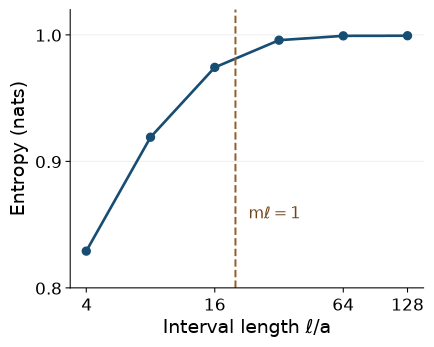
Vacuum interval entropy at , , . The dashed vertical line marks . Points are calculated from restricted covariance matrices; connecting segments guide the eye.
One should not fit these length increments blindly to . In a noncompact scalar, the approach to the small- interval law includes slowly varying infrared contributions. The cutoff experiment above holds fixed and avoids confusing that effect with the ultraviolet coefficient. At large and small , the two endpoint contributions instead give the leading logarithmic saturation term . This leading statement does not determine the subleading infrared terms or the additive regulator convention.
Compare quantities with matched boundaries
The bare entropy includes short-distance contributions localized near each endpoint. In higher dimensions, a smooth vacuum boundary can have a leading term proportional to its area divided by , where is spacetime dimension. Its coefficient generally depends on the regulator. This is a property of specified states and theories, not a universal area law for every QFT state: thermal entropy has an extensive contribution, and highly excited states can have volume-scale entanglement. Eisert, Cramer and Plenio, §§II–III.1 discuss the relevant lattice assumptions and exceptions.
For our two intervals, use the same mass, state and regulator and subtract from . Both have two locally identical endpoints, so their local ultraviolet terms cancel. At and :
| 0.090202578 | |
| 0.090202021 | |
| 0.090201760 |
The individual entropies grow while their difference settles. The last change is . This tests cancellation within the chosen regulator family. Universality across distinct regulators additionally requires matching the theory and the physical regions; it does not follow from one table alone. Mutual information of separated regions provides another useful matched combination, developed in the mutual-information chapter.
Why the zero mode cannot be erased silently
At finite , the constant-mode terms are and . Sending to zero at fixed ring size destroys the normalized vacuum of that noncompact oscillator. Omitting it changes the equal-time commutator of the projected variables to
The projected coordinates are no longer independent site oscillators, so the unchanged submatrix entropy formula would answer a different problem without its required algebraic reduction. Boundary conditions that remove a zero frequency, compactification, and a small positive mass are possible infrared choices, but must be specified as different setups.
Exercises
- A misleading refinement. What changes if and are held fixed while is halved at fixed physical mass?
Solution
Both physical lengths and halve. The ratios and also halve, so the state moves toward a more infrared-sensitive regime even though is fixed. This is not a cutoff removal at fixed region and volume. To follow that physical comparison, double and each time is halved.
- A finite difference cancels the constant. Using the first and last cutoff rows, estimate the coefficient of and compare with the last local slope.
Solution
The total spacing ratio is eight, so
The additive finite term cancels because agree. The last local slope, , lies closer to , consistent with smaller cutoff corrections. Neither estimate measures the finite function separately from the regulator constant.
- The finite-ring infrared singularity. Explain why a fixed proper subinterval typically has as at fixed finite lattice, up to bounded terms.
Solution
The regional position covariance contains the rank-one divergent term . The restricted momentum covariance has a finite positive limit for a proper subset of sites: its only global null direction is not supported entirely in that subset. Therefore one eigenvalue of grows as , and one symplectic eigenvalue grows as . Since at large , it contributes . The complete ring remains pure for every positive ; restriction is essential to this argument.
- An interval contains sites. Its spacing is halved while is kept fixed. Is this a cutoff refinement of the same physical region?
Solution
No: is halved. At fixed physical mass, also changes, so the operation simultaneously changes the region and the regulator. To keep the physical interval fixed, double ; to keep the circumference fixed, double as well. Holding the dimensionless lattice mass fixed would instead change the physical mass when changes.
- Suppose two regulator definitions shift every interval entropy by the same endpoint contribution . Which of the bare entropy, , and the mutual information of two disjoint intervals is invariant under this shift?
Solution
The bare entropy changes by . The difference cancels . For disjoint intervals, and each shift by , while shifts by , so is unchanged. This argument assumes the same endpoint prescription in all terms and a nonzero physical separation. When two endpoints meet, their short-distance correlations change the subtraction.
References
-
Calabrese, Pasquale, and John Cardy. “Entanglement entropy and quantum field theory.” Journal of Statistical Mechanics (2004), P06002, §§III.1 and IV, using the corrected version and its note on multiple intervals. arXiv:hep-th/0405152.
-
Casini, Horacio, and Marina Huerta. “Entanglement entropy in free quantum field theory.” Journal of Physics A 42 (2009), 504007, §§3.1.1, 3.1.3–4, and 3.1.8. arXiv:0905.2562.
-
H. Casini and M. Huerta, Lectures on entanglement in quantum field theory (2022; version 2, 2023), §3.2, equations (3.7)–(3.10), for the free-field covariance construction.
-
J. Eisert, M. Cramer and M. B. Plenio, “Area laws for the entanglement entropy—a review,” Reviews of Modern Physics 82, 277–306 (2010), §§II–III.1 and III.4, for lattice area laws and the conformal interval coefficient. Their covariance is twice ours and their logarithms have base two.
Scrollable formula. Use Left and Right arrow keys to reveal hidden content.
Scrollable table. Use Left and Right arrow keys to reveal hidden columns.
Scrollable figure. Use Left and Right arrow keys to reveal hidden content.