Entanglement after a Global Quench
An isolated system remains in a pure state during unitary evolution, yet a finite region can become highly mixed. A hopping quench gives an exact example: particles initially occupy alternate sites, and the subsequent motion entangles an interval with its complement. The entropy grows approximately linearly in a scaling regime, approaches a volume law, and can decrease when a finite ring brings excitations back.
Preparation: Fermionic correlation matrices. We use natural logarithms, lattice spacing one, and . The initial state and the lattice cutoff are part of the problem; this is a finite-energy-density lattice quench.
A product state released into a hopping chain
Let be spinless fermion operators and take
On an even periodic ring, prepare the occupation state with every even site occupied and every odd site empty. It is the limiting ground state of a sufficiently strong staggered potential at half filling. At remove that potential and evolve with . The state initially has zero entanglement across every spatial cut.
Our correlation matrix convention is
Writing , the Heisenberg equation gives . Hence
The nearest-neighbor matrix anticommutes with . Therefore
This identity is an efficient exact solution. It also shows why the correlation pattern involves twice the one-particle propagation time.
On the infinite chain, Fourier transformation gives
where is an ordinary Bessel function. At it reduces to the alternating projector. Unitary evolution preserves on the complete chain, even though a restricted block is generally not a projector.
For an interval of sites, diagonalize with eigenvalues . Its exact entropy is
No real-time step approximation is needed: either the finite Fourier sum or the Bessel kernel supplies the matrix directly.
Counting pairs in the extensive limit
The initial state correlates momentum modes differing by . Their velocities are opposite because . Their stationary occupations are , so the entropy carried per momentum mode is .
In the limit of large and at fixed , a pair contributes when exactly one member lies inside the interval. The allowed initial positions have total length controlled by the pair separation , until the interval length limits it. With the full Brillouin zone counted once, the leading extensive answer is
The full-zone measure and the factor two belong together. Adding an extra factor for the two members of each pair would double the stationary entropy. This pair-counting construction is the quasiparticle description of Calabrese and Cardy, §IV.
Set and . Direct integration yields
Thus the extensive early growth rate is . The fastest modes stop increasing their contribution at , but modes near the band extrema move arbitrarily slowly. The approach to is rounded rather than an abrupt plateau. In fact at large .
Exact entropy and the meaning of the approximation
The following values use the infinite-chain Bessel kernel. They compare the entropy density at fixed ray while increasing the interval size.
| , | Pair limit | |||
|---|---|---|---|---|
The differences per site decrease; the finite corrections have not been set to zero. Independent finite-ring diagonalization checks the Bessel phases, and doubling a ring from to sites at , changes the entropy by less than . That particular comparison tests wraparound effects, not every late-time limit.
The linear law is not the Taylor expansion at . For an interval with two separated boundaries, each occupied-empty bond creates a small Schmidt probability . Consequently
At , exact evolution gives , while the displayed leading expression gives . Taking small at fixed lattice spacing and taking the large-, large- scaling limit are different operations.
Returns on a finite ring
The exact finite-ring formula remains valid after quasiparticles wrap around the system. For and , selected entropies are
The decline near reflects returning correlations; the dispersive band does not produce a single perfectly synchronized revival. A finite isolated system has no theorem requiring monotonically increasing subsystem entropy. Its global entropy remains zero throughout.
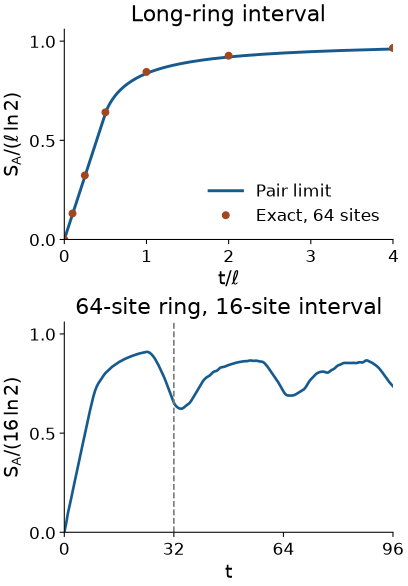
The upper panel compares a -site interval on a -site ring with the leading pair-counting expression. The lower panel uses a -site interval on a -site ring; the dashed line marks . The retained exact data show finite corrections and returns, rather than an irreversible entropy law.
Worked exercises
1. Recover the initial occupations and purity
Check the Bessel expression at and prove full-system purity directly from the matrix evolution.
Solution
Since , the diagonal is and every off-diagonal entry vanishes. Thus . With ,
Restriction and squaring do not commute: omits terms with intermediate sites outside . Those omitted terms allow nontrivial eigenvalues and positive regional entropy.
2. Calculate the entropy velocity
Define through the extensive growth rate , with . Find and compare it with the largest group velocity.
Solution
Before the fastest-pair crossover,
Therefore , whereas . The entropy velocity is a weighted production rate per boundary. It is not the speed of the fastest wave packet. The factor two in its definition counts the interval's two boundaries.
3. Find the late scaling correction
Expand the closed expression for through order and explain why the answer does not describe arbitrarily late times on a fixed ring.
Solution
Using and gives
and hence . The integral assumes an effectively infinite system. On a ring, propagation over distances comparable to changes the pair geometry and produces returns before an unrestricted late-time limit can be taken.
Where this leads
A global quench deposits energy throughout space and produces extensive entropy. Joining two ground-state half-chains instead perturbs one bond and gives a logarithmic growth law. The local-quench calculation makes the difference explicit.
References
- P. Calabrese and J. Cardy, “Evolution of entanglement entropy in one-dimensional systems”, §§IV–V, especially Eq. (31), for quasiparticle counting and the role of dispersive velocities.
- I. Peschel and V. Eisler, “Reduced density matrices and entanglement entropy in free lattice models”, for correlation-matrix methods and time-dependent free-state applications.
Scrollable formula. Use Left and Right arrow keys to reveal hidden content.
Scrollable table. Use Left and Right arrow keys to reveal hidden columns.
Scrollable figure. Use Left and Right arrow keys to reveal hidden content.