Entanglement Asymmetry and Broken Symmetry
A spin can lose its locally visible charge coherence while the full isolated system retains it. Entanglement asymmetry measures this distinction by comparing a reduced state with the state obtained by forgetting its symmetry phase. An exactly propagating spin excitation makes local restoration, revivals and conservation of global asymmetry visible in the same calculation.
Preparation: Density-matrix entropy and charge resolution. The example uses spins, so coherence between different excitation numbers is an allowed preparation; no fermion-parity superselection assumption is hidden in it.
Forgetting the symmetry phase
For an integer-valued charge , the average is
Define the asymmetry
To derive the equality, note that is block diagonal. Its expectation value is the same in and its dephased state. Substituting this into the relative entropy proves the identity, with the usual restriction to supports. Equality holds precisely when .
This is not an entanglement monotone for arbitrary local operations. A product of spins individually prepared in has zero spatial entanglement but nonzero local asymmetry. For a single pure spin , dephasing produces probabilities , hence .
If a global unitary commutes with the total charge, the global twirl commutes with its evolution. Both entropies in the global difference are invariant, so global asymmetry is conserved. A regional twirl generally does not commute with interactions across its boundary. Local asymmetry may therefore decrease, increase or revive.
An exact chain quench
Consider the infinite spin chain with excitation-conserving hopping
Here . The all-zero vacuum has energy zero. Initially only site zero carries coherence:
This is a product state in position space. In the one-excitation sector, a Fourier wave has energy , so
Here on the right is a Bessel function and is the amplitude. The evolved state is . Tracing every site except gives, with ,
The off-diagonal element survives only between the vacuum and the excitation on the retained site. Excitations elsewhere contribute to the zero-occupation diagonal entry. Therefore
At site zero and , the asymmetry is , while . At a zero of both the excitation and its local coherence vanish: the site is in the pure symmetric vacuum. At later times they return. The first such zero occurs near ; it is not permanent relaxation.
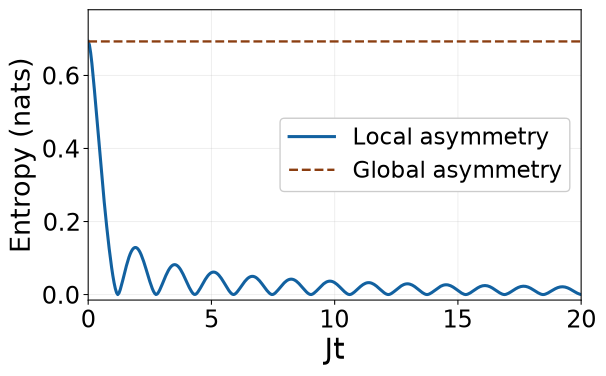
Infinite-chain result at the initially perturbed site. The solid curve is ; the dashed line is the conserved global asymmetry. Bessel zeros give exact local zeros followed by revivals. These are dimensionless entropies in nats.
For fixed , the large-argument Bessel asymptotics gives with oscillations. Expanding the entropy expression at small gives
Information has spread across the chain; the full pure state's charge-zero and charge-one weights remain one half, so its asymmetry remains . This is restoration of a finite site's symmetry after a localized coherent preparation. It is not a calculation of spontaneous symmetry breaking or of a homogeneously tilted many-body ground state.
The companion compares Bessel amplitudes with independent periodic-chain propagation at 128 and 256 sites, before the wave reaches around the ring, and explicitly traces the vacuum-plus-one-excitation state. A finite isolated ring eventually has recurrences. The stated long-time limit takes the infinite-chain limit first and keeps the observed region fixed.
Summary
Asymmetry is the relative entropy lost under a specified symmetry average. Its local decrease can coexist with conserved global asymmetry and increasing spatial entanglement. The chain example restores local symmetry asymptotically, but its intermediate evolution is not monotone.
Exercises
1. A mixed coherent spin
For , with , dephase in the occupation basis and calculate the asymmetry.
Solution
Dephasing gives , while the original eigenvalues are . Thus
It vanishes at and reaches at . For small , Taylor expansion gives . This measures coherence even without a bipartition.
2. Why a global conserved quantity can disappear locally
At a Bessel zero on site zero, where is the global asymmetry stored? Explain why dephasing that site does not dephase the whole state.
Solution
The full state still coherently superposes and a normalized one-excitation wave packet supported away from site zero. Both branches have occupation zero at that site, so the local state is and its local twirl changes nothing. The global charge twirl removes coherence between the two branches, producing a mixture with entropy . The two operations resolve different charges and are not interchangeable.
References
- Ares, Murciano and Calabrese, Entanglement asymmetry as a probe of symmetry breaking, Eqs. (1)–(5): dephasing, relative entropy and charged moments; the homogeneous quenches of Eqs. (6)–(14) use different initial states from the localized quench derived here.
Scrollable formula. Use Left and Right arrow keys to reveal hidden content.
Scrollable table. Use Left and Right arrow keys to reveal hidden columns.
Scrollable figure. Use Left and Right arrow keys to reveal hidden content.