Topological Entanglement Entropy
Most entropy across a spatial cut comes from short-distance correlations near the boundary. Can a combination of entropies remove that local contribution and expose a constraint that extends around the region? In the toric-code ground state, the answer is exact: a disk partition gives , while a related annular partition gives . The geometry determines the factor of two.
Preparation: Entropy and partial trace, with the toric-code construction as background. We use the tensor factors of the physical edge spins. This is a specified lattice prescription, not an unqualified entropy of every possible gauge-invariant regional algebra.
The closed-string constraint
Place one qubit on each edge of a square lattice and define
Every star and plaquette commute because they share either zero or two edges. In a ground state their eigenvalues are . On a torus, fixing two independent commuting logical Wilson-loop eigenvalues selects one pure ground state from the four-dimensional ground space.
A simply connected cut exposes binary boundary data subject to one closed-string parity constraint. When there are independent candidate boundary bits before that constraint, the fixed-point Schmidt distribution is uniform on allowed configurations. Thus
The precise boundary count depends on how a cut assigns edge spins and corners. Its extensive part is local; the missing binary degree of freedom contributes the constant . For multiple disconnected boundary components, with vacuum topological charge and the nonwrapping geometries used below, each contributes such a constraint. One must still count the region topology before subtracting entropies.
The four anyon types are , each with quantum dimension one. The total quantum dimension is
It is not the logarithm of the number of anyon types. More generally, a gapped topological vacuum has a disk entropy with local boundary terms and a universal constant , under the usual large-region and fixed-sector assumptions.
A subtraction whose geometry matters
For three disjoint sets of edge spins, write , and define
In a Kitaev–Preskill disk partition, the three pieces and their unions are disk-like. Each boundary segment cancels between terms, while the constant contributes .
Now divide an annulus into left and right strips , joined by two disconnected pieces comprising . The regions and each have two components; has two boundary components. The constant counts in the same seven-term expression are
This is the alternative topology of Kitaev and Preskill's Fig. 3. It is not an inconsistent normalization of the disk result.
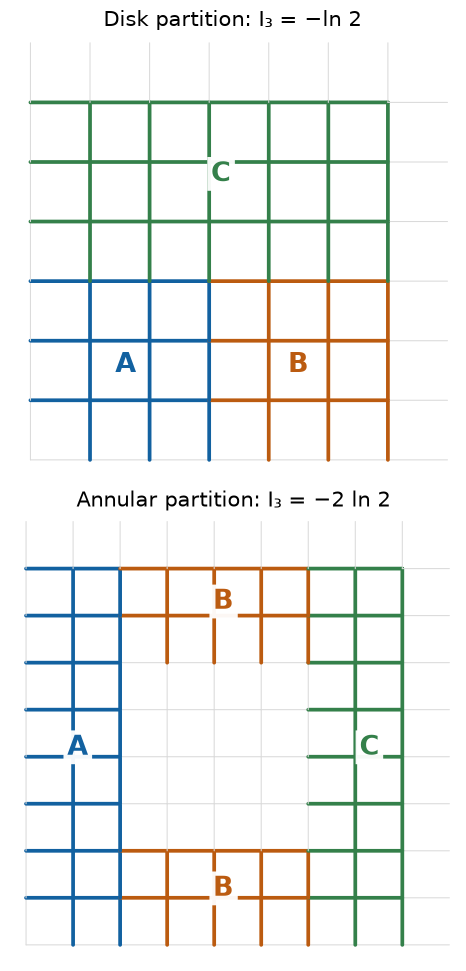
The colored edges are the retained regions on a periodic lattice; gray edges belong to the complement. Labels identify sets of edge spins, including the two disconnected pieces of in the annulus. Both arrangements lie away from a periodic seam and share the same pure ground state and regulator.
All seven entropies from stabilizers
A pure stabilizer state on qubits has density matrix . Tracing the complement of removes every Pauli operator acting nontrivially there, leaving
If the subgroup supported entirely in has independent generators, this is proportional to a projector of rank . Its nonzero eigenvalues are equal, hence
This formula handles the lattice corners without replacing them by a smooth perimeter. The companion builds the 288-qubit torus stabilizers, checks their commutation and full rank after adding two logical loops, then computes by binary elimination. If is the generator matrix, its combinations trivial on the complement form the kernel of that restriction, so .
The resulting entropies, in units of , are:
| Region | Disk partition | Annular partition |
|---|---|---|
The one-unit asymmetry between and in the disk is due to the exact edge assignment at their corners. It is retained in the subtraction. In coordinates measured in lattice units, that disk uses edge centers in , with above and separated below it at . The annulus uses the outer square minus the inner square , with left of and right of . These definitions reproduce the figure and every table entry.
What survives away from the fixed point
For a general gapped ground state, regions, widths and junction-smoothing scales must be large compared with the correlation length , and far from physical boundaries. Local boundary contributions can include orientation and corner terms, not just a multiple of perimeter. The seven geometries must match those contributions so they cancel. A finite-size residual at one shape or near an edge is insufficient.
A short-range entangled symmetry-protected or invertible phase can have and zero topological subtraction while still having protected boundary states or a quantized response. The Chern-band example demonstrates why spectra and response supply additional information. Conversely, classical correlations in a symmetry-breaking cat state can contribute constants that require a separate state-selection analysis. The subtraction is a diagnostic within a gapped ground-state setting, not a complete phase classifier.
Summary
At the toric-code fixed point, a stabilizer rank calculation isolates the missing boundary bit exactly. Disk and annular partitions count different numbers of global constraints. Away from that fixed point, matched boundaries, ground-state sector and the large-region limit are part of the conclusion.
Exercises
1. Reproduce both subtractions
Use the table without assuming a perimeter formula.
Solution
For the disk, the positive terms sum to , while the negative terms sum to . Thus . For the annulus they sum to and , giving . Keeping the actual corner-dependent entries is necessary for the first result.
2. An Abelian generalization and a trivial control
For a vacuum Abelian topological order with anyon types, what constants do the two partitions give? Compare a product state of the edge spins.
Solution
All Abelian quantum dimensions are one, so . The disk gives , and the annulus gives , assuming the same boundary-counting and large-region conditions. A product state has zero entropy for every edge subset, hence both combinations vanish exactly. The latter is a direct finite-state control, not a general proof that every state with vanishing subtraction is trivial.
References
- Kitaev and Preskill, Topological entanglement entropy, Eqs. (1)–(5), (15), and Fig. 3: total quantum dimension, boundary cancellation and the two region topologies.
- Savary and Balents, Quantum spin liquids, §2.2, Eqs. (8)–(10): topological entropy and the toric-code value. The finite edge assignments and binary stabilizer calculation above are explicit new checks.
Scrollable formula. Use Left and Right arrow keys to reveal hidden content.
Scrollable table. Use Left and Right arrow keys to reveal hidden columns.
Scrollable figure. Use Left and Right arrow keys to reveal hidden content.