Wilson and Clover Fermions
The naive lattice derivative creates light fermions at every Brillouin-zone corner. Wilson's remedy is to give the unwanted corners masses of order the inverse spacing. The same term breaks the axial symmetry that would protect the light mass, so removing doublers also creates a mass-tuning problem. Clover improvement addresses a further question: how can one cancel the leading on-shell error without undoing that remedy?
Preparation: Fermion doubling, forward links and plaquettes, and the Wilson gauge action. Gamma matrices below are Euclidean and Hermitian, and plane waves are . The lattice fermion action is in even dimension .
Add a covariant Laplacian
For the site's forward link , define shifts acting on a field at by
Both terms transform at , and on a periodic lattice. Set
For real , the Wilson operator is
The last term is Hermitian and nonnegative: for periodic unitary shifts. On smooth fields it is , so it vanishes at fixed physical momentum as . Yet near a zone edge it is of order . This is exactly the contrast needed to lift doublers.
In components the diagonal is ; the forward and backward hopping blocks are respectively
These signs follow from the endpoint convention. In sources using backward links , substitute ; compare Gupta, §10, Eqs. (10.1)–(10.3), printed p. 46, PDF. For open boundaries in this chapter's determinant example, the fields are extended by zero outside the grid. Missing neighbors are omitted but the diagonal remains : replacing it by the number of existing bonds would define a different boundary operator.
The derivative part anticommutes with , while the scalar Wilson term commutes with it. Consequently
The first identity is often called -Hermiticity. It makes Hermitian and makes real. It does not, by itself, make an arbitrary one-flavor Wilson determinant positive. The second identity shows explicit axial breaking even at bare mass zero.
The spectrum and its critical branches
On identity links,
Its eigenvalues are , and its singular values are . Around a corner with edge components,
At only the physical corner is light. In four dimensions the unwanted mass coefficients are with multiplicities . These are coefficients in local momentum expansions, not exact finite-spacing temporal pole energies. Other free branches become massless if ; choosing a negative mass without specifying the intended branch is not a generic way to approach the physical massless theory.
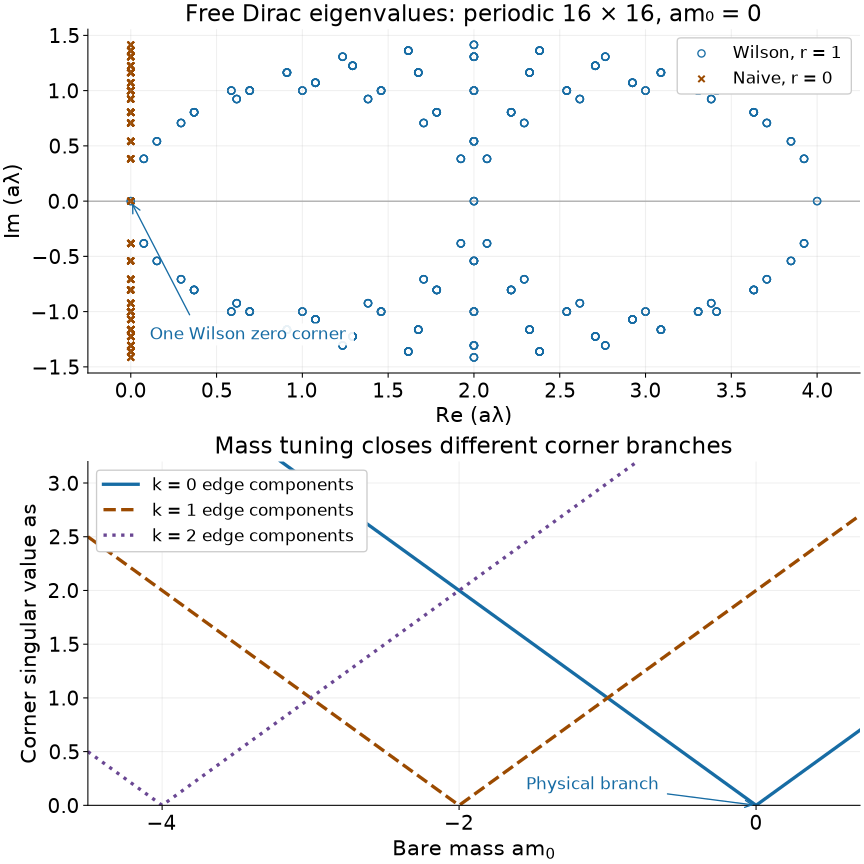
Free two-dimensional symbols with for Wilson fermions. The upper panel evaluates a periodic momentum grid at ; overlapping points do not display multiplicity. The lower panel shows at the corners, distinguishing the desired branch from the lifted branches. These are Dirac eigenvalues and singular values, not measured particle energies. The companion checks the analytic symbols against finite position-space matrices.
For a real positive mass, obtain the zero-spatial-momentum decay rate by continuing . A vanishing eigenvalue requires
For this gives
For example, gives , not . The companion verifies that the analytically continued matrix is singular at this value. The same tree-level pole relation appears in Weisz, §5.2, Eq. (5.18), printed p. 49, PDF.
What must be tuned in an interacting theory
Factoring out the diagonal coefficient gives the hopping parameter
where sums the link hoppings with spin matrices . The free physical critical point is : in two dimensions and in four for .
Interactions allow an additive mass counterterm because the Wilson action lacks the protecting axial symmetry. Define a critical bare mass by a specified massless renormalization condition, and a subtracted mass
A renormalized mass then has the schematic form with mass-dependent improvement corrections when required. One practical condition uses a nonsinglet axial Ward identity, , implemented with renormalized and appropriately improved lattice operators. A ratio such as supplies a mass estimator away from contact points; its zero defines the tuning condition. Finite-spacing definitions can differ by cutoff effects. The free spectrum cannot supply an interacting numerical . See Gupta, §10, Eq. (10.5), printed p. 47, PDF.
Cancel the leading on-shell error
Write the continuum covariant derivative as , so . Define the Euclidean spin tensor
It is Hermitian. It is not the site's Lorentzian spin generator . The Clifford algebra gives
For a massless on-shell spinor, , hence . The Wilson correction therefore contains
The symbol here denotes equality after use of the field equations for on-shell improvement; it is not an identity between arbitrary off-shell insertions. Adding the opposite Pauli term cancels this tree-level contribution:
Both antisymmetric orders are included. A sum over would have coefficient . This definition includes explicitly; the familiar convention usually sets .
The on-shell dimension-five classification and the resulting Sheikholeslami–Wohlert term are given in Weisz, §5, Eqs. (5.2)–(5.7), printed pp. 47–48, PDF. His gauge field is anti-Hermitian, with : and . Thus his translates to the positive Hermitian-field term above. This translation is essential to the sign.
The four leaves and a non-Abelian check
Let be the sum of four positively oriented elementary loops touching , all based at . Their step sequences are , , and . Each loop multiplies its first traversed transporter on the right. Define
with the trace part removed for SU(). Each leaf starts as . Averaging their opposite displacements removes the leading odd displacement error, so for smooth bulk fields. The clover term is Hermitian, commutes with , and preserves -Hermiticity, but does not restore naive axial symmetry.
A check that detects the sign uses constant SU(2) potentials , , , with color Pauli matrices separate from spin. Then . Take spin matrices . The constant spin–color vector obeys . Exact links and the four oriented leaves give:
| , | ||
|---|---|---|
The Wilson residual halves when halves; the improved residual decreases by nearly eight in this symmetric constant-field example. Reversing the clover sign gives at , almost twice the unimproved error. This is a classical on-shell sign and cancellation check, not an interacting scaling study. Its special residual does not promise errors in general observables.
Beyond tree level must be matched, and masses, composite operators and boundaries can need their own improvement terms. In particular the clover term vanishes on identity links, so it cannot by itself change the free massive pole relation. These limitations are part of on-shell improvement, as explained in Weisz, §§5.1–5.2, printed pp. 48–49, PDF.
Summary
The Wilson Laplacian raises corner masses while breaking the axial protection of the physical mass. Critical-mass tuning identifies the desired light branch. Clover improvement cancels the leading on-shell Pauli error with a sign fixed by the gauge and Euclidean spin conventions; it neither restores exact naive chiral symmetry nor replaces mass and operator improvement.
Exercises
A critical point on the wrong branch
In four dimensions with , tune the free bare mass to . How many light species result, what is their relative chirality orientation, and what hopping parameter represents this point?
Solution
At a corner with edge components, . Only vanishes. There are such corners, each giving a Dirac species. Their gamma matrices have one reversed sign, so each local axial orientation is opposite to the original . The other corners have nonzero masses of order . Since , this point has , whereas the physical free branch has . A vanishing eigenvalue alone does not identify the desired continuum species content.
Tune a specified free pole energy
For , choose the bare mass so that the zero-momentum pole energy is a prescribed . Compare that choice with through first order in , and explain whether setting repairs the difference on identity links.
Solution
Inverting gives
If instead , the pole is . For example, requires . All plaquettes are the identity in a free background, so and changing does nothing. The discrepancy is a mass-parameter improvement issue, consistent with the need for mass-dependent terms in addition to the massless on-shell clover cancellation.
References
- R. Gupta, Introduction to Lattice QCD, Les Houches lectures (1998), arXiv:hep-lat/9807028, §10, printed pp. 46–48, Eqs. (10.1)–(10.7).
- P. Weisz, Renormalization and lattice artifacts, Les Houches lectures, arXiv:1004.3462, §1.6 for the anti-Hermitian convention and §§5–5.2, printed pp. 47–49, for on-shell improvement and mass matching.
Scrollable formula. Use Left and Right arrow keys to reveal hidden content.
Scrollable table. Use Left and Right arrow keys to reveal hidden columns.
Scrollable figure. Use Left and Right arrow keys to reveal hidden content.