Gauge-Invariant Tensor Networks
A variational state can have a plausible energy while violating the local constraints of a gauge theory. The tensor construction can prevent this failure before an optimizer changes a single parameter: an electric-flux label enters each site, the matter charge changes it, and the outgoing label must carry precisely the resulting flux. The remaining tensor entries describe physical fluctuations.
This article builds that construction for a short open U(1) chain, performs a small constrained variational calculation and compares it with a finite Gauss-law penalty. Exact invariance will survive even an inadequate bond dimension. That distinction is the central diagnostic.
Preparation. Matrix product states, Gauss's law in a Hamiltonian basis and the Schwinger Hamiltonian. The scalar chain used for DMRG is replaced here by the explicitly declared gauge model.
The open-chain constraint
Use even , sites , occupation and staggered background
The integer link variable obeys
The external values are . Summing the constraints gives , or . Once the matter configuration is given, the internal fluxes are fixed:
We retain the preceding chapter's orientation: raises , the physical forward electric field is , and a staggered field redefinition makes the hopping positive. In units with ,
The matter-only representation substitutes the cumulative flux into the last term. It is useful for a small exact reference, but the electric energy then becomes nonlocal in the occupations. A tensor method must represent that dependence explicitly.
Flux on a virtual index
Resolve the virtual bond into a direct sum of charge sectors,
The integer specifies flux; the index describes independent states with that same flux. In this article always bounds the total bond dimension, summed over sectors.
Write a matter tensor as
The boundary labels are zero. To display the physical gauge link as well, copy the outgoing charge into its electric basis:
There is no outgoing physical link at the final site; its right virtual label is the fixed external flux. Contracting the tensors gives amplitudes in the orthonormal basis .
Every nonzero contraction path satisfies at every site. Therefore each coefficient is annihilated by every , regardless of the complex numbers in the allowed tensors. Optimization only changes those numbers. The copied-link map is an isometry from the fixed-charge matter basis because each matter configuration has one allowed link configuration.
This is the finite open-chain form of the charge-index construction in Buyens et al., Eqs. (3)–(5), PDF pp. 2–3. The source's gauge variables are translated to the orientation above. No thermodynamic-limit accuracy from that paper is attributed to our short chain.
Two different uses of the word gauge now coexist. The physical transformation is generated by the . The representation change merely changes virtual coordinates without changing the represented state. A representation change compatible with explicit charge labels acts within their blocks. It is not the physical Gauss-law condition.
For a non-Abelian group, a virtual index carries a representation and a degeneracy index. Allowed tensors are intertwiners: their representation indices must fuse to the required invariant channel, while degeneracy tensors carry variational freedom. The U(1) Kronecker delta above is the simplest such fusion rule. Representation truncation and degeneracy truncation remain different approximations.
What a symmetry-preserving truncation retains
Across a bond the Schmidt matrix separates into flux blocks. Within each block, take a singular-value decomposition, then retain the globally largest singular values up to the chosen total . The retained vectors carry their original flux labels. This procedure never mixes distinct sectors and hence preserves the tensor selection rule.
It can nevertheless discard important physics. Removing all vectors in one sector preserves Gauss's law while losing that sector's contribution to the wavefunction. Conversely, increasing the degeneracy inside an already retained sector does not restore a flux that was excluded by a separate bound .
If is the probability in a flux block and its normalized density matrix, the ordinary Schmidt entropy in this specified tensor-product embedding is
The first term records the distribution among sectors, and the second records correlations within them. We use this embedding entropy as a numerical diagnostic; questions about an operational gauge-algebra entropy require specifying the observable algebra and boundary treatment separately.
For four sites with neutral boundaries, all physical paths fit inside . The middle bond can carry , with maximum degeneracy dimensions . Thus total rank four can represent any neutral four-site state, whereas rank two can still satisfy every constraint exactly.
Optimize only the allowed entries
Take , , and . The six-dimensional physical Hamiltonian is the same independently checked matrix used in the Gauss-law example. Here it supplies small reference energies and local environment contractions; the initial tensors are not obtained from its exact ground state.
At a chosen site, move the MPS into mixed canonical form and collect its allowed tensor entries into a vector . Contracting the other tensors defines a map from those entries to the physical state. The local Rayleigh quotient is
Minimization gives the generalized eigenproblem
Canonical environments make the norm matrix the identity on independent allowed entries. The implementation checks that property and removes numerical null directions before solving. Updating one tensor and sweeping through the chain is an actual variational minimization. The DMRG article develops the matrix-product-operator version for larger systems.
The declared complex initial amplitudes in the ordered physical basis are proportional to
They are normalized and charge-factorized before six forward-and-backward sweeps. All local squared Gauss generators are zero before optimization. Both starts lead to the following results; energies are in the units fixed above.
| Total | Full residual | |
|---|---|---|
| 1 | ||
| 2 | ||
| 4 | below | below |
The exact reference is . The tensor norm and environment checks reach floating-point accuracy, and the constraints remain exactly zero. The rank-one state is plainly inaccurate despite being exactly physical.
One-site updates also have an important limitation: their fixed charge ranks need not explore every sector allocation available at the same total . As a control, remove the factor from the two starting states. At the sweeps converge to an energy error about , much worse than the primary result, while each local update lowers or preserves the energy. Local convergence and agreement between these two similar starts do not prove a global variational optimum. A two-site update or an explicit change of sector allocation can explore directions unavailable to that fixed-rank sweep.
An explicit link register can also keep unphysical states available. The Gauss-square and code-projector checks distinguish leaving the encoded flux range from violating Gauss's law at a site. Here the virtual flux label enforces the local rule directly, while the allowed flux range and multiplicity still limit the variational state.
A penalty needs a specified imperfection
A common alternative works in an enlarged space and adds
If , a penalty separates sectors without mixing them. Once the physical sector contains the lowest penalized energy, an exact eigenvector is exactly physical at finite . It would be incorrect to attribute unavoidable leakage to a finite penalty in this ideal situation.
To test a nontrivial limitation, declare an explicit gauge-breaking term,
Raising a link without changing its endpoint matter violates the two neighboring constraints. This is a controlled imperfection in the test, not an interaction in the target Schwinger model. It preserves total matter number, and its projection into the physical sector vanishes: .
The enlarged four-site space has six neutral matter configurations and link configurations, hence dimension . An independent assembly verifies and that its physical projection equals the reduced six-state matrix entrywise. Exact diagonalization of this enlarged matrix gives:
| , | Physical probability | |
|---|---|---|
For the control , every selected from through already gives the physical ground state and squared Gauss violation at roundoff. For , increasing the penalty suppresses the admixture but does not make it identically zero. The constrained tensors satisfy the equations exactly because those admixtures are absent from their parameter space.
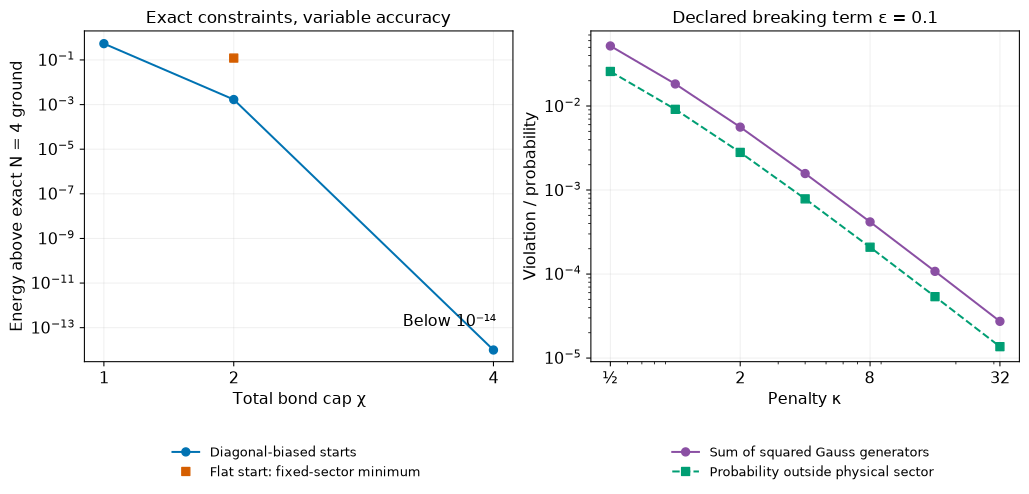
Four-site U(1) chain with and . The left panel compares constrained variational errors, including the poorer fixed-sector start. The right panel shows and for the declared imperfection . These are different quantities; both vanish to roundoff in the invariant control.
The companion gauge_tensor_checks.py retains these data and checks complex tensor norms and energies, explicit copied-link states, local gauge transformations and the projected Hamiltonian. The subsequent time-evolution example checks the same selection rules during genuine gate updates. Neither a zero Gauss norm nor a small penalty response removes bond, flux-range, lattice-spacing or finite-volume errors.
Summary
A flux label and a charge-selection delta make every represented state satisfy Gauss's law before optimization. Degeneracy ranks control correlations inside flux sectors, while the retained flux range controls a different approximation. Small constrained variational and penalty calculations show why physicality, optimization accuracy and numerical convergence require distinct diagnostics. The same labels make the electric part of tensor time evolution explicit.
Exercises
1. Count the flux blocks
For four sites with zero external flux, list the six neutral occupation strings in site order and their three internal fluxes. Determine the largest middle-bond rank needed for an arbitrary physical state. Why can a lower-rank truncation still satisfy every ?
Solution
Using the background and cumulative charge gives:
| Occupations | |
|---|---|
At the central cut, the prefixes have fluxes . The suffix carries the compensating charge. The Schmidt matrix therefore has blocks of maximum sizes , and . A generic state can have ranks , totaling four.
Truncating singular vectors within these blocks preserves their labels and every allowed tensor path. It changes amplitudes and possibly removes a whole flux sector, but it cannot create a path with a wrong charge increment. Thus rank and Gauss-law accuracy are logically independent.
2. Bound and estimate penalty leakage
In the enlarged globally neutral space, show that . Then suppose and have a nondegenerate physical ground state and simultaneous unphysical eigenstates with energies and eigenvalues . Derive the leading perturbative expressions for the outside-sector probability and for under . Assume the relevant penalized levels are separated from the physical ground energy .
Solution
The external fluxes and total matter charge vanish, so . Each is integer-valued in the occupation/flux basis. A nonzero vector of such integers with zero sum contains at least one positive and one negative component, hence . Therefore the operator inequality on this globally neutral space is
which proves the probability bound. The equality alone would not suffice: opposite violations can cancel in that first moment.
To first order in , the unphysical component is
Normalization changes the physical component at second order. The leading outside-sector probability is
The squared Gauss expectation instead contains the eigenvalue weight:
At large these scale as , with generally different coefficients. The expansion fails near a penalized level crossing. For , no mixing is produced at all; a sufficiently separated physical ground state is exactly invariant even at finite penalty.
References
- B. Buyens, J. Haegeman, K. Van Acoleyen, H. Verschelde and F. Verstraete, “Matrix product states for gauge field theories,” Physical Review Letters 113, 091601 (2014), doi:10.1103/PhysRevLett.113.091601, arXiv:1312.6654v2 (PDF). Equations (3)–(7), PDF pp. 2–3, give Gauss-law charge blocks and their variational degeneracy indices.
Scrollable formula. Use Left and Right arrow keys to reveal hidden content.
Scrollable table. Use Left and Right arrow keys to reveal hidden columns.
Scrollable figure. Use Left and Right arrow keys to reveal hidden content.