Moving Frames and Partial-Wave Mixing
Giving a two-particle system nonzero total momentum produces additional scattering energies without changing the box. It also reduces the symmetry: a finite-volume level can depend on more than one partial wave. For unequal-mass particles, an S wave and a P wave can enter the same irrep even when their infinite-volume scattering amplitudes do not mix.
We construct this mixing explicitly for two distinguishable spin-zero particles with momentum along a cube axis. A deterministic example shows that a small P-wave phase can noticeably bias an S-wave extraction. A second irrep provides a separate constraint, provided its different energy is handled consistently.
Preparation: Elastic quantization at rest defines the box sum and phase convention. The present example extends that construction to unequal masses; it is not the same scattering system as the equal-mass benchmark.
Boost the relative momentum, not the integer grid
Let the laboratory energy be , the total momentum be , and the center-of-mass energy be . For masses ,
We retain real scattering momenta. Define to multiply a vector's component parallel to by , leaving its transverse components unchanged. The dimensionless center-of-mass mesh is
To see the mass-dependent shift, let particle 1 have laboratory momentum . Its center-of-mass energy is
The inverse boost then gives on shell. Both and depend on the trial energy; freezing them while searching for a level changes the quantization condition. These kinematics and the shifted mesh are given in Leskovec and Prelovsek, Eqs. (6)–(11), printed pp. 5–6 (PDF). Their equals here.
The free poles should therefore be computed from the physical energies
then converted to . Integer values of are generally not the pole locations in a moving frame.
The little group admits both S and P waves
Choose . The scalar little group preserving this vector is , containing fourfold rotations about and vertical reflections. Its irrep projector has the standard form
Within , the functions and are each invariant under the little group, so and both belong to . The pair transforms as the two-dimensional irrep . A rotation mixes and ; the component remains unchanged.
Spatial inversion sends to and is not itself a symmetry within this fixed nonzero-momentum sector. For unequal masses the shifted mesh also lacks the inversion pairing needed to cancel odd harmonics. This allows S/P mixing in the finite-volume geometric matrix. It does not imply parity violation by the infinite-volume interaction.
For equal masses, , and the integer transformation sends . Odd mesh sums then vanish. This is a useful decoupling check even for distinguishable equal-mass particles. For identical spin-zero bosons, exchange symmetry independently excludes odd orbital waves.
Normalize the geometric matrix
Use real Cartesian solid harmonics
The analytically continued zeta functions and normalized combinations are
The first equation requires analytic continuation; direct unregulated summation is not its numerical definition. At rest , so as required by the earlier article.
Projecting the periodic Green function onto these harmonics yields, in the basis,
The angular coefficients can be understood from and
The azimuthally symmetric transverse contribution instead carries . The relative comes from the phases of the partial-wave Green functions; rephasing the P basis makes the block real symmetric without changing its determinant. For real energies these are real and is Hermitian. The explicit block, including the essential off-diagonal factor, is checked against Leskovec and Prelovsek, Eqs. (55)–(58) and footnote 13, printed pp. 22–23 (PDF).
With all interactions set to zero, the two conditions are
A single energy gives one equation for two phase shifts. In a physical application, neglected higher waves enlarge both blocks, and spin introduces additional angular-momentum and row indices. A lattice irrep is not a unique infinite-volume partial wave.
A convergent shifted-mesh calculation
The companion evaluates all three required zeta functions together. For any positive split , define and . A Poisson-summed representation is
The shifted Poisson phase and the odd-harmonic factor must be translated together. Pairing and makes the displayed expression real. This form follows by the same Schwinger split as at rest, using the Fourier transform of a Gaussian times a solid harmonic; the continuation is also given in Leskovec and Prelovsek, Appendix A, Eqs. (59)–(70), printed pp. 25–27 (PDF).
Independent direct and Poisson-transformed heat sums test the phase and boost Jacobian. The implementation also tests the rest normalization, equal-mass odd-wave cancellation, the parity change under mass exchange, and the residue of an individual free pole. These checks distinguish a consistent geometric construction from a determinant that happens to be insensitive to an isolated sign error in .
A small P wave can give a visible S-wave bias
Use the frozen deterministic model
Thus , and the scattering volume is , with . Higher waves are exactly zero by definition. We restrict the model to and do not infer a microscopic potential or a physical bound on omitted QCD waves.
Define quantities useful for a stable numerical determinant,
The condition is . It differs from the dimensionless determinant only by an overall nonzero power of . A pure-S interpretation of the full mixed level would instead return . Therefore
This formula evaluates both quantities at the same energy. The difference between the full mixed level and a separately solved pure-S level is another observable and must be calculated separately.
We retain three branches above the first three distinct free multiplets. For particle 1 these begin with , then , then the transverse orbit . The first two axial multiplets have no component; the first level belongs to the third interval. At :
| branch | Full | Shift in laboratory energy | Relative bias in |
|---|---|---|---|
| 0 | 0.2102921765 | 0.0000801784 | +6.292% |
| 1 | 0.3076208374 | 0.0001496667 | +10.729% |
| 2 | 0.5709857165 | 0.0003889251 | +10.716% |
Here the energy shift means , while the relative bias means . Across all twelve levels, , yet the bias ranges from 1.64% to 10.73%. The scaled denominator stays between approximately and : these points were not selected near a zero of the P-wave Schur denominator.
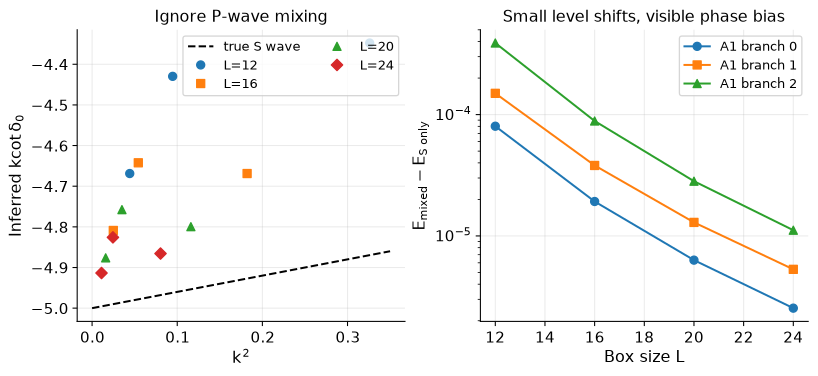
The unequal-mass , , , , model. Left: the pure-S inference from each full mixed level, compared with the true S-wave function. Right: the separately calculated displacement of each laboratory energy from its S-only control. All points are deterministic roots; the two panels measure different effects of the same omitted P wave.
The first momenta at are respectively , , and . Each gives
They recover in the stipulated constant- model. Their energies differ from the energies. Using them to correct an level requires an assumption or determination of the energy dependence between those points. Here the assumption is explicit, so one inserts that common in and recovers .
The retained moving_checks.py compares split parameters, direct/dual cutoffs, quadrature orders, an adaptive integral and denser pole-free branch scans. Selected roots are below and . Decreasing by factors of ten drives the mixed roots toward their S-only controls and the roots toward their free poles. The shared rest-kernel warning about cancellation at much larger positive still applies; accurate checks here do not establish accuracy over an arbitrary energy range.
Summary
A moving frame changes both the allowed center-of-mass mesh and the symmetry used to organize the spectrum. Unequal-mass levels along a cube axis constrain S and P phases together; the irrep supplies a separate P-wave relation within the stated truncation. Small higher-wave phases do not alone bound the bias of a one-wave inference.
Exercises
1. Equal masses and exchanged masses
Prove that at equal masses for . Then interchange and at fixed . Determine how transforms and whether the levels change.
Solution
At equal masses . Pair every integer vector with . The corresponding shifted vectors satisfy
The denominator is unchanged and is odd, so the pair cancels. The same pairing holds in the regulated continuation; and the S/P block decouples.
Mass exchange sends while leaving unchanged. Reindexing again by reverses the shifted vector. Since a degree- solid harmonic changes by ,
Only the odd off-diagonal entry changes sign. The determinant depends on , so the spectrum is unchanged when the masses are relabeled with the same amplitudes. This spectral invariance would not, by itself, detect a mistaken sign in the odd sum; the heat-kernel and parity checks test that sign directly.
2. Correct a contaminated S-wave inference
At the third mixed level, use , , and the model's . Find and the corrected value. Explain why knowing only that is small is not a general error estimate.
Solution
The true function at this momentum is . Therefore the naive bias is . The Schur relation gives
and
The correction is negative because . Its magnitude is about of , although . Generally the bias depends on both geometric mixing and the denominator ; a small phase can be enhanced near a geometric pole or a small Schur denominator. A useful error estimate therefore needs the omitted amplitude and its kinematics, or data that constrain them.
References
- Luka Leskovec and Saša Prelovsek, Scattering phase shifts for two particles of different mass and non-zero total momentum in lattice QCD, arXiv:1202.2145v3 (PDF), Eqs. (6)–(11), (30)–(32), (55)–(58), footnote 13 and Appendix A. Unequal-mass mesh, normalized geometric blocks and convergent zeta representation.
Scrollable formula. Use Left and Right arrow keys to reveal hidden content.
Scrollable table. Use Left and Right arrow keys to reveal hidden columns.
Scrollable figure. Use Left and Right arrow keys to reveal hidden content.