Phase Transitions in an Expanding Universe
A bubble can nucleate without converting much of the Universe. It must grow, meet other bubbles, and overcome the expansion of the space still occupied by the false phase. Even a decreasing false-phase fraction need not mean a decreasing physical false-phase volume.
We will integrate a specified thermal rate history in a radiation-dominated Universe. The calculation separates the first appreciable nucleation, a conventional percolation estimate, and completion to a stated tolerance. An exactly solvable vacuum-dominated example then shows why these distinctions matter.
Preparation: Thermal nucleation rates supplies the local decay problem; bubble-wall dynamics explains the additional input needed for a growth speed. No gravitational-wave spectrum or baryon asymmetry follows from the conversion history alone.
From a local rate to a growing bubble
Use a spatially flat expanding metric with the site's mostly-minus signature,
Let be the thermal nucleation rate per unit physical false-phase volume per unit proper time. Its mass dimension is four. Assume a homogeneous temperature, independently nucleated bubbles, negligible initial bubble radii, and a specified wall speed relative to the comoving plasma. Neglect reheating and changes of speed caused by fluid flows or collisions. These are dynamical assumptions, not consequences of a potential's minima.
A bubble nucleated at has comoving radius and proper radius at time :
Thus is only the negligible-expansion limit. The local nucleation calculation also requires its critical bubble and formation time to be much smaller than the relevant expansion scales; otherwise the flat-space thermal rate is not an adequate input.
For a microscopic theory, write . In a canonically normalized three-dimensional thermal EFT, is the dimensionless bounce action difference. A convention that instead uses a dimension-one three-dimensional energy functional writes the same exponent as . Matching the static action supplies neither the full prefactor nor .
The neighboring scalar bounce calculation uses a tilted quartic theory. Its metastable phase must first be prepared; cooling at fixed nonzero tilt neither prepares that phase by itself nor crosses the zero-tilt coexistence line. Here we specify the rate history directly, so we do not attribute an uncomputed thermal trajectory, determinant or wall velocity to that example.
Count the region that could have reached a point
Choose a comoving point and ask whether any earlier bubble could have covered it. Candidate centers at occupy a comoving ball of volume . Multiplying by converts that ball to physical volume at nucleation. The Poisson no-event probability gives
is the extended volume, which counts overlapping bubbles repeatedly. The actual converted fraction is , not once overlap matters. One may extend candidate nucleation into already converted regions: with the stipulated common growth law, those extra bubbles cannot overtake the bubble that converted their center. This construction explains why no extra factor belongs inside the integral for .
By contrast, the number density of bubbles that actually nucleate contains that factor:
The approximation treats overlap geometrically; it does not simulate collision-induced heating or correlated nucleation. The expanding-volume formulas agree with Ellis, Lewicki and No, §2.1, Eqs. (2.4)–(2.5).
Three different transition milestones
The coexistence temperature , when equilibrium free energies agree, does not specify when nucleation becomes appreciable. A commonly used nucleation diagnostic is
This counts events using an instantaneous Hubble volume along the history, with an order-one volume convention. It is a useful onset estimate, not the bubble density or the conversion probability of one fixed region. The still simpler crossing discards the time integral and bubble growth altogether.
For percolation we will report the conventional proxy . It corresponds to , or about converted volume. This threshold is motivated by randomly placed overlapping spheres; it is not an exact connectivity theorem for every distribution of bubble sizes and growth histories. Our calculation evaluates that proxy, rather than performing a spatial percolation simulation.
The expected physical false-phase volume in a fixed comoving region is proportional to . It decreases only if
This condition, emphasized in Ellis, Lewicki and No, §2.3, Eq. (2.26), is stronger than . It is necessary for that physical volume to disappear, but a negative derivative at one instant does not establish later completion. We must follow the subsequent history. For the finite calculation below, define completion to one-percent tolerance by , with decreasing physical false volume thereafter throughout the stated interval. This is a specified numerical tolerance, not an assertion that every point in an infinite Universe has converted.
Integrate a specified radiation-era history
Assume adiabatic radiation domination, constant energy and entropy degrees of freedom, and subdominant transition energy. Normalize and define . Then
For , take the following assumed rate-history model:
The initial state at contains no bubbles and has no earlier nucleation contribution. marks that initial condition, not a computed . The rate can be represented as and with . Neither nor is inferred from a determinant here. The logarithmic slope of the full rate is , whereas ; dropping the prefactor would confuse these slopes.
Since , all dimensional scales cancel from the conversion integral:
The factors are instructive: supplies , supplies , and supplies . Omitting the expansion factor would therefore change the integrand's power. Differentiating the positive integral gives
For an analytic check, extending the lower endpoint formally to zero gives . Our finite-start integral subtracts the contribution from ; it does not silently include bubbles from before the initial state.
Direct integration gives:
| Milestone | |||
|---|---|---|---|
| Nucleation proxy | |||
| Physical false volume starts decreasing | |||
| Percolation proxy | |||
| One-percent completion |
When the instantaneous rate first equals , essentially no volume has converted. At the percolation proxy, physical false volume is already decreasing. The one-percent criterion is reached later, at and ; relative to the initial physical volume. The derivative remains negative up to , the end of the assumed history.
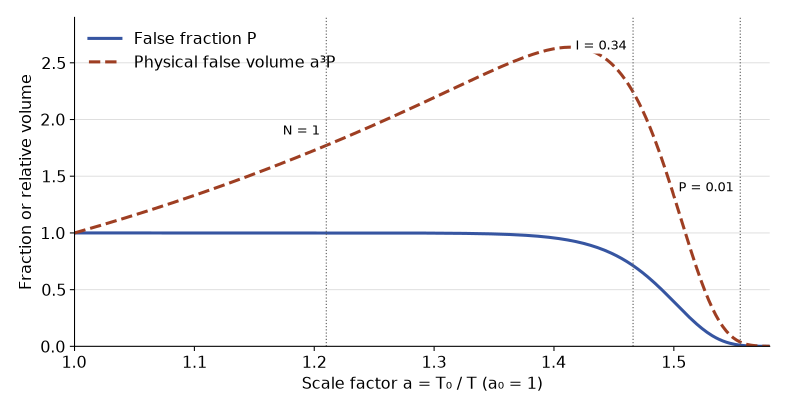
Expansion initially wins over phase conversion. The solid curve is and the dashed curve is , with . Both come from the stated radiation-era input , , ; vertical marks are diagnostic milestones, not separate thermodynamic transitions.
The companion in examples/thermal/phase-transitions/cosmology-washout/ compares this history integral with the initial-value problem , . Tightening its tolerance reduces the maximum error scaled by from to . An incomplete-beta evaluation and fixed-node polynomial quadrature provide further analytic checks. These tests verify the integration and expansion factors, not the assumed microphysical rate.
A decreasing fraction can still fail to complete
Consider a different, idealized late history with constant , constant , constant , and . Write and . The same growth integral becomes
Although for any , the physical false volume behaves as at late times. It tends to zero only for ; at it approaches a nonzero constant. With and , , so the fraction decreases while the expected physical false volume continues to grow. The late shrinking condition is
This is a counterexample within a prescribed background, not a self-consistent prediction for a reheating Universe. It explains why a fraction or nucleation threshold alone cannot establish completion.
For a physical strongly supercooled transition, one must instead solve the expansion and energy-transfer problem. Vacuum energy can alter ; latent heat can halt cooling, suppress nucleation or change the wall speed. Entropy conservation gives only while there is no entropy production. The radiation example is conditional on those effects being negligible over its interval. A gravitational-wave calculation additionally needs stress-energy evolution, and baryogenesis needs charge production and washout.
Summary
The local rate and wall speed determine an integrated coverage exponent, . Overlap gives , while expansion makes the physical-volume test . In the worked history, the rate crossing, nucleation proxy, percolation proxy and one-percent completion all occur at different times. A complete cosmological prediction requires the rate, growth law, background expansion and reheating assumptions to be mutually consistent.
Exercises
1. A rapid transition in nearly fixed space
For a transition much faster than expansion, take constant and , extending the negligible early tail to . Compute and . At and , what corresponds to ?
Solution
Neglecting expansion during bubble growth gives . With , the integral is
Thus the requested crossing has , despite the earlier rate crossing at unity. At this point . The fourth power comes from integrating both nucleation time and three-dimensional bubble growth. The approximation requires and nearly constant during the relevant interval; it is not an approximation for the slow de Sitter counterexample.
2. Can a transition finish after nucleation stops?
Retain the radiation example but set after , its crossing. Assume radiation domination and the same wall speed continue indefinitely. Does the false phase necessarily remain? Calculate the later one-percent crossing.
Solution
Existing bubbles continue to grow. For ,
Since , and . In this stipulated radiation background, a nonzero population of growing bubbles eventually removes the false volume even though the instantaneous nucleation rate is zero. Solving with the unrounded gives and . This extension changes the allowed duration of the assumed background; it does not establish that radiation domination or constant wall speed would persist that long in a microscopic model.
References
- J. Ellis, M. Lewicki and J. M. No, “On the maximal strength of a first-order electroweak phase transition and its gravitational wave signal,” Journal of Cosmology and Astroparticle Physics 2019(04), 003, arXiv:1809.08242v2 (PDF). §2.1, Eqs. (2.2)–(2.5), defines nucleation and growth integrals; §2.3, Eqs. (2.25)–(2.26), distinguishes decreasing false fraction from decreasing physical false volume. The numerical rate history on this page is separately specified and is not a model result taken from that paper.
Scrollable formula. Use Left and Right arrow keys to reveal hidden content.
Scrollable table. Use Left and Right arrow keys to reveal hidden columns.
Scrollable figure. Use Left and Right arrow keys to reveal hidden content.