Spin Glasses and Replica Symmetry Breaking
Competing random bonds can prevent all local preferences from being satisfied. An overlap can then detect frozen correlations even when the average magnetization vanishes. The infinite-range Sherrington–Kirkpatrick model makes this idea calculable, but its simplest replica saddle fails two tests: it has an unstable overlap direction and predicts negative entropy at low temperature.
Preparation: The replica method and fixed-point stability. Here is inverse physical temperature, , and denotes the number of spins. This is a classical infinite-range model, not a solution of a finite-dimensional or quantum spin glass.
Frustration and the overlap
On a loop of Ising bonds, the product of bond signs is invariant under changing local spin conventions , . A negative product means at least one bond must remain unsatisfied. Disorder and frustration are distinct: independent positive random bonds have the former without the latter.
For two thermal copies with the same frozen bonds, define
Independent copies with independently drawn bonds would answer another question. At zero field a finite system respects global spin flip, so . A nonzero Edwards–Anderson overlap refers to a selected thermodynamic state or to the corresponding structure of the overlap distribution, with the order of limits specified. Squaring the finite-volume symmetric one-point function before that limit would miss it. Conversely, a magnetic field can give a nonzero overlap even in an ordinary paramagnet; nonzero alone is not a glass criterion.
Average the SK bonds before imposing a saddle
The model and its normalized disorder law are
Different bonds are independent. The variance makes the free energy extensive; is an energy scale. Gaussian averaging of the integer moment gives
Use . The diagonal replica pairs contribute , and the removed site diagonal contributes . Decoupling each off-diagonal overlap by a Gaussian integral yields, up to the explicit Gaussian normalization,
The finite-integer construction is exact. Stationarity gives in the one-site replicated measure. Taking , continuing and choosing the relevant saddle require further reasoning; the permutation symmetry of does not prove that its physically relevant saddle has equal overlaps.
The replica-symmetric saddle
Impose for . Since , a second Gaussian transformation gives the one-site trace
where . Expanding the logarithm through first order in gives the replica-symmetric free energy per spin
For , differentiate and integrate by parts. Because , stationarity becomes
This is the classical RS result in Sherrington and Kirkpatrick, Eqs. (9)–(10), with their ferromagnetic mean coupling set to zero. At , exists at every temperature; a positive branch appears below . Choosing that branch is not yet a stability test.
Derive the replicon test from a covariance
The negative Hessian of , divided by the positive factor , is
In the RS limit, conditional on , replicas are independent spins of mean . The pair covariance therefore has three entries: for the same pair, for one shared index, and for disjoint pairs. An overlap fluctuation with zero sum along each replica row lies in the replicon sector. Acting on it gives , hence
A negative value is a local instability of the RS saddle. At , , already locating its high-temperature loss of stability. This criterion concerns an overlap direction, not just the curvature along the single variable . Toninelli, Eqs. (8), (11)–(12) also establishes that in this unstable region the true thermodynamic free energy differs strictly from the RS approximation.
A numerical check constructs the full six-by-six covariance matrix of the six pairs of four conditional spins. Projecting on the pair-ordered vector , whose replica-row sums vanish, reproduces the integral eigenvalue to better than at . This compares the pair-covariance construction with the integral for .
The low-temperature consistency test
At , let and . Differentiating the free energy on a stationary branch means its implicit derivative drops out. Gaussian integration by parts gives
For small , only of order contributes to . With , changing variables to gives
Also , so . Substituting the expansion into the entropy cancels the terms proportional to and leaves
An Ising Gibbs distribution has nonnegative Shannon entropy. This negative limit is an inconsistency of the approximation, not an exotic physical entropy. The original SK paper itself identifies the problem in its low-temperature discussion on printed p. 1795.
Adaptive Gaussian integration and the positive self-consistent branch give the following illustrative values, with and :
| 0.90 | |||
| 0.50 | |||
| 0.20 | |||
| 0.010 | |||
| 0.0025 |
The companion also differentiates the re-solved saddle free energy at nearby temperatures, rather than holding an inaccurate numerical fixed. The entropy agrees with the analytic expression within at . Resolving the narrow small- region is essential at low temperature.
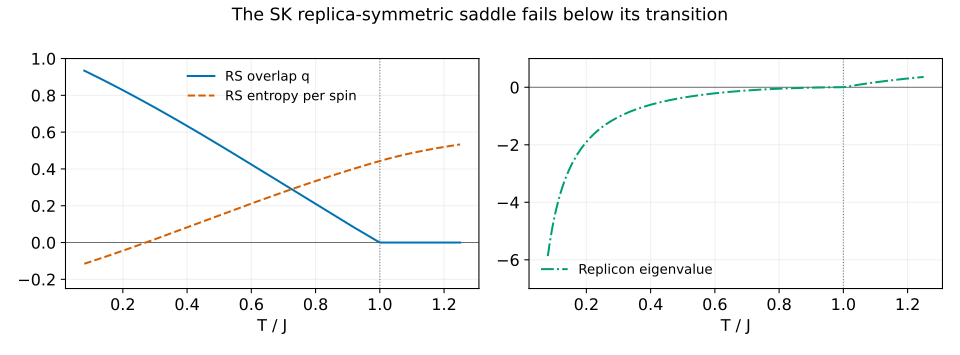
The positive RS branch at zero field. The replicon is negative below , even where the RS entropy is still positive. Negative low-temperature entropy supplies a second failure test; neither curve is the corrected low-temperature solution.
What replica symmetry breaking changes
Replica symmetry breaking allows an overlap structure richer than one number. In a pure-state description, the overlaps between states need not all coincide; their weights define a nontrivial distribution. The Parisi construction organizes this information through a hierarchical order parameter. It addresses the instability of the equal-overlap ansatz; merely selecting its positive- root does not.
These checks motivate but do not derive the full Parisi solution. Infinite-range equilibrium results do not establish the same phase structure in short-range materials, transverse-field models or aging experiments; those require spatial, quantum or dynamical analysis. Sherrington and Kirkpatrick (2025) recount developments beyond the original RS construction.
Summary
The Gaussian bond average generates an overlap action whose replica-symmetric saddle can be solved explicitly. The pair-covariance Hessian then exposes a negative replicon, and the low-temperature free energy predicts negative entropy. These are tests of a particular mean-field approximation and explain why its overlap ansatz must be enlarged.
Exercises
1. The onset of the positive overlap
At zero field, expand the RS equation near and obtain the leading positive solution. Does its existence imply stability?
Solution
Using and , write . The equation is . Besides , it gives
It is positive just below . Stability under unequal-overlap fluctuations requires the replicon test; its negative values show that following this stationary root to low temperature does not repair RS.
2. Frustration without a magnetization
Take three Ising spins on a triangle with and , , at zero field. Find the ground-state energy and degeneracy. Why can this finite system have zero magnetization yet remain frustrated?
Solution
The negative bond-sign product prevents all three bond energies from equaling . Two satisfied bonds give . Three choices of unsatisfied bond, each doubled by global spin flip, give six ground states. The other two configurations have all bonds unsatisfied and energy . At finite temperature spin-flip symmetry makes every one-point function vanish without removing the incompatible bond preferences. This frustration alone does not establish a thermodynamic spin-glass phase.
References
- D. Sherrington and S. Kirkpatrick, Solvable Model of a Spin-Glass, Physical Review Letters 35 (1975), 1792–1796, Eqs. (4)–(10), printed pp. 1792–1793, and the entropy discussion on p. 1795. We set their mean exchange to zero and use bond variance .
- D. Sherrington and S. Kirkpatrick, 50 years of spin glass theory, v1, pp. 1–2: historical discussion of the original RS inconsistency and subsequent developments.
- F. L. Toninelli, About the Almeida–Thouless transition line in the Sherrington–Kirkpatrick mean field spin glass model, v1, Eqs. (1)–(2), (8), (11)–(12), pp. 1–2: the RS equation and instability condition; pp. 2–3 give the free-energy comparison.
Scrollable formula. Use Left and Right arrow keys to reveal hidden content.
Scrollable table. Use Left and Right arrow keys to reveal hidden columns.
Scrollable figure. Use Left and Right arrow keys to reveal hidden content.