Coupled Order Parameters and Multicriticality
Can two kinds of order occupy the same phase, or does one expel the other? A two-scalar free energy answers this question by combining boundedness, the positivity of the order-parameter squares and a Hessian test. The result distinguishes a coexistence wedge from a first-order boundary between competing pure phases.
Preparation: Multicomponent order parameters and the difference between local and global minima. The analysis here is homogeneous mean field for two global orders.
Stability on the physical quadrant
Take the physical density
The parameters are two tunable masses. For , the preceding anisotropy model maps to ; its point therefore occurs here at , not at zero mixed coupling. Let and . The quartic is a quadratic form on this quadrant, not on unrestricted signed . The identity
shows strict positivity for nonzero when . If , the ray is unstable. Equality gives a quartic-flat ray, whose quadratic term and possible sextic terms must be examined separately.
In particular, is perfectly bounded despite . Requiring the quartic matrix to be positive definite on the whole plane would wrongly exclude the regime of strong competition.
All candidate phases and their Hessians
The stationary equations are and . They give four types of candidates:
| Phase | Existence | Local stability away from boundaries | Free energy |
|---|---|---|---|
| Disordered | |||
| Pure | |||
| Pure | |||
| Mixed | , |
For the mixed stationary point, the Cartesian Hessian is
Its trace is positive. Thus a mixed solution with positive is a minimum only for ; for it is a saddle. The table's pure-phase transverse inequalities follow from the remaining Hessian eigenvalue, not from comparing pure-phase depths alone.
Tetracritical coexistence
For , . The quartic form is strictly convex in , so minimizing over the convex quadrant gives a unique pair of squares. A mixed minimum occurs exactly where both numerators in the table are positive. Its boundaries with the pure phases are
On each line one order parameter vanishes continuously while the other remains nonzero. Together with the two disordered-to-pure boundaries, four continuous lines meet at : a tetracritical mean-field diagram. For negative , the mixed phase can extend into regions with one positive , because the existing order helps induce the other.
For , the point has , and Hessian eigenvalues and . Each pure candidate has energy and negative transverse curvature . The mixed state is therefore both locally stable and globally preferred.
Bicritical exclusion
For , any interior stationary point is a saddle. In the region , compare the pure free energies. Equality occurs at
Across this line, the equilibrium state switches from one nonzero scalar to the other. The pure-phase transverse curvatures are positive on the line because , so it is first order. Its metastability boundaries are the transverse-zero lines from the table. Two continuous disordered-to-pure boundaries meet this first-order line at the origin: a bicritical mean-field diagram.
At , the two pure states have energy and Hessian eigenvalues . The mixed stationary point has , energy and eigenvalues . The negative mode is the fluctuation that transfers amplitude from one order into the other.
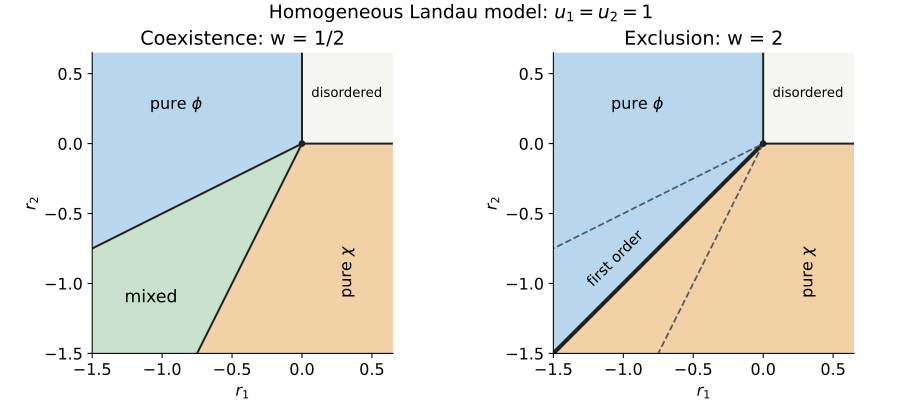
The same positive self-couplings, , permit coexistence at and exclusion at . Solid black boundaries are continuous except for the heavy diagonal in the right panel; dashed lines are homogeneous spinodals. These diagrams result from the stated polynomial, not measured phase boundaries.
Enhanced symmetry is a further condition
At and , the potential becomes . With equal gradient stiffnesses and no higher anisotropies, the full model has symmetry. For the circle of minima replaces the separate pure and mixed candidates; formulas dividing by cannot be used at this point.
For unequal , the condition alone gives a quartic square after field rescaling, but does not guarantee a common mass, equal kinetic terms or an symmetry of the complete theory. Nor does a symmetric bare potential establish an infrared-stable symmetric fixed point. RG must test all symmetry-allowed perturbations. The mean-field phase classification and the fluctuation stability question are distinct even when their parameters share names.
Summary
Boundedness is tested on . Moderate coupling permits stable coexistence and tetracriticality; sufficiently strong positive coupling gives exclusion and bicriticality. Enhanced symmetry and RG stability require additional conditions.
Exercises
1. Induced order with a positive mass. Set . Find the stable phase and show why the sign of is insufficient to decide whether orders.
Solution
Here , and . Both are positive; the Hessian has determinant and positive trace. The mixed energy beats the pure- value . That pure state's transverse curvature is . Attraction induces order even with a positive bare quadratic coefficient.
2. A first-order boundary with unequal self-couplings. Take . At , compare pure and mixed stationary points and their stability.
Solution
The quartic is bounded since , despite . Pure has and pure has , both with energy . Transverse curvatures and are positive: both are local minima. The mixed solution has energy and determinant , so it is a saddle. The equality locates the first-order boundary. Full-plane positivity is unnecessary: still permits quadrant stability.
References
- P. Calabrese, A. Pelissetto and E. Vicari, Multicritical phenomena in O(n₁)+O(n₂)-symmetric theories, v2, §I, Eq. (1.1), Figs. 1–2, pp. 2–4: mean-field diagrams and RG stability. For unchanged fields the reduced quartics are ; gradient normalization may rescale them.
- D. Tong, Statistical Field Theory, Michaelmas 2017, §§4.1–4.2: symmetry and the order-parameter manifold.
Scrollable formula. Use Left and Right arrow keys to reveal hidden content.
Scrollable table. Use Left and Right arrow keys to reveal hidden columns.
Scrollable figure. Use Left and Right arrow keys to reveal hidden content.