Topological Defects in Ordered Media
An arrow and an unoriented rod can look locally similar, but they admit different defects. Following an arrow around a closed curve must return it to itself; following a director may return its vector representative to its negative. The physical identification changes the topology, while an elastic functional determines the energy.
Preparation: Goldstone stiffness and scalar domain walls. We use physical free energies and classical static configurations outside a core. No dynamics or thermal proliferation criterion follows from topology alone.
Identify the physical manifold first
For a global order parameter, the field on a small sphere surrounding a defect maps into its allowed vacuum manifold . A codimension- defect is tested by maps from ; homotopy means deforming that map continuously while remaining in .
| Order | Physical manifold | Elementary topological distinction |
|---|---|---|
| Real scalar with two minima | Disconnected components permit walls | |
| Planar vector | : integer vortices | |
| Three-component vector | , | |
| Three-dimensional uniaxial director | : two line classes |
The manifold must describe physical states, not redundant coordinates. A uniaxial nematic with nonzero scalar order has : and are the same tensor. A planar director constrained to a plane instead has , so it has an integer classification of half-turns. It is not topologically identical to a director allowed to tilt in three dimensions.
For vector and director examples, the loop argument is developed explicitly in Sethna, “Order Parameters, Broken Symmetry, and Topology,” §IV, discussion of Figs. 12A–12B and Eqs. (7)–(8). Spatial defects in crystals additionally obey compatibility conditions; this simple manifold dictionary is being used here for internal vector or orientational order, not as a general classification of all elastic media.
XY winding and its far-field energy
Write on an annulus . Single-valued vector order requires
For fixed winding, the circular field solves the Laplace equation away from the core. With ,
The same result follows as a lower bound on each circle: . Radial variation adds positive energy, so the circular configuration attains the annular minimum for compatible boundary data. A microscopic core energy must be added; the phase-only theory cannot compute it. A straight vortex in three spatial dimensions has this expression per unit length.
In the soft-spin completion the magnitude can vanish inside the core, where the map leaves . This permits creation or destruction of vortex–antivortex pairs, motion through the boundary, or a phase slip that changes winding. With the boundary fixed, a defect can still move and a closed loop can shrink within the same sector.
A director half-turn and the factor of four
Take a straight disclination along , assume a constant-amplitude director, and use the one-constant elastic model
The configuration is a valid director if . For , a continuous lift to ends at after one circuit. It cannot be contracted as a director loop: during any continuous deformation the lift's endpoint sign cannot change. Traversing it twice gives a closed lifted loop on the simply connected sphere, hence the two classes form .
The far-field energy is
For this isotropic one-constant model the half-turn also minimizes the logarithmic coefficient in its nontrivial class. A lifted path from to has spherical length at least ; Cauchy–Schwarz on the angular interval then gives . The great-circle half-turn saturates it. Distinct splay, twist and bend constants, boundary anchoring or a biaxial core can change the energetic problem.
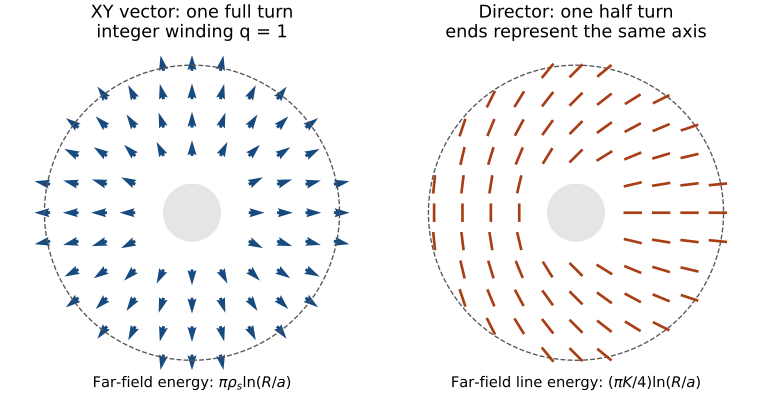
The arrow is a vector; a director segment has no preferred end. With equal numerical stiffnesses and the same annulus, the displayed half-disclination has one quarter of the full-vector vortex's far-field energy. The gray cores are excluded from the elastic calculation. The director picture is a planar representative of a three-dimensional orientational manifold.
For numerical differentiation use the single-valued tensor , which obeys . Differentiating an artificially periodic vector representative across its sign seam creates a spurious energy. At and , the exact half-disclination line energy is in the chosen units. Periodic centered differences of on angular points give , , , with second-order convergence. The incorrect vector seam instead produces values growing with refinement, rather than converging to the elastic energy.
Why classification is not an energetic phase diagram
A full-turn planar director loop () becomes trivial if tilt into the third direction is allowed: two half-turns lift to a closed loop in , which can contract. The resulting smooth escape can lower a core cost, although boundaries may prevent it. Conversely, the two signs of an isolated half-turn represent the same class in even when a fixed planar drawing makes them look distinct.
For XY vortices, energy grows as while the number of possible core positions gives an entropy growing as . Their competition motivates a vortex transition, but an isolated-defect estimate does not compute screening by pairs, the renormalized stiffness, or a transition temperature. For a scalar wall, the far-field energy is tension times area and the disconnected minima cannot be joined while staying in the vacuum set. Topology, elastic cost and thermodynamic proliferation answer three different questions.
For a compact XY angle take two opposite isolated windings and calculate the logarithmic pair interaction. The single-defect classification fixes the allowed winding; its fugacity and screening then determine whether free vortices survive on large scales.
Summary
The physical order-parameter identification determines which loops can contract. XY vectors have integer winding; a three-dimensional uniaxial director has a nontrivial half-turn class of order two. The elastic functional then supplies a logarithmic energy, with a quarter-sized coefficient for the half-turn at equal stiffness. Core structure and boundaries remain additional physics.
Exercises
1. A three-dimensional vector hedgehog
For on , compute the energy and explain its topological test.
Solution
Since , the squared gradient is . Therefore
The surrounding sphere maps once onto the target , with degree one in . This is a point defect, not a vortex line; a loop alone cannot detect it. Its linear energy divergence differs from the line defect's logarithm. The core contribution and boundary configuration have been omitted explicitly.
2. Fill a full-turn director loop
The boundary loop is . Construct a smooth vector field on the disk that fills this loop, and explain why the analogous construction fails for the half-turn director.
Solution
Let be smooth with , , and near zero. Then
is regular at the center and has the desired boundary. It is a vector filling, and therefore also a director filling. Replacing by does not work: at and , the transverse components change sign but the third component does not, so the two vectors are neither equal nor opposite for intermediate . The failed seam reflects the nontrivial endpoint sign of a lifted half-turn, not a removable coordinate inconvenience.
References
- James P. Sethna, “Order Parameters, Broken Symmetry, and Topology” (1992), §IV, Figs. 12A–12B and Eqs. (7)–(8): vector hedgehogs, director half-turns and composition of defects.
- David Tong, Statistical Field Theory (2017), §4.4.1: XY vortex energy and its infrared cutoff.
Scrollable formula. Use Left and Right arrow keys to reveal hidden content.
Scrollable table. Use Left and Right arrow keys to reveal hidden columns.
Scrollable figure. Use Left and Right arrow keys to reveal hidden content.