Lee–Yang Zeros and Thermodynamic Singularities
Every finite Ising partition function is analytic at a real field, yet an infinite magnet can have a sharp transition. Complex-field zeros explain how these statements coexist. Their location matters: the mere existence of roots does not establish a physical singularity.
Preparation: Partition functions and sources, the Ising-chain eigenvalues, and roots of a polynomial. We keep and use a uniform dimensionless field .
A finite partition polynomial
On a graph of Ising spins, group configurations by their number of down spins. With ,
Each is positive for finite real couplings. At zero background field, flipping every spin gives . Thus has reciprocal and complex-conjugate root symmetries. Those symmetries alone do not force roots onto a circle.
The Lee–Yang circle theorem states that for Ising spins with real pair couplings , zero background fields and a common complex field, every root of satisfies . Missing bonds are allowed, and the finite graph need not be regular or connected. The pair couplings must be ferromagnetic. Antiferromagnets and multispin interactions require separate arguments. The general theorem is an input here, proved by Lee and Yang through a multivariable polynomial argument. We derive the small-system and chain roots directly rather than treating numerical root finding as a proof for all graphs.
Real corresponds to positive real . A finite positive-coefficient polynomial cannot vanish there. On the circle the potentially relevant real point is , or zero physical field.
One bond: zeros without a transition
For two spins with one ferromagnetic bond,
For these roots lie on the unit circle; at both are . The corresponding real-field partition function is strictly positive. For independent spins, : increasing the degree merely piles every root at . There is no approach to the physical point , and no finite-temperature transition.
For a four-site periodic nearest-neighbor chain, direct configuration counting gives
The four configurations with two adjacent down spins contribute , while the two alternating configurations contribute . This identifies the boundary condition and avoids counting a two-site ring as a single bond. Its four roots can be found numerically or from the general chain formula below.
All zeros of the periodic chain
For and , set and define . In the part of the imaginary-field axis where , the two transfer eigenvalues can be written
Indeed their sum is and their product is , as required by the exact transfer matrix. The roots are therefore
They are distinct for and supply the entire degree- polynomial. The closest root to has
At every fixed positive temperature the zeros leave an open angular gap of width around . Consequently they do not pinch the real-field axis there. This agrees with the analytic free energy of the finite-range one-dimensional Ising model. The gap closes only as ; the zero-temperature limit is different from taking at a fixed .
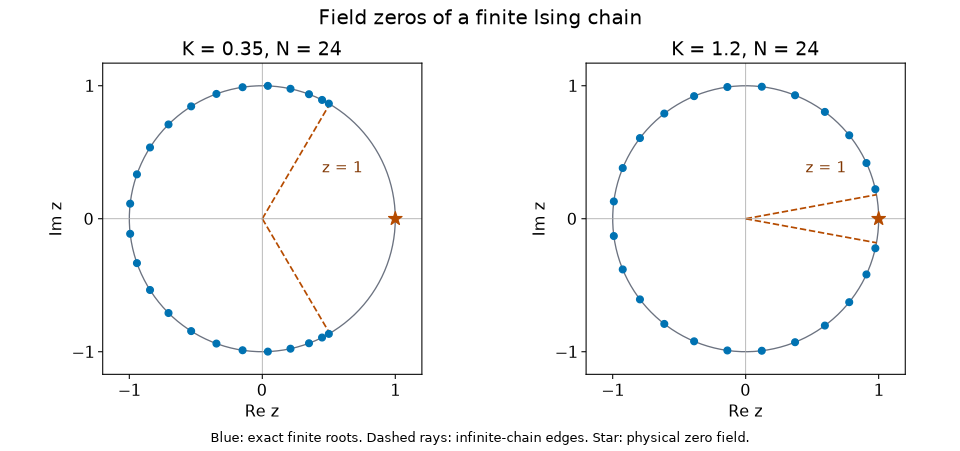
Exact finite-chain zeros for . The marked point is the real zero-field limit; the dashed rays show the infinite-chain edges at angles . Both couplings retain a nonzero gap at fixed temperature.
From a root distribution to a free energy
Factorizing relates the intensive free energy to the roots:
For real , the combined expression is the real logarithm of the positive partition function; consistent branches are needed when continuing the individual complex logarithms. In a thermodynamic limit, the normalized root measure can approach a continuous distribution. Its logarithmic potential may become nonanalytic when the support reaches the physical field. The density and limiting behavior determine the type of singularity; a few nearby finite-size roots do not by themselves establish a particular critical exponent.
These are field zeros: is held real while becomes complex. Zeros obtained by continuing temperature or a coupling are usually called Fisher zeros and obey a different problem. Neither the circle theorem nor the chain's gap formula should be transferred to them without a derivation.
Summary
Ferromagnetic pair interactions constrain finite-volume field zeros to the unit circle. The periodic Ising chain makes the thermodynamic question explicit: its roots become dense on an arc while a finite gap excludes the real zero-field point at every positive temperature. Complex roots provide information about a limiting singularity, not a transition merely by existing.
Exercises
- For the single two-spin bond, take . Locate the roots and explain exactly which hypothesis of the circle theorem fails.
Solution
Let . Then
Both roots are negative real; one has modulus below one and the other above one. Reciprocal symmetry survives, but the ferromagnetic condition does not. The real positive axis remains free of finite-system roots because the coefficients are still positive.
- At fixed , obtain the leading finite- correction to the nearest chain zero. Explain why it is not uniform as .
Solution
Use and expand the inverse cosine about . Since ,
The coefficient grows as . In fact this expansion requires when the edge is small. If first, and instead. Thus the approach to a nonzero edge cannot be extrapolated uniformly into the zero-temperature limit.
References
- T. D. Lee and C. N. Yang, “Statistical Theory of Equations of State and Phase Transitions. II. Lattice Gas and Ising Model”, Physical Review 87 (1952) 410–419, §IV, Theorem 3 and Eqs. (23)–(27); §V, Eqs. (28)–(31); Appendix II. The theorem assumes ferromagnetic pair interactions; the chain roots above follow directly from its transfer matrix.
- David Tong, Statistical Physics, §5.4.3, printed pp. 176–179: finite partition polynomials and thermodynamic limits.
Scrollable formula. Use Left and Right arrow keys to reveal hidden content.
Scrollable table. Use Left and Right arrow keys to reveal hidden columns.
Scrollable figure. Use Left and Right arrow keys to reveal hidden content.