Subdivergences and the BPHZ Forest Formula
At two loops, subtracting the overall divergence can leave a divergent coefficient multiplying a physical momentum logarithm. The missing subtraction belongs to a proper subgraph. We will calculate this failure and its repair, then renormalize a sunset whose three divergent subgraphs overlap.
Preparation. Local Counterterms explains Taylor subtraction. Work with positive mass , real Euclidean external momentum , and . Every four-dimensional loop measure is . Below and are scalar graph integrals with their coupling and graph symmetry factors stripped; the subtraction acts on each graph before those overall factors are restored.
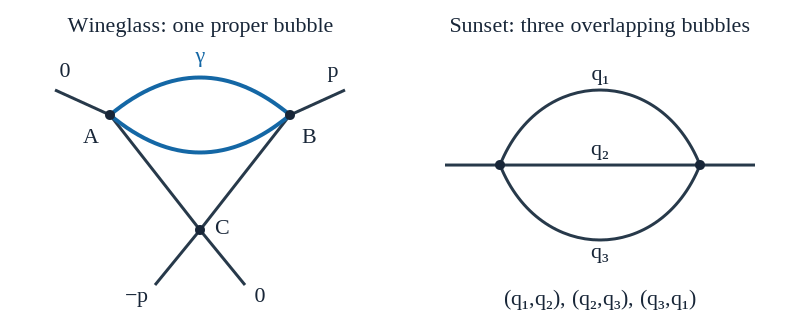
Two actual graphs used below. The wineglass's proper bubble is nested inside the overall divergence. In the sunset the three bubble choices overlap, since each pair shares a line with each other pair. External arrows are replaced by the stated incoming momentum convention; the drawn lengths have no kinematic significance.
A nested bubble exposes a nonlocal divergence
The four-point wineglass has vertices , two parallel lines between , and one line each from to . Assign incoming external momenta at and at . The mass makes these exceptional external momenta infrared safe. Its only divergent proper loop subgraph is the parallel-line bubble. A routing gives
Both and have degree zero. Use a translation-invariant auxiliary regulator while manipulating their divergent terms; the convergent final expression will not need it. Write and . At regulator removal,
Overall subtraction alone yields the exact regulated decomposition
The first term diverges. For example in dimensional regularization it contains . Its coefficient depends logarithmically on momentum; no local overall four-point counterterm can cancel it.
The proper bubble counterterm is the constant . Contracting that bubble to a vertex gives the counterterm graph . Its overall-subtracted value is , exactly the unwanted term with opposite sign. The renormalized answer is therefore
The notation means the Taylor operators act on their own subgraph external momenta, with the inner operation first. It is not multiplication of two numerical Taylor polynomials after integration. A single local insertion has canceled a nonlocal divergence because its remaining loop was momentum dependent.
Evaluate the finite wineglass
Let , and . The normalized angular average on the three-sphere is
It follows by integrating with weight for ; its limit is . Hence
Before angular averaging the kernel difference falls as , which remains integrable when multiplied by . The radial expression converges faster. Its bracket can be rationalized to
This avoids subtracting almost equal numbers at large and shows that the bracket is negative. Since , for . Direct angular quadrature and the reduced radial integral give the following dimensionless results; no coupling or symmetry factor is included.
| 0.6 | 0.01395879340 |
| 1.4 | 0.07924842178 |
| 2.5 | 0.26079129431 |
Keeping the inner constant instead produces a growing term proportional to . The numerical companion checks that failure as well as convergence of the subtracted integral.
Forests combine compatible subtractions
For a graph , a forest is a set of divergent one-particle-irreducible subgraphs that are mutually disjoint or nested. Nested operations are ordered from inner to outer. Overlapping subgraphs share part of the graph without either containing the other; they never appear together in a forest. With the overall operation separated,
The empty forest contributes the original integrand. For disjoint subgraphs both single subtractions and their positive double subtraction occur. For a nested chain the outer Taylor operation acts on the already-subtracted inner structure. These rules organize the subtraction of all ultraviolet regions; they do not identify arbitrary overlapping contractions with a well-defined simultaneous local vertex.
Renormalize the overlapping sunset
The sunset has three lines joining two vertices. Each pair is a logarithmically divergent four-point bubble, so there are three proper subgraphs . They overlap pairwise. With degree two for the full graph, the forest formula is
Here is an explicit routing and subtraction, not only the combinatorial expression. Take
For the bubble made from , its external momentum is and a relative loop momentum is . Setting that subgraph momentum to zero replaces the two propagators by , leaving untouched. The other two replacements follow by cyclic permutation:
Each contracted graph integrates to a zero-momentum bubble times a tadpole. In a translation-invariant regulator its value is independent of , so the final kills it. This special simplification does not mean subdivergences can generally be ignored. It follows after specifying all three terms and performing the allowed momentum shifts.
Introduce Schwinger parameters . The Gaussian loop integrations give and . Including the measures, the result is
The subtraction removes the constant and quadratic momentum terms. To evaluate it, set , , and define , . The remaining scale integral follows by differentiating with respect to and integrating back from :
Thus the fully subtracted two-loop graph is the finite simplex integral
Near a simplex corner, and both vanish linearly in the distance to that corner, while the bracket is quadratic in ; the apparent divergence is canceled. The large- region is damped by . The result is positive, begins at order , and satisfies , as the chosen mass and kinetic subtraction requires. At , the companion obtains ; increasing the simplex quadrature from 100 to 180 nodes per coordinate changes it by .
This is massive Euclidean BPHZ. Setting in the zero-momentum subtractions is not an innocuous limit: artificial infrared singularities can appear. The finite polynomial changes in another scheme, while its parameters must be matched before comparing predictions.
Result and exercises
The finite wineglass and sunset demonstrate nested and overlapping subtractions; Regulators and Symmetry Restoration adds symmetry constraints on local terms.
1. Count the sunset terms. Expand its forest formula and explain why there is no term. Which terms vanish only after the specified integration and overall subtraction?
Solution
Eight terms occur: , , three and three . Overlapping bubbles cannot form a forest pair. Each contraction integrates to a -independent bubble times tadpole; its negative term cancels its positive overall-Taylor term. This requires translation-invariant integration: it is neither pointwise in the original loop variables nor valid for arbitrarily shifted hard cutoffs.
2. Check the sunset's low-momentum limit. Find the coefficient of in the finite simplex answer and prove that it is positive and integrable.
Solution
The expansion gives
The interior integrand is positive. Along an edge away from corners, the numerator vanishes quadratically and stays nonzero. At a corner , numerator and denominator are : their bounded angular-ratio quotient is integrable with the two-dimensional simplex measure. The positive coefficient is unchanged by mass or kinetic counterterms in this subtraction class.
References
D. N. Blaschke et al., BPHZ Renormalization and Its Application to Non-Commutative Field Theory (2013), arXiv:1307.4650, §§2.3–2.7, Eqs. (34), (41), (46)–(51): forest ordering, sunset routing and Schwinger subtraction. We restore their omitted loop-measure factors .
Scrollable formula. Use Left and Right arrow keys to reveal hidden content.
Scrollable table. Use Left and Right arrow keys to reveal hidden columns.
Scrollable figure. Use Left and Right arrow keys to reveal hidden content.