Black-Hole Thermodynamics and the Euclidean Schwarzschild Saddle
A Schwarzschild solution has vanishing Ricci scalar everywhere on its smooth Euclidean section. How can its classical action give a nonzero entropy? Fix the geometry of a spherical wall, fill it with a regular solution and evaluate the surface term required by those boundary data. The same calculation identifies which black hole can equilibrate with a reservoir at the wall.
Preparation. Use the stationary Schwarzschild exterior and the Hartle–Hawking state. Work in four-dimensional Einstein gravity with zero cosmological constant, fixed Newton constant , and . We compute the classical contribution to . The calculation omits matter entropy and fluctuation determinants.
Read the temperature from the tip
Let and . The asymptotic Lorentzian clock has unit norm in the site's mostly-minus convention. Continuing gives the positive-definite metric
Near , put . To leading order the time and radial directions have metric . Smoothness at the origin fixes the period . Thus with surface gravity . The horizon two-sphere is a smooth interior surface. There is no inner boundary term in the action used below. This periodic saddle describes equilibrium. The positive outward flux of a collapsing black hole requires a different choice of state.
Match the wall before subtracting the action
At areal radius , fix the induced metric. Its invariant data are the area and the proper time circumference . A flat reference filling has a time circle of period . Taking its coordinate period equal to would give it a different boundary metric.
For outward normal and , the reference-subtracted Euclidean Dirichlet action is
The bulk integral vanishes on this family. On the wall , so , while the isometric wall in flat space has . The physical wall volume is . Integrating gives, with all quantities evaluated at ,
The second line is an algebraic rearrangement using the regular period. It identifies a candidate energy and entropy. To test it thermodynamically, vary the smooth solutions at fixed . One finds and . Hence on either regular branch. The canonical definitions and give and , where . Gibbons and Hawking, §II, Eqs. (2.5)–(2.12), and §III
Take the asymptotically flat limit
At fixed and , and . Regularity then gives
The first law along this uncharged, nonrotating family is . Its heat capacity is negative. At fixed bath temperature a small gain in energy makes the hole colder, favoring further absorption. The smooth asymptotically flat solution therefore supplies a stationary action and a microcanonical entropy but fails the local canonical stability test for energy exchange.
The classical laws of black-hole mechanics have broader hypotheses. The zeroth law gives constant surface gravity on a connected stationary Killing horizon under the usual regularity and matter conditions. For nearby stationary Einstein–Maxwell solutions the first law also contains angular-momentum and electric work terms. The classical area theorem requires the null energy condition and suitable global predictability. Its hypotheses need reexamination for quantum stress in an evaporating state. The third law is an unattainability statement for zero surface gravity by a regular finite physical process under additional restrictions on the matter and horizon evolution. This Schwarzschild family stays nonextremal throughout. Bardeen, Carter and Hawking, §4, pp. 166–169
Compare the two solutions in a cavity
For a fixed wall write . The boundary condition becomes
Its maximum is at . Below that maximum the same wall period admits two distinct smooth black holes. Differentiating with respect to the proper wall temperature gives
The branch with has positive heat capacity. To decide which filling dominates, compare actions at the same boundary data. Relative to hot flat space, whose subtracted classical free energy vanishes, the free energy of the hole is
The nontrivial crossing occurs at . For the large hole is locally stable against thermal energy exchange while flat space has lower classical free energy. A reflecting wall and negative cosmological constant change the boundary problem in different ways. In AdS the Hawking–Page comparison uses a common conformal boundary. To include fluctuations of matter about a horizon, follow the conical entropy and Newton-constant renormalization. York, pp. 2092–2096
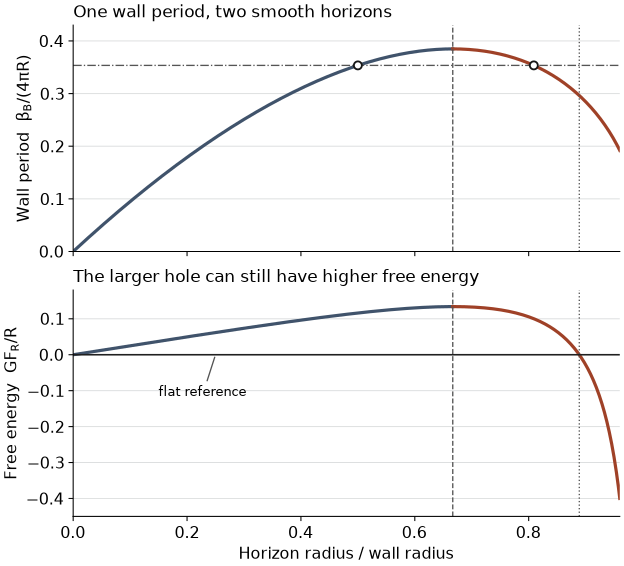
The leftmost marked horizon has negative heat capacity. The rightmost has positive heat capacity, but the free energy there is still above that of flat space. The vertical dashed and dotted lines mark and . Both panels use the analytic four-dimensional cavity formulas derived above.
Exercises
Find a pair with the same thermometer reading
Choose . Find both horizons and decide which of the two black holes and the flat filling dominates at classical order.
Solution
Squaring the boundary equation gives . Factoring out leaves . The two positive roots in the allowed interval are and . Substitution in the original unsquared equation confirms both. The first has negative heat capacity and the second positive. The values of are and , respectively. The larger hole wins between the two black holes, and the flat filling, with zero subtracted free energy, wins among all three.
Detect a mismatched reference period
Suppose a flat subtraction uses period at the outer wall although the Schwarzschild period measured there is . What finite error survives when ?
Solution
Replacing by in the integrated action raises the answer by . At large this tends to . The erroneous action would be . The small proper-period mismatch is multiplied by a boundary integral that grows linearly in . Matching the induced metrics before taking the limit removes this finite error.
Scrollable formula. Use Left and Right arrow keys to reveal hidden content.
Scrollable table. Use Left and Right arrow keys to reveal hidden columns.
Scrollable figure. Use Left and Right arrow keys to reveal hidden content.