Hawking Flux from the Two-Dimensional Stress Tensor
The energy carried by Hawking radiation can be found without assigning a local particle number. In a two-dimensional conformal theory, conservation and the trace anomaly determine the geometric stress; the state fixes the remaining null functions. At infinity the resulting energy flux agrees with the thermal particle integral, including its normalization.
Preparation: The black-hole state comparison. Set and use , with the site's mostly-minus curvature convention.
The stress components needed outside the hole
In these null coordinates the integrated two-dimensional conservation equations leave one free function for each direction. For equal chiral central charges , the outgoing component is
Interchanging and gives with independent . In the Schwarzschild exterior, and give the geometric term of the black-hole state comparison. Where the metric approaches flat space it is that the outgoing flux measures. To determine it, propagate the early vacuum through collapse.
Subtraction in the early vacuum
Let the outgoing early vacuum be defined by . In an asymptotically flat region the separated derivative two-point function is
Subtract the local inertial singularity . A symmetric coincidence expansion yields
This compares different vacuum definitions with a fixed subtraction. It is not an extra anomalous coordinate transformation of an already renormalized tensor.
For , the Schwarzian is , so the outgoing flux is . The exact shell instead has and
It grows from zero to and remains positive. Differentiating gives . These statements concern this chosen shell, not every collapse or mirror trajectory. The same transient flux is obtained in Good, Anderson and Evans, §IV.
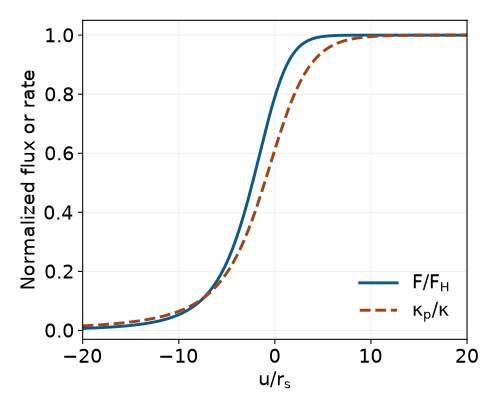
Exact shell formulas with . The solid curve is ; the dashed curve is the local peeling rate divided by . They are different during the transient because the flux also contains a derivative of that rate.
A separate thermal-energy check
For a single outgoing scalar channel at ,
The integral is finite at zero frequency even though the corresponding number integral is not. Independent quadrature checks this energy identity; the two calculations use distinct observables and show that the asymptotic stress normalization is correct. For general CFT central charge, thermal stress has the factor without requiring a free-particle description.
For a four-dimensional minimally coupled scalar, instead use
The greybody calculation supplies . The reduced field also carries radial/dilaton structure. Multiplying the two-dimensional flux by the horizon area omits both the scattering and the correct field normalization, and even gives the wrong physical dimensions for luminosity.
Summary
Trace plus conservation fixes geometric polarization; an early vacuum and its ray map fix the state functions. The stationary one-channel flux equals the Planck energy integral. The exact shell transient contains more information than an instantaneous temperature, and four-dimensional luminosity requires radial scattering.
Exercises
- Define . Express the flux through and explain when its instantaneous thermal approximation is valid.
Solution
Differentiation gives , so . Therefore . Dropping the derivative requires ; a packet interpretation additionally requires a duration long enough to resolve frequencies but short compared with the variation time. For the shell, and , which reproduce the displayed flux.
- A coordinate change has on a nonsingular interval. Does its vacuum carry a Schwarzian flux there?
Solution
One has , and . The two terms in the Schwarzian cancel, so the local flux is zero. Global domains and any pole still matter for defining the state; the result applies on the specified interval and does not assert a global diffeomorphism of the full null line.
References
- Good, M. R. R., P. R. Anderson and C. R. Evans. “Mirror Reflections of a Black Hole”, §IV, Eqs. (79)–(82); the covariant two-dimensional trace and Ward identities above are derived in the stated convention.
- Jacobson, T. “Introduction to Quantum Fields in Curved Spacetime and the Hawking Effect”, §§6.2 and 6.3.9, transmitted thermal spectrum and distinction from local stress.
Scrollable formula. Use Left and Right arrow keys to reveal hidden content.
Scrollable table. Use Left and Right arrow keys to reveal hidden columns.
Scrollable figure. Use Left and Right arrow keys to reveal hidden content.